
Pulp Fiction, 1953 · page 77 of 132
Astounding Science Fiction, British Edition — page 77: what you’re looking at
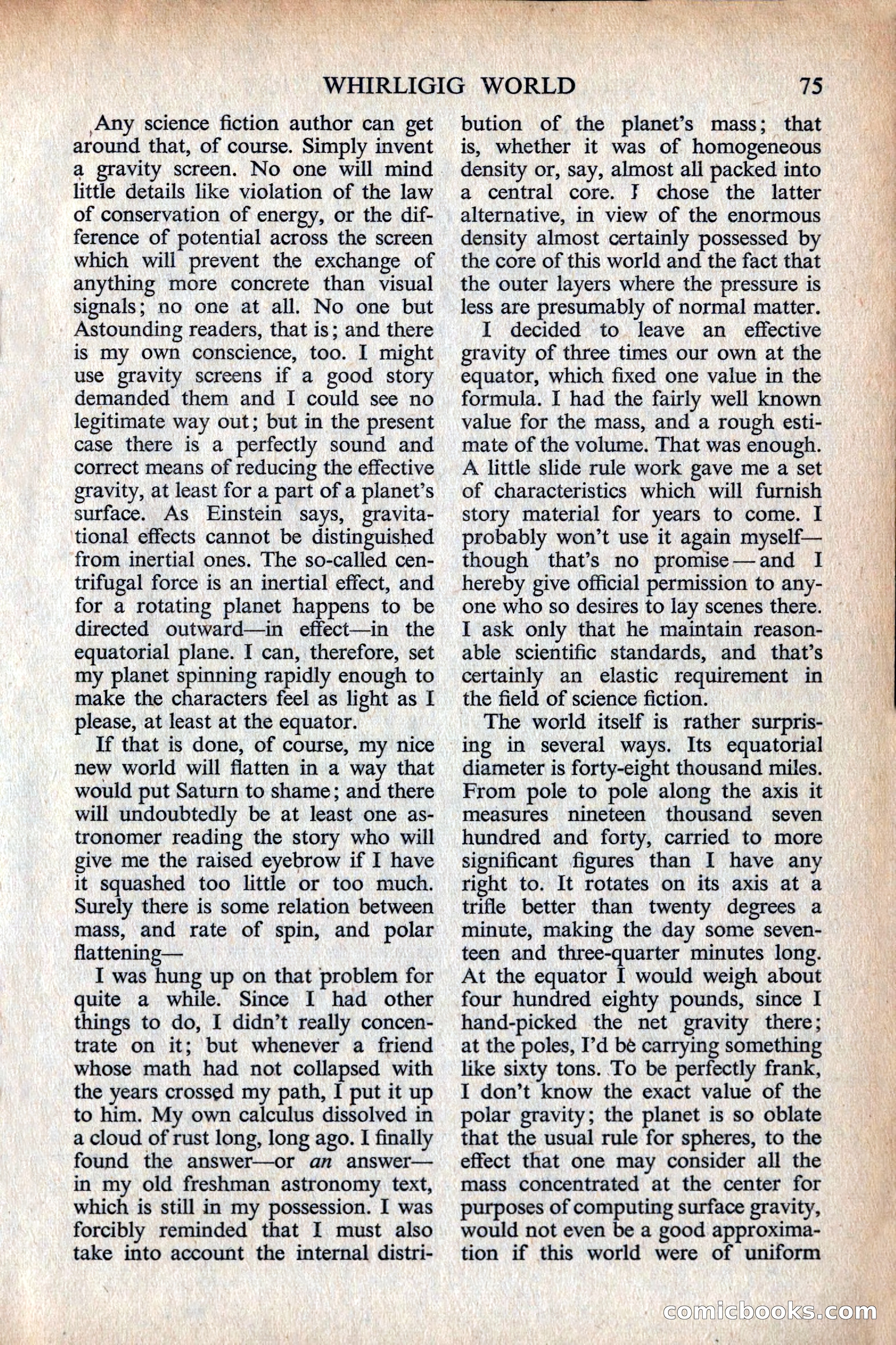
A restored page from Pulp Fiction, 1953. Page through the whole issue in the reader above.
📄 Transcribed text from this page (OCR, searchable)
Machine-transcribed from the original scan — historical spelling and the odd misread are preserved.
WHIRLIGIG WORLD Any science fiction author can get around that, of course. Simply invent a gravity screen. No one will mind little details like violation of the law of conservation of energy, or the dif- ference of potential across the screen which will prevent the exchange of anything more concrete than visual signals; no one at all. No one but Astounding readers, that is; and there is my Own conscience, too. I might use gravity screens if a good story demanded them and I could see no legitimate way out; but in the present case there is a perfectly sound and correct means of reducing the effective gravity, at least for a part of a planet’s surface. As Einstein says, gravita- tional effects cannot be distinguished from inertial ones. The so-called cen- trifugal force is an inertial effect, and for a rotating planet happens to be directed outward—in effect—in the equatorial plane. I can, therefore, set my planet spinning rapidly enough to make the characters feel as light as I please, at least at the equator. If that is done, of course, my nice new world will flatten in a way that would put Saturn to shame; and there will undoubtedly be at least one as- tronomer reading the story who will give me the raised eyebrow if I have it squashed too little or too much. Surely there is some relation between mass, and rate of spin, and polar flattening— I was hung up on that problem for quite a while. Since I had other things to do, I didn’t really concen- trate on it; but whenever a friend whose math had not collapsed with the years crossed my path, I put it up to him. My own calculus dissolved in a cloud of rust long, long ago. I finally found the answer—or an answer— in my old freshman astronomy text, which is still in my possession. I was forcibly reminded that I must also take into account the internal distri- >»! Ah) ne; a 75 bution of the planet’s mass; that is, whether it was of homogeneous density or, say, almost all packed into a central core. | chose the latter alternative, in view of the enormous density almost certainly possessed by the core of this world and the fact that the outer layers where the pressure is less are presumably of normal matter. I decided to leave an effective gravity of three times our own at the equator, which fixed one value in the formula. I had the fairly well known value for the mass, and a rough esti- mate of the volume. That was enough. A little slide rule work gave me a set of characteristics which will furnish story material for years to come. I probably won’t use it again myself— though that’s no promise—and I hereby give official permission to any- one who so desires to lay scenes there. I ask only that he maintain reason- able scientific standards, and that’s certainly an elastic requirement in the field of science fiction. The world itself is rather surpris- ing in several ways. Its equatorial diameter is forty-eight thousand miles. From pole to pole along the axis it measures nineteen thousand seven hundred and forty, carried to more significant figures than I have any right to. It rotates on its axis at a trifle better than twenty degrees a minute, making the day some seven- teen and three-quarter minutes long. At the equator I would weigh about four hundred eighty pounds, since I hand-picked the net gravity there; at the poles, I’d bé carrying something like sixty tons. To be perfectly frank, I don’t know the exact value of the polar gravity; the planet is so oblate that the usual rule for spheres, to the effect that one may consider all the mass concentrated at the center for purposes of computing surface gravity, would not even be a good approxima- tion if this world were of uniform Conniclooolks (Eo)