
Pulp Fiction, 1953 · page 76 of 132
Astounding Science Fiction, British Edition — page 76: what you’re looking at
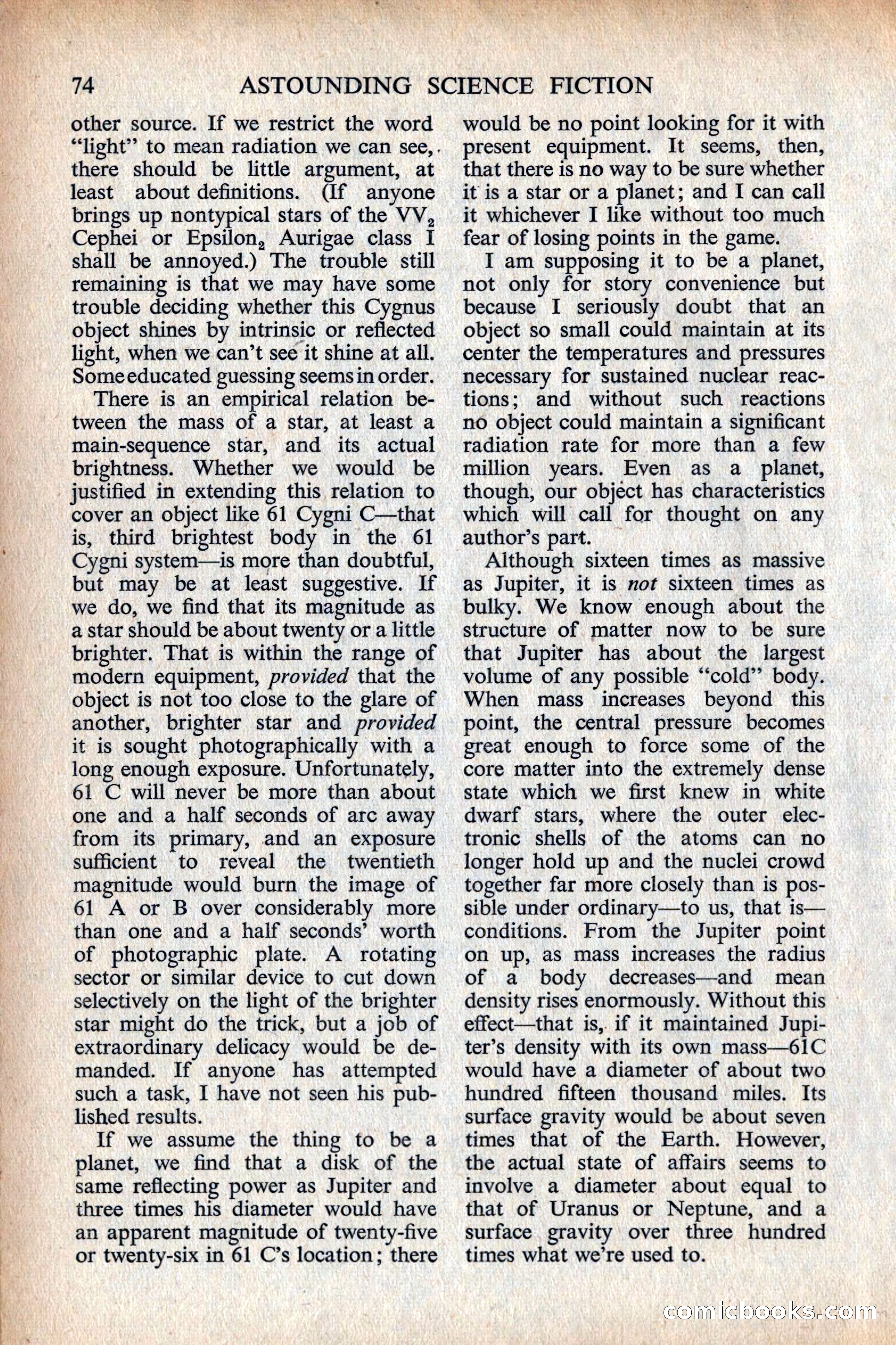
A restored page from Pulp Fiction, 1953. Page through the whole issue in the reader above.
📄 Transcribed text from this page (OCR, searchable)
Machine-transcribed from the original scan — historical spelling and the odd misread are preserved.
DY rt 74 ASTOUNDING SCIENCE FICTION other source. If we restrict the word “light” to mean radiation we can see,. there should be little argument, at least about definitions. (If anyone brings up nontypical stars of the VV, Cephei or Epsilon, Aurigae class I shall be annoyed.) The trouble still remaining is that we may have some trouble deciding whether this Cygnus object shines by intrinsic or reflected light, when we can’t see it shine at all. Someeducated guessing seems in order. There is an empirical relation be- tween the mass of a star, at least a main-sequence star, and its actual brightness. Whether we would be justified in extending this relation to cover an object like 61 Cygni C—that is, third brightest body in the 61 Cygni system—is more than doubtful, but may be at least suggestive. If we do, we find that its magnitude as a star should be about twenty or a little brighter. That is within the range of modern equipment, provided that the object is not too close to the glare of another, brighter star and provided it is sought photographically with a long enough exposure. Unfortunately, 61 C will never be more than about one and a half seconds of arc away from its primary, and an exposure sufficient to reveal the twentieth magnitude would burn the image of 61 A or B over considerably more than one and a half seconds’ worth of photographic plate. A rotating sector or similar device to cut down selectively on the light of the brighter star might do the trick, but a job of extraordinary delicacy would be de- manded. If anyone has attempted such a task, I have not seen his pub- lished results. If we assume the thing to be a planet, we find that a disk of the same reflecting power as Jupiter and three times his diameter would have an apparent magnitude of twenty-five or twenty-six in 61 C’s location; there would be no point looking for it with present equipment. It seems, then, that there is no way to be sure whether it is a star or a planet; and I can call it whichever I like without too much fear of losing points in the game. I am supposing it to be a planet, not only for story convenience but because I seriously doubt that an object so small could maintain at its center the temperatures and pressures necessary for sustained nuclear reac- tions; and without such reactions no object could maintain a significant radiation rate for more than a few million years. Even as a_ planet, though, our object has characteristics which will call for thought on any author’s part. _ Although sixteen times as massive as Jupiter, it is mot sixteen times as bulky. We know enough about the structure of matter now to be sure that Jupiter has about the largest volume of any possible “‘cold’’ body. When mass increases beyond this point, the central pressure becomes great enough to force some of the core matter into the extremely dense state which we first knew in white dwarf stars, where the outer elec- tronic shells of the atoms can no longer hold up and the nuclei crowd together far more closely than is pos- sible under ordinary—to us, that is— conditions. From the Jupiter point on up, as mass increases the radius of a body decreases—and mean density rises enormously. Without this effect—that is, if it maintained Jupi- ter’s density with its own mass—61C would have a diameter of about two hundred fifteen thousand miles. Its surface gravity would be about seven times that of the Earth. However, the actual state of affairs seems to involve a diameter about equal to that of Uranus or Neptune, and a surface gravity over three hundred times what we’re used to. GComicdooksicon