
Pulp Fiction, 1953 · page 68 of 132
Astounding Science Fiction, British Edition — page 68: what you’re looking at
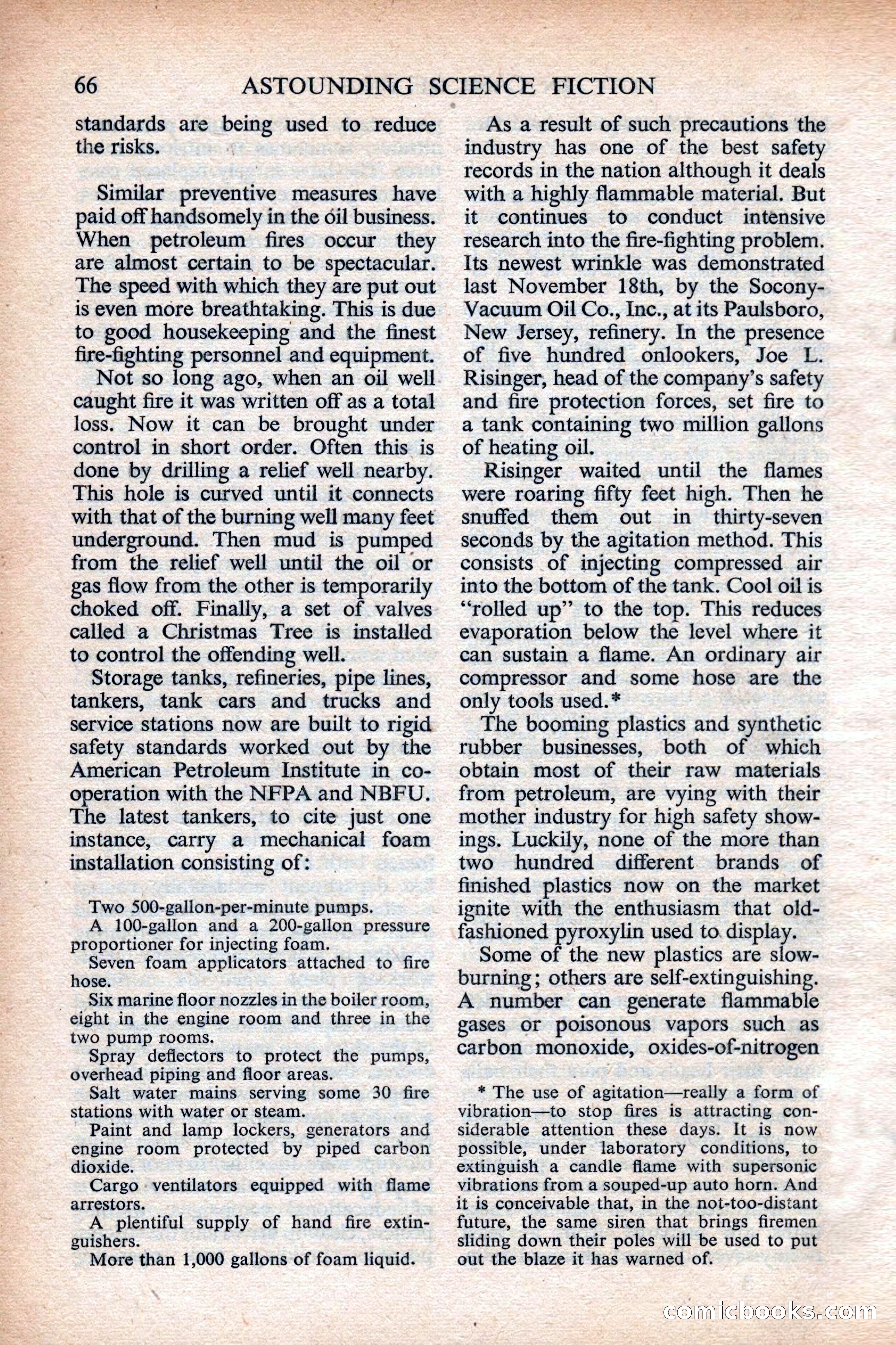
A restored page from Pulp Fiction, 1953. Page through the whole issue in the reader above.
📄 Transcribed text from this page (OCR, searchable)
Machine-transcribed from the original scan — historical spelling and the odd misread are preserved.
66 standards are being used to reduce the risks. Similar preventive measures have paid off handsomely in the oil business. When petroleum fires occur they are almost certain to be spectacular. The speed with which they are put out is even more breathtaking. This is due to good housekeeping and the finest fire-fighting personnel and equipment. Not so long ago, when an oil well caught fire it was written off as a total loss. Now it can be brought under control in short order. Often this is done by drilling a relief well nearby. This hole is curved until it connects with that of the burning well many feet underground. Then mud is pumped from the relief well until the oil or gas flow from the other is temporarily choked off. Finally, a set of valves called a Christmas Tree is installed to control the offending well. Storage tanks, refineries, pipe lines, tankers, tank cars and trucks and service stations now are built to rigid safety standards worked out by the American Petroleum Institute in co- operation with the NFPA and NBFU. The latest tankers, to cite just one instance, carry a mechanical foam installation consisting of: Two 500-gallon-per-minute pumps. A 100-gallon and a 200-gallon pressure proportioner for injecting foam. Seven foam applicators attached to fire hose. _ §ix marine floor nozzles in the boiler room, eight in the engine room and three in the two pump rooms. Spray deflectors to protect the pumps, overhead piping and floor areas. Salt water mains serving some 30 fire stations with water or steam. Paint and lamp lockers, generators and engine room protected by piped carbon dioxide. Cargo ventilators equipped with flame arrestors. A plentiful supply of hand fire extin- guishers. More than 1,000 gallons of foam liquid. ASTOUNDING SCIENCE FICTION As a result of such precautions the industry has one of the best safety records in the nation although it deals with a highly flammable material. But it continues to conduct intensive research into the fire-fighting problem. Its newest wrinkle was demonstrated last November 18th, by the Socony- Vacuum Oil Co., Inc., at its Paulsboro, New Jersey, refinery. In the presence of five hundred onlookers, Joe L. Risinger, head of the company’s safety and fire protection forces, set fire to a tank containing two million gallons of heating oil. Risinger waited until the flames were roaring fifty feet high. Then he snuffed them out in thirty-seven seconds by the agitation method. This consists of injecting compressed air into the bottom of the tank. Cool oil is “rolled up” to the top. This reduces evaporation below the level where it can sustain a flame. An ordinary air compressor and some hose are the only tools used. * The booming plastics and synthetic rubber businesses, both of which obtain most of their raw materials from petroleum, are vying with their mother industry for high safety show- ings. Luckily, none of the more than two hundred different brands of finished plastics now on the market ignite with the enthusiasm that old- fashioned pyroxylin used to. display. Some of the new plastics are slow- burning; others are self-extinguishing. A number can generate flammable gases or poisonous vapors such as carbon monoxide, oxides-of-nitrogen * The use of agitation—really a form of vibration—to stop fires is attracting con- siderable attention these days. It is now possible, under laboratory conditions, to extinguish a candle flame with supersonic vibrations from a souped-up auto horn. And it is conceivable that, in the not-too-distant future, the same siren that brings firemen sliding down their poles will be used to put out the blaze it has warned of. comiclboolks COTM