
Pulp Fiction, 1953 · page 67 of 132
Astounding Science Fiction, British Edition — page 67: what you’re looking at
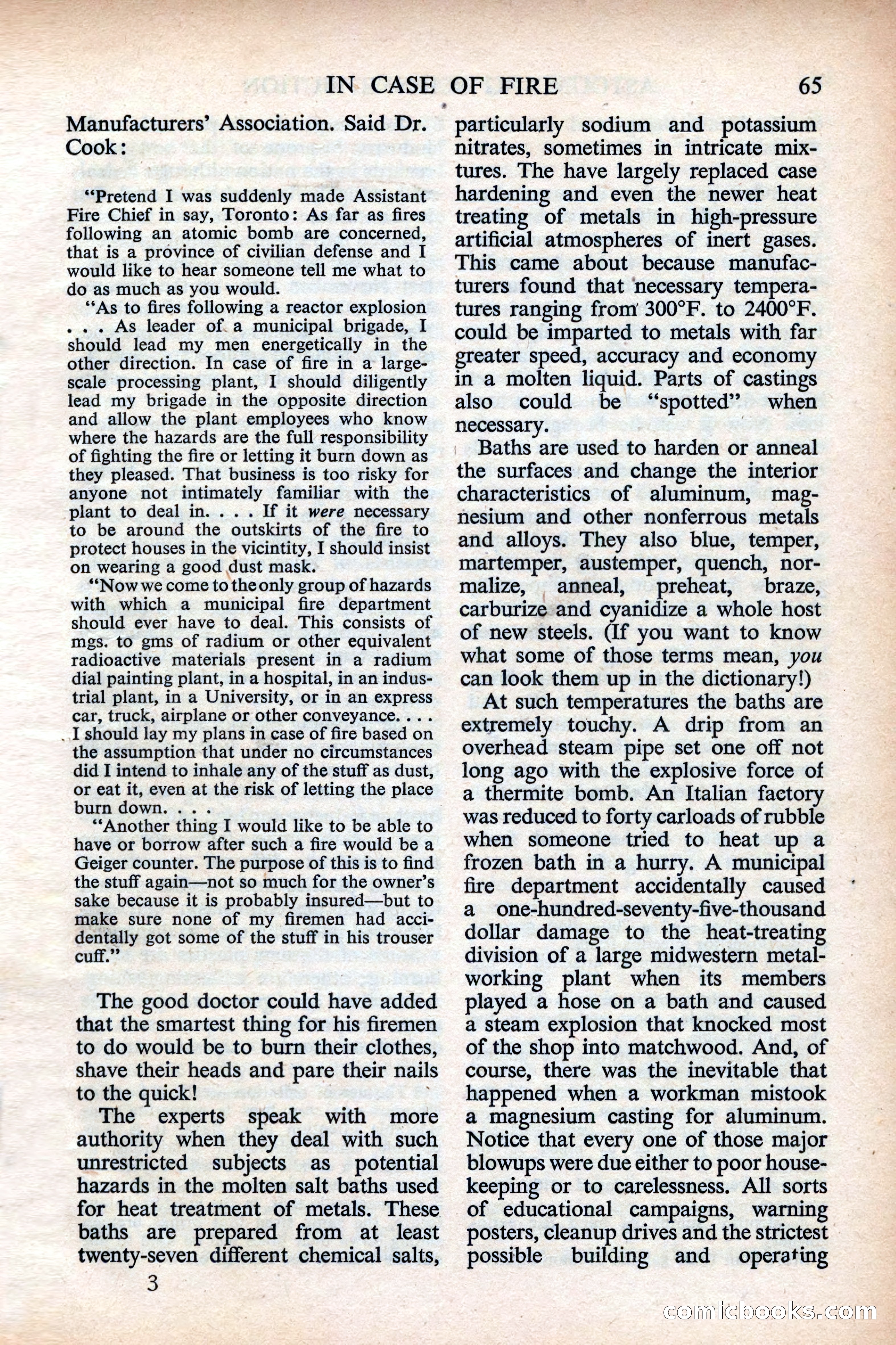
A restored page from Pulp Fiction, 1953. Page through the whole issue in the reader above.
📄 Transcribed text from this page (OCR, searchable)
Machine-transcribed from the original scan — historical spelling and the odd misread are preserved.
IN CASE Manufacturers’ Association. Said Dr. Cook: “Pretend I was suddenly made Assistant Fire Chief in say, Toronto: As far as fires following an atomic bomb are concerned, that is a province of civilian defense and I would like to hear someone tell me what to do as much as you would. **As to fires following a reactor explosion . . - As leader of. a municipal brigade, I should lead my men energetically in the other direction. In case of fire in a large- scale processing plant, I should diligently lead my brigade in the opposite direction and allow the plant employees who know where the hazards are the full responsibility of fighting the fire or letting it burn down as they pleased. That business is too risky for anyone not intimately familiar with the plant to deal in... . If it were necessary to be around the outskirts of the fire to protect houses in the vicintity, I should insist on wearing a good dust mask. *"Now we come to theonly group of hazards with which a municipal fire department should ever have to deal. This consists of mgs. to gms of radium or other equivalent radioactive materials present in a radium dial painting plant, in a hospital, in an indus- trial plant, in a University, or in an express car, truck, airplane or other conveyance.... _ I should lay my plans in case of fire based on the assumption that under no circumstances did I intend to inhale any of the stuff as dust, or eat it, even at the risk of letting the place burn down. ... **Another thing I would like to be able to have or borrow after such a fire would be a Geiger counter. The purpose of this is to find the stuff again—not so much for the owner’s sake because it is probably insured—but to make sure none of my firemen had acci- dentally got some of the stuff in his trouser cuff.” The good doctor could have added that the smartest thing for his firemen to do would be to burn their clothes, shave their heads and pare their nails to the quick! The experts speak with more authority when they deal with such unrestricted subjects as _ potential hazards in the molten salt baths used for heat treatment of metals. These baths are prepared from at least twenty-seven different chemical salts, 3 OF FIRE 65 particularly sodium and potassium nitrates, sometimes in intricate mix- tures. The have largely replaced case hardening and even the newer heat treating of metals in high-pressure artificial atmospheres of inert gases. This came about because manufac- turers found that necessary tempera- tures ranging from 300°F. to 2400°F. could be imparted to metals with far greater speed, accuracy and economy in a molten liquid. Parts of castings also could be “spotted” when necessary. : | Baths are used to harden or anneal the surfaces and change the interior characteristics of aluminum, mag- nesium and other nonferrous metals and alloys. They also blue, temper, martemper, austemper, quench, nor- malize, anneal, preheat, braze, carburize and cyanidize a whole host of new steels. (If you want to know what some of those terms mean, you can look them up in the dictionary!) At such temperatures the baths are extremely touchy. A drip from an overhead steam pipe set one off not long ago with the explosive force of a thermite bomb. An Italian factory was reduced to forty carloads of rubble when someone tried to heat up a frozen bath in a hurry. A municipal fire department accidentally caused a one-hundred-seventy-five-thousand dollar damage to the heat-treating division of a large midwestern metal- working plant when its members played a hose on a bath and caused a steam explosion that knocked most of the shop into matchwood. And, of course, there was the inevitable that happened when a workman mistook a magnesium casting for aluminum. Notice that every one of those major blowups were due either to poor house- keeping or to carelessness. All sorts of educational campaigns, warning posters, cleanup drives and the strictest possible building and operating connicloooks.comnn