
Pulp Fiction, 1953 · page 62 of 132
Astounding Science Fiction, British Edition — page 62: what you’re looking at
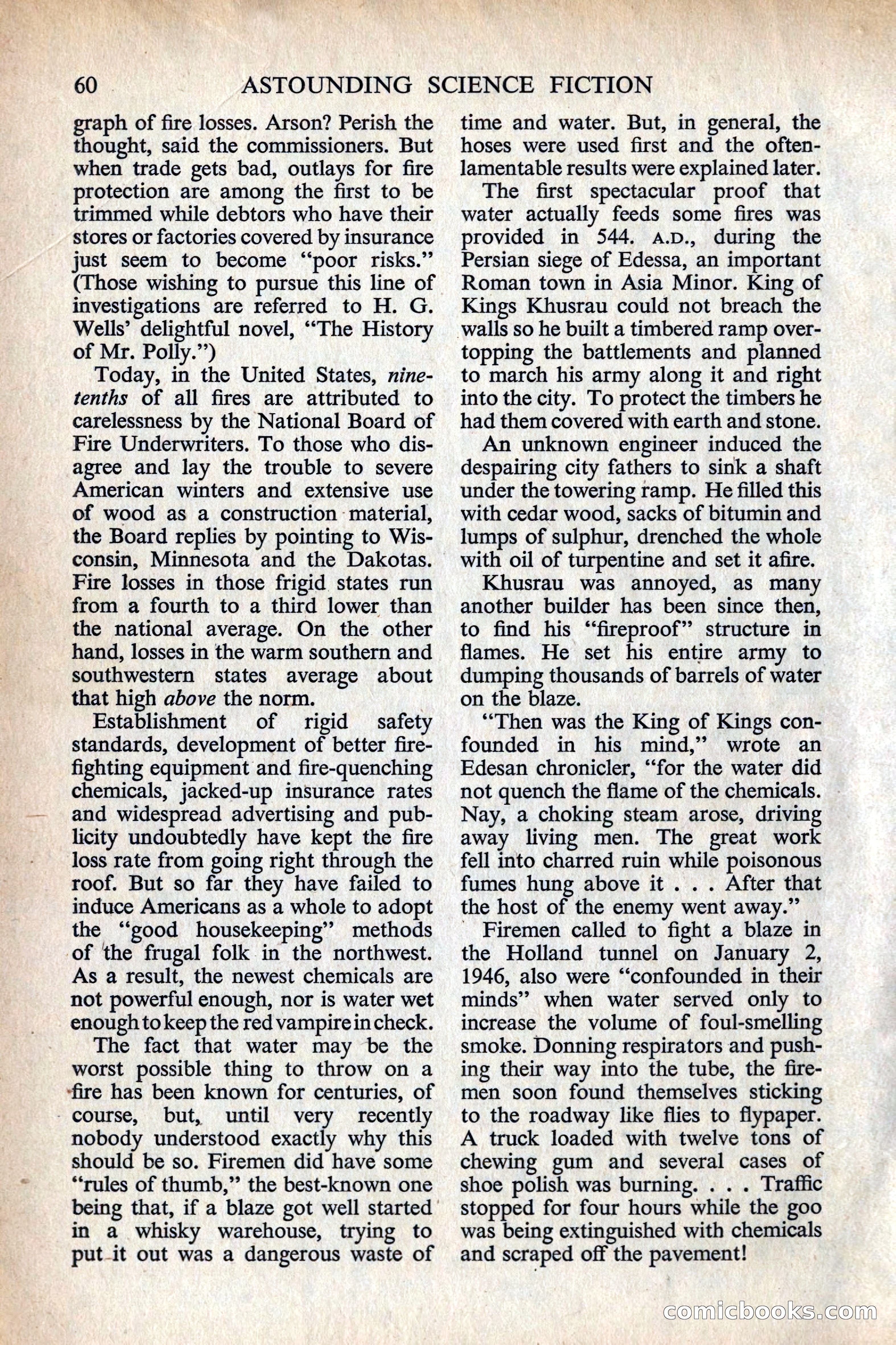
A restored page from Pulp Fiction, 1953. Page through the whole issue in the reader above.
📄 Transcribed text from this page (OCR, searchable)
Machine-transcribed from the original scan — historical spelling and the odd misread are preserved.
60 | graph of fire losses. Arson? Perish the thought, said the commissioners. But when trade gets bad, outlays for fire protection are among the first to be trimmed while debtors who have their stores or factories covered by insurance just seem to become “‘poor risks.” (Those wishing to pursue this line of investigations are referred to H. G. Wells’ delightful novel, ‘““The History of Mr. Polly.’’) Today, in the United States, nine- tenths of all fires are attributed to carelessness by the National Board of Fire Underwriters. To those who dis- agree and lay the trouble to severe American winters and extensive use of wood as a construction - material, the Board replies by pointing to Wis- consin, Minnesota and the Dakotas. Fire losses in those frigid states run from a fourth to a third lower than the national average. On the other hand, losses in the warm southern and southwestern states average about that high above the norm. Establishment of frigid safety standards, development of better fire- fighting equipment and fire-quenching chemicals, jacked-up insurance rates and widespread advertising and pub- licity undoubtedly have kept the fire loss rate from going right through the roof. But so far they have failed to induce Americans as a whole to adopt the “good housekeeping” methods of the frugal folk in the northwest. As a result, the newest chemicals are not powerful enough, nor is water wet enough to keep the red vampirein check. The fact that water may be the worst possible thing to throw on a ‘fire has been known for centuries, of - course, but, until very recently nobody understood exactly why this should be so. Firemen did have some “rules of thumb,” the best-known one being that, if a blaze got well started in a whisky warehouse, trying to put-it out was a dangerous waste of ASTOUNDING SCIENCE FICTION time and water. But, in general, the hoses were used first and the often- lamentable results were explained later. The first spectacular proof that water actually feeds some fires was provided in 544. A.p., during the Persian siege of Edessa, an important Roman town in Asia Minor. King of Kings Khusrau could not breach the walls so he built a timbered ramp over- topping the battlements and planned to march his army along it and right into the city. To protect the timbers he had them covered with earth and stone. An unknown engineer induced the despairing city fathers to sink a shaft under the towering ramp. He filled this with cedar wood, sacks of bitumin and lumps of sulphur, drenched the whole with oil of turpentine and set it afire. Khusrau was annoyed, as many another builder has been since then, to find his “fireproof” structure in flames. He set his entire army to dumping thousands of barrels of water on the blaze. “Then was the King of Kings con- founded in his mind,” wrote an Edesan chronicler, ‘‘for the water did not quench the flame of the chemicals. Nay, a choking steam arose, driving away living men. The great work fell into charred ruin while poisonous fumes hung above it . . . After that the host of the enemy went away.” _ Firemen called to fight a blaze in the Holland tunnel on January 2, 1946, also were “‘confounded in their minds” when water served only to increase the volume of foul-smelling smoke. Donning respirators and push- ing their way into the tube, the fire- men soon found themselves sticking to the roadway like flies to flypaper. A truck loaded with twelve tons of chewing gum and several cases of shoe polish was burning. . . . Traffic stopped for four hours while the goo was being extinguished with chemicals and scraped off the pavement! Cconmicloooks CON