
Pulp Fiction, 1953 · page 63 of 132
Astounding Science Fiction, British Edition — page 63: what you’re looking at
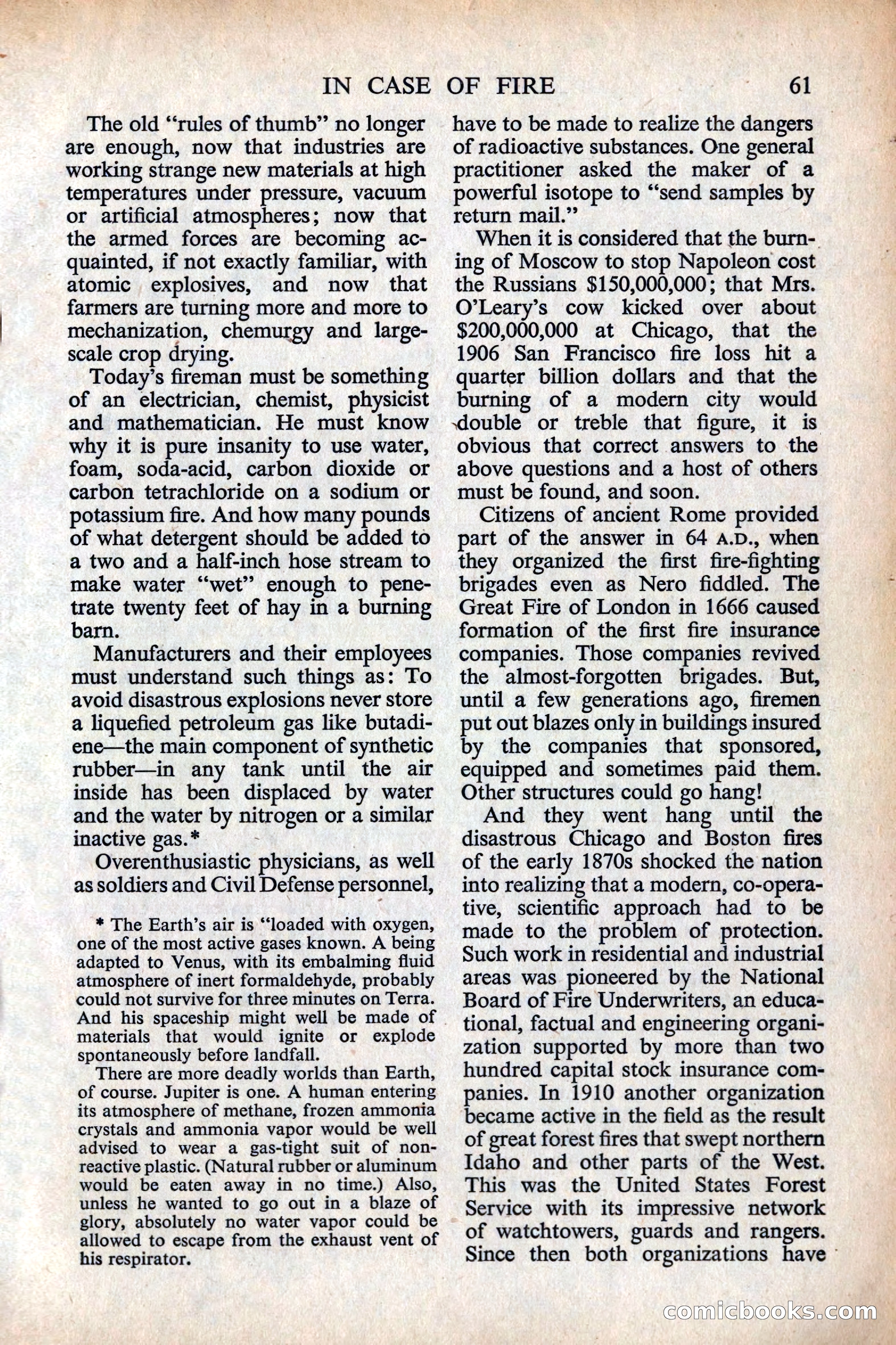
A restored page from Pulp Fiction, 1953. Page through the whole issue in the reader above.
📄 Transcribed text from this page (OCR, searchable)
Machine-transcribed from the original scan — historical spelling and the odd misread are preserved.
IN CASE The old “rules of thumb” no longer are enough, now that industries are working strange new materials at high temperatures under pressure, vacuum or artificial atmospheres; now that the armed forces are becoming ac- quainted, if not exactly familiar, with atomic explosives, and now that farmers are turning more and more to mechanization, chemurgy and large- scale crop drying. Today’s fireman must be something of an electrician, chemist, physicist and mathematician. He must know why it is pure insanity to use water, foam, soda-acid, carbon dioxide or carbon tetrachloride on a sodium or potassium fire. And how many pounds of what detergent should be added to a two and a half-inch hose stream to make water “‘wet’” enough to pene- trate twenty feet of hay in a burning barn. Manufacturers and their employees must understand such things as: To avoid disastrous explosions never store a liquefied petroleum gas like butadi- ene—the main component of synthetic rubber—in any tank until the air inside has been displaced by water and the water by nitrogen or a similar inactive gas.* Overenthusiastic physicians, as well as soldiers and Civil Defense personnel, * The Earth’s air is ‘loaded with oxygen, one of the most active gases known. A being adapted to Venus, with its embalming fluid atmosphere of inert formaldehyde, probably could not survive for three minutes on Terra. And his spaceship might well be made of | materials that would ignite or explode spontaneously before landfall. There are more deadly worlds than Earth, of course. Jupiter is one. A human entering its atmosphere of methane, frozen ammonia crystals and ammonia vapor would be well advised to wear a gas-tight suit of non- reactive plastic. (Natural rubber or aluminum would be eaten away in no time.) Also, unless he wanted to go out in a blaze of glory, absolutely no water vapor could be allowed to escape from the exhaust vent of his respirator. OF FIRE 61 have to be made to realize the dangers of radioactive substances. One general practitioner asked the maker of a powerful isotope to “‘send samples by return mail.” When it is considered that the burn- ing of Moscow to stop Napoleon cost the Russians $150,000,000; that Mrs. O’Leary’s cow kicked over about $200,000,000 at Chicago, that the 1906 San Francisco fire loss hit a quarter billion dollars and that the burning of a modern city would double or treble that figure, it is obvious that correct answers to the above questions and a host of others must be found, and soon. Citizens of ancient Rome provided part of the answer in 64 A.D., when they organized the first fire-fighting brigades even as Nero fiddled. The Great Fire of London in 1666 caused formation of the first fire insurance companies. Those companies revived the almost-forgotten brigades. But, until a few generations ago, firemen put out blazes only in buildings insured by the companies that sponsored, equipped and sometimes paid them. Other structures could go hang! And they went hang until the disastrous Chicago and Boston fires of the early 1870s shocked the nation into realizing that a modern, co-opera- tive, scientific approach had to be made to the problem of protection. Such work in residential and industrial areas was pioneered by the National Board of Fire Underwriters, an educa- tional, factual and engineering organi- zation supported by more than two hundred capital stock insurance com- panies. In 1910 another organization became active in the field as the result of great forest fires that swept northern Idaho and other parts of the West. This was the United States Forest Service with its impressive network of watchtowers, guards and rangers. Since then both organizations have" Conmicloooks com