
Pulp Fiction, 1953 · page 58 of 132
Astounding Science Fiction, British Edition — page 58: what you’re looking at
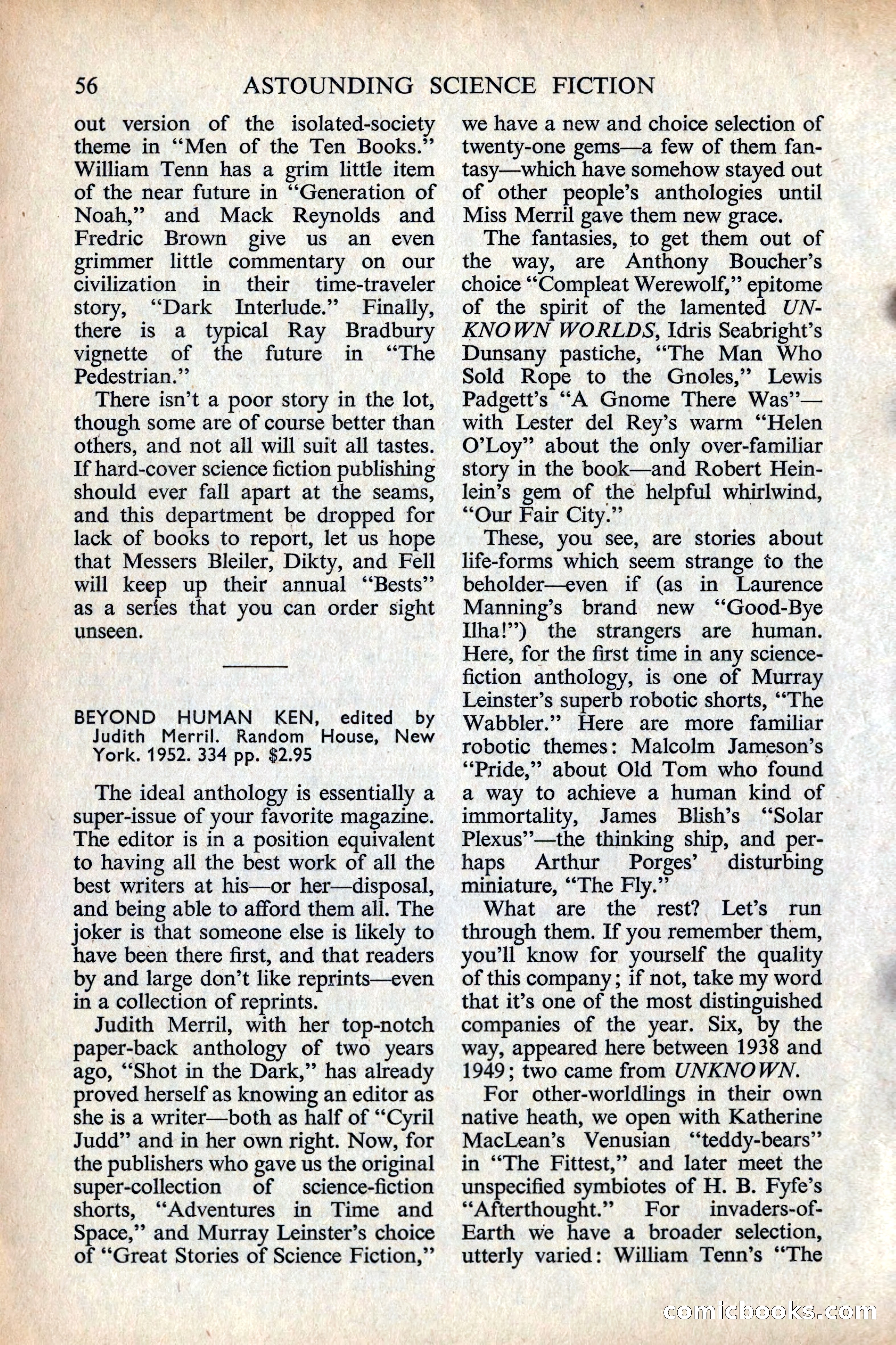
A restored page from Pulp Fiction, 1953. Page through the whole issue in the reader above.
📄 Transcribed text from this page (OCR, searchable)
Machine-transcribed from the original scan — historical spelling and the odd misread are preserved.
56 out version of the isolated-society theme in “‘Men of the Ten Books.” William Tenn has a grim little item of the near future in “Generation of - Noah,” and Mack Reynolds and Fredric Brown give us an even grimmer little commentary on our civilization in their time-traveler story, “Dark Interlude.’’ Finally, there is a typical Ray Bradbury vignette of the future in “The Pedestrian.” There isn’t a poor story in the lot, though some are of course better than others, and not all will suit all tastes. If hard-cover science fiction publishing should ever fall apart at the seams, and this department be dropped for lack of books to report, let us hope that Messers Bleiler, Dikty, and Fell will keep up their annual “‘Bests”’ as a series that you can order sight unseen. BEYOND HUMAN KEN, edited by Judith Merril. Random House, New York. 1952. 334 pp. $2.95 The ideal anthology is essentially a super-issue of your favorite magazine. The editor is in a position equivalent to having all the best work of all the best writers at his—or her—disposal, and being able to afford them all. The joker is that someone else is likely to have been there first, and that readers by and large don’t like reprints—even in a collection of reprints. Judith Merril, with her top-notch paper-back anthology of two years ago, “‘Shot in the Dark,” has already proved herself as knowing an editor as she is a writer—both as half of “Cyril Judd’’ and in her own right. Now, for the publishers who gave us the original super-collection of science-fiction shorts, “‘Adventures in Time and Space,”” and Murray Leinster’s choice of ““Great Stories of Science Fiction,”’ ASTOUNDING SCIENCE FICTION we have a new and choice selection of twenty-one gems—a few of them fan- tasy—which have somehow stayed out of other people’s anthologies until Miss Merril gave them new grace. The fantasies, to get them out of the way, are Anthony Boucher’s choice ““Compleat Werewolf,” epitome of the spirit of the lamented UN- KNOWN WORLDS, Idris Seabright’s Dunsany pastiche, “The Man Who Sold Rope to the Gnoles,” Lewis Padgett’s ““A Gnome There Was’— with Lester del Rey’s warm “Helen O’Loy” about the only over-familiar story in the book—and Robert Hein- lein’s gem of the helpful whirlwind, “Our Fair City.” These, you see, are stories about life-forms which seem strange to the beholder—even if (as in Laurence Manning’s brand new ‘“Good-Bye Ilha!) the strangers are human. Here, for the first time in any science- fiction anthology, is one of Murray Leinster’s superb robotic shorts, ““The Wabbler.” Here are more familiar robotic themes: Malcolm Jameson’s **Pride,”” about Old Tom who found a way to achieve a human kind of immortality, James Blish’s “Solar Plexus”—the thinking ship, and per- haps Arthur Porges’ disturbing miniature, “The Fly.” What are the rest? Let’s run through them. If you remember them, you'll know for yourself the quality of this company; if not, take my word that it’s one of the most distinguished companies of the year. Six, by the way, appeared here between 1938 and 1949; two came from UNKNOWN. For other-worldlings in their own native heath, we open with Katherine MacLean’s Venusian ‘“‘teddy-bears” in “‘The Fittest,” and later meet the unspecified symbiotes of H. B. Fyfe’s ““Afterthought.” For invaders-of- Earth we have a broader selection, utterly varied: William Tenn’s “The CoOnnicloooks com