
Pulp Fiction, 1953 · page 59 of 132
Astounding Science Fiction, British Edition — page 59: what you’re looking at
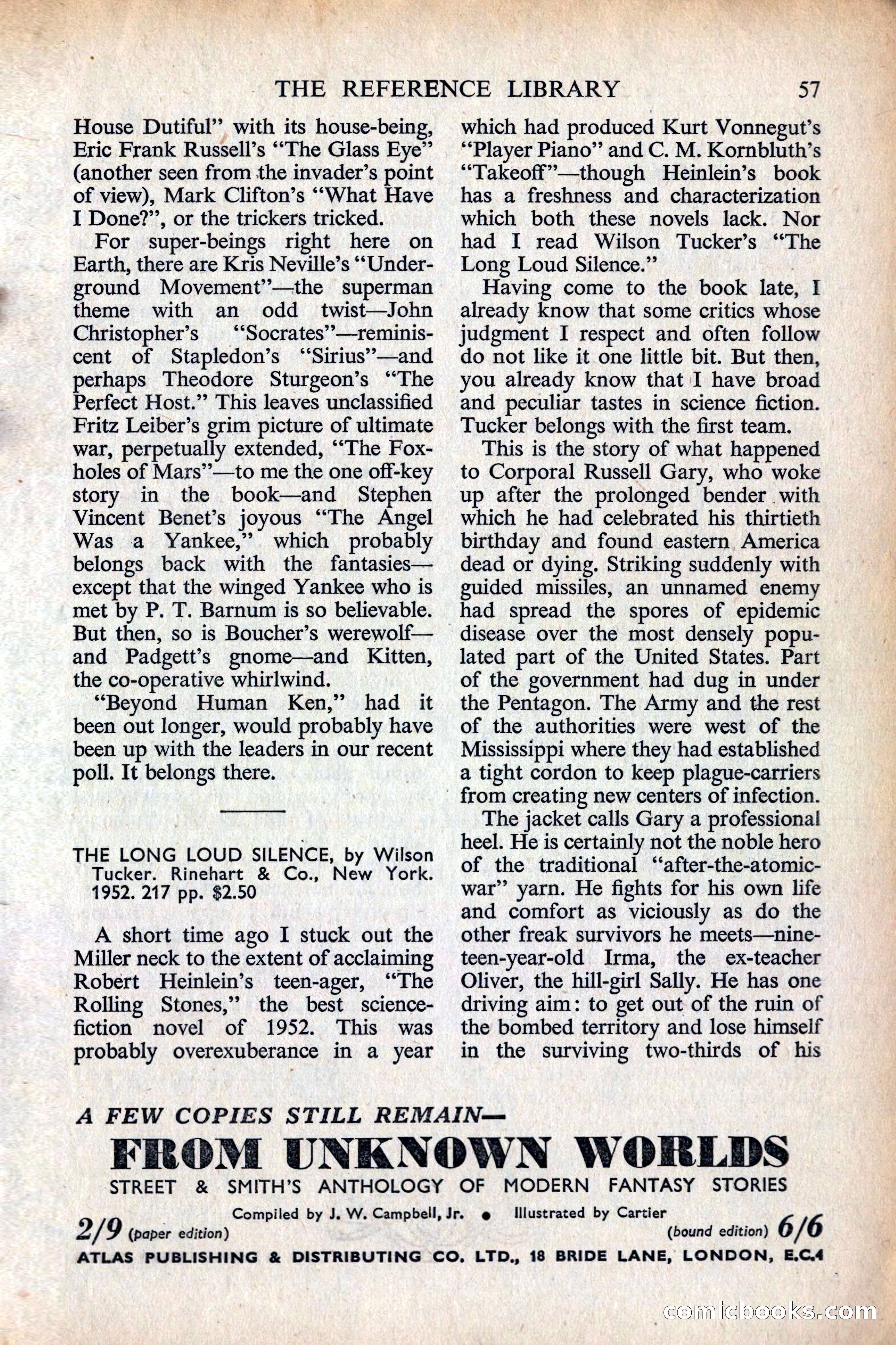
A restored page from Pulp Fiction, 1953. Page through the whole issue in the reader above.
📄 Transcribed text from this page (OCR, searchable)
Machine-transcribed from the original scan — historical spelling and the odd misread are preserved.
THE REFERENCE LIBRARY 57 House Dutiful” with its house-being, Eric Frank Russell’s “The Glass Eye” (another seen from the invader’s point of view), Mark Clifton’s ‘““What Have I Done?”’’, or the trickers tricked. For super-beings right here on Earth, there are Kris Neville’s “‘Under- ground Movement’—the superman theme with an odd _ twist—John Christopher’s ‘“‘Socrates”—reminis- cent of Stapledon’s ‘“Sirius’”—and perhaps Theodore Sturgeon’s “The Perfect Host.” This leaves unclassified Fritz Leiber’s grim picture of ultimate war, perpetually extended, ““The Fox- holes of Mars’”—to me the one off-key story in the book—and Stephen Vincent Benet’s joyous “The Angel Was a Yankee,” which probably belongs back with the fantasies— except that the winged Yankee who is met by P. T. Barnum is so believable. But then, so is Boucher’s werewolf— and Padgett’s gnome—and Kitten, the co-operative whirlwind. “Beyond Human Ken,” had it been out longer, would probably have been up with the leaders in our recent poll. It belongs there. THE LONG LOUD SILENCE, by Wilson Tucker. Rinehart & Co., New York. 1952. 217 pp. $2.50 A short time ago I stuck out the Miller neck to the extent of acclaiming Robert MHeinlein’s teen-ager, “The Rolling Stones,” the best science- fiction novel of 1952. This was probably overexuberance in a year which had produced Kurt Vonnegut’s ‘*Player Piano” and C. M. Kornbluth’s *“Takeoff’’—though Heinlein’s book has a freshness and characterization which both these novels lack. Nor had I read Wilson Tucker’s “The Long Loud Silence.” Having come to the book late, I already know that some critics whose judgment I respect and often follow do not like it one little bit. But then, you already know that'I have broad and peculiar tastes in science fiction. Tucker belongs with the first team. This is the story of what happened to Corporal Russell Gary, who woke up after the prolonged bender with which he had celebrated his thirtieth birthday and found eastern, America dead or dying. Striking suddenly with guided missiles, an unnamed enemy had spread the spores of epidemic disease over the most densely popu- lated part of the United States. Part of the government had dug in under the Pentagon. The Army and the rest of the authorities were west of the Mississippi where they had established a tight cordon to keep plague-carriers - from creating new centers of infection. The jacket calls Gary a professional heel. He is certainly not the noble hero of the traditional “‘after-the-atomic- war’ yarn. He fights for his own life and comfort as viciously as do the other freak survivors he meets—nine- teen-year-old Irma, the ex-teacher Oliver, the hill-girl Sally. He has one driving aim: to get out of the ruin of the bombed territory and lose himself in the surviving two-thirds of his A FEW COPIES STILL REMAIN— FROM UNKNOWN WORLDS STREET & SMITH’S ANTHOLOGY OF MODERN FANTASY STORIES 2/ 9 (paper edition) ATLAS PUBLISHING & DISTRIBUTING CO, LTD., Compiled by J. W. Campbell, Jr. @ Illustrated by Cartier (bound edition) 6 / 6 18 BRIDE LANE, LONDON, E.C.4 -COMilcloookxs