
Pulp Fiction, 1953 · page 57 of 132
Astounding Science Fiction, British Edition — page 57: what you’re looking at
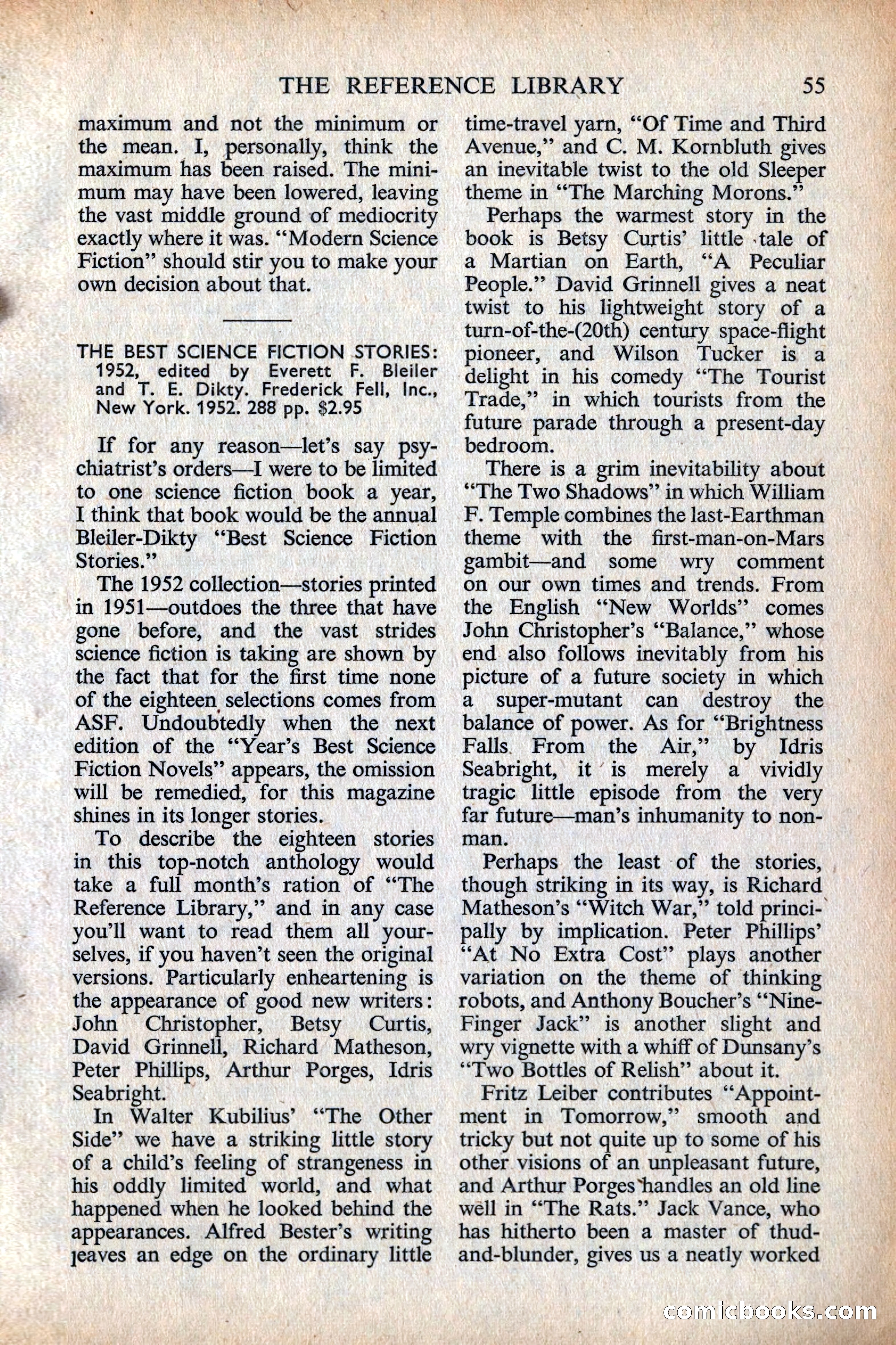
A restored page from Pulp Fiction, 1953. Page through the whole issue in the reader above.
📄 Transcribed text from this page (OCR, searchable)
Machine-transcribed from the original scan — historical spelling and the odd misread are preserved.
THE REFERENCE LIBRARY maximum and not the minimum or the mean. I, personally, think the maximum has been raised. The mini- mum may have been lowered, leaving the vast middle ground of mediocrity exactly where it was. ““Modern Science Fiction” should stir you to make your own decision about that. THE BEST SCIENCE FICTION STORIES: 1952, edited by Everett F. Bleiler and T. E. Dikty. Frederick Fell, New York. 1952. 288 pp. $2.95 Inc., If for any reason—let’s say psy- chiatrist’s orders—I were to be limited to one science fiction book a year, I think that book would be the annual Bleiler-Dikty “Best Science Fiction Stories.” The 1952 collection—stories printed in 1951—outdoes the three that have gone before, and the vast strides science fiction is taking are shown by the fact that for the first time none of the eighteen selections comes from ASF. Undoubtedly when the next edition of the “Year’s Best Science Fiction Novels” appears, the omission will be remedied, for this magazine shines in its longer stories. To describe the eighteen stories in this top-notch anthology would take a full month’s ration of “The Reference Library,’ and in any case you'll want to read them all your- selves, if you haven’t seen the original versions. Particularly enheartening is the appearance of good new writers: John Christopher, Betsy Curtis, David Grinnell, Richard Matheson, Peter Phillips, Arthur Porges, Idris Seabright. In Walter Kubilius’ “The Other Side” we have a striking little story of a child’s feeling of strangeness in his oddly limited world, and what happened when he looked behind the appearances. Alfred Bester’s writing jeaves an edge on the ordinary little 55 time-travel yarn, “Of Time and Third Avenue,” and C. M. Kornbluth gives an inevitable twist to the old Sleeper theme in “The Marching Morons.” Perhaps the warmest story in the book is Betsy Curtis’ little tale of a Martian on Earth, “A Peculiar People.’’ David Grinnell gives a neat twist to his lightweight story of a turn-of-the-(20th) century space-flight pioneer, and Wilson Tucker is a delight in his comedy “The Tourist Trade,” in which tourists from the future parade through a present-day bedroom. There is a grim inevitability about “The Two Shadows” in which William F. Temple combines the last-Earthman theme with the first-man-on-Mars gambit—and some wry comment on our own times and trends. From the English ‘“‘New Worlds’ comes John Christopher’s “Balance,” whose end also follows inevitably from his picture of a future society in which a super-mutant can destroy the balance of power. As for “Brightness Falls. From the Air,” by Idris Seabright, itis merely a_ vividly tragic little episode from the very far future—man’s inhumanity to non- man. Perhaps the least of the stories, though striking in its way, is Richard Matheson’s “Witch War,” told princi- pally by implication. Peter Phillips’ “At No Extra Cost’ plays another variation on the theme of thinking robots, and Anthony Boucher’s ““Nine- Finger Jack’? is another slight and wry vignette with a whiff of Dunsany’s “Two Bottles of Relish’ about it. Fritz Leiber contributes ““Appoint- ment in Tomorrow,” smooth and tricky but not quite up to some of his other visions of an unpleasant future, and Arthur Porges*handles an old line well in “‘The Rats.’’ Jack Vance, who has hitherto been a master of thud- and-blunder, gives us a neatly worked CoOMIcdoOoks