
Pulp Fiction, 1953 · page 56 of 132
Astounding Science Fiction, British Edition — page 56: what you’re looking at
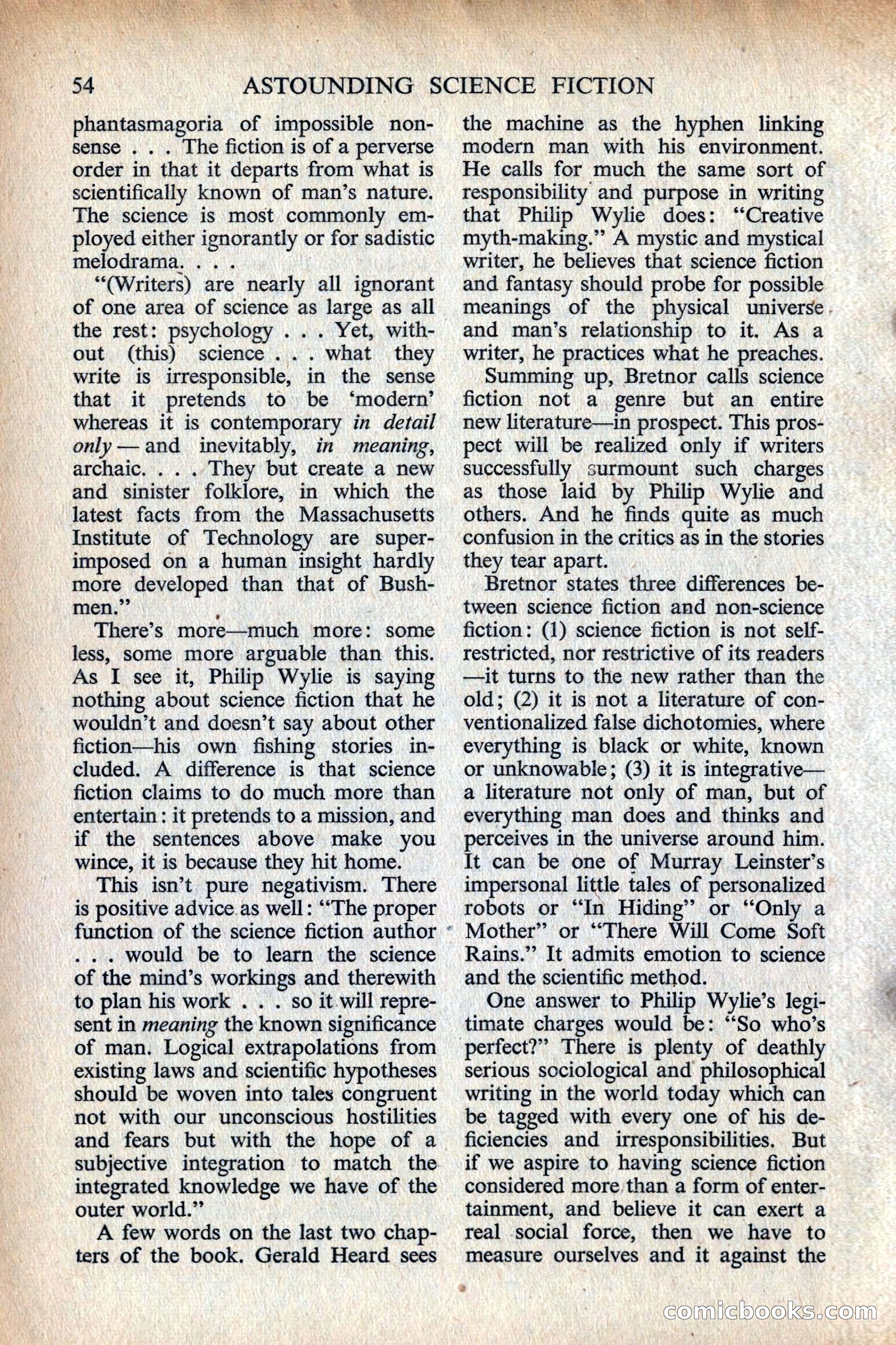
A restored page from Pulp Fiction, 1953. Page through the whole issue in the reader above.
📄 Transcribed text from this page (OCR, searchable)
Machine-transcribed from the original scan — historical spelling and the odd misread are preserved.
ART OR aise ces AWM i Unk Pete Oh Same > ane emis wee We Prmal' d oh ye: TS isis esas Oe eat es ce Wo Pies ack Tecan E ee» Fr nt be ‘ t " . ‘ ¢ . ‘ ay pig a'® ey ms : UR oe ' , } » is re be Se: 2% bre by Se rs At 54 phantasmagoria of impossible non- sense . . . The fiction is of a perverse order in that it departs from what is scientifically known of man’s nature. The science is most commonly em- ployed either ignorantly or for sadistic melodrama. ... (Writers) are nearly all ignorant of one area of science as large as all the rest: psychology ... Yet, with- out (this) science ... what they write is irresponsible, in the sense that it pretends to be ‘modern’ whereas it is contemporary in detail only —and inevitably, in meaning, archaic. . . . They but create a new and sinister folklore, in which the latest facts from the Massachusetts Institute of Technology are super- imposed on a human insight hardly more developed than that of Bush- men.” ; There’s more—much more: some less, some more arguable than this. As I see it, Philip Wylie is saying nothing about science fiction that he wouldn’t and doesn’t say about other fiction—his own fishing stories in- cluded. A difference is that science fiction claims to do much more than entertain : it pretends to a mission, and if the sentences above make you wince, it is because they hit home. This isn’t pure negativism. There is positive advice.as well: “The proper function of the science fiction author ° . would be to learn the science of the mind’s workings and therewith to plan his work . . . so it.will repre- sent in meaning the known significance of man. Logical extrapolations from existing laws and scientific hypotheses should be woven into tales congruent not with our unconscious hostilities and fears but with the hope of a subjective integration to match the integrated knowledge we have of the outer world.” A few words on the last two chap- ters of the book. Gerald Heard sees ASTOUNDING SCIENCE FICTION the machine as the hyphen linking modern man with his environment. He calls for much the same sort of responsibility and purpose in writing that Philip Wylie does: ‘Creative myth-making.”” A mystic and mystical writer, he believes that science fiction and fantasy should probe for possible meanings of the physical universe. and man’s relationship to it. As a writer, he practices what he preaches. Summing up, Bretnor calls science fiction not a genre but an entire new literature—in prospect. This pros- pect will be realized only if writers successfully surmount such charges as those laid by Philip Wylie and others. And he finds quite as much confusion in the critics as in the stories they tear apart. Bretnor states three differences be- tween science fiction and non-science fiction: (1) science fiction is not self- restricted, nor restrictive of its readers —it turns to the new rather than the old; (2) it is not a literature of con- ventionalized false dichotomies, where everything is black or white, known or unknowable; (3) it is integrative— a literature not only of man, but of everything man does and thinks and perceives in the universe around him. It can be one of Murray Leinster’s impersonal little tales of personalized robots or “In Hiding” or ‘Only a Mother” or “There Will Come Soft Rains.” It admits emotion to science and the scientific method. One answer to Philip Wylie’s legi- timate charges would be: “‘So who’s perfect?” There is plenty of deathly serious sociological and philosophical writing in the world today which can be tagged with every one of his de- ficiencies and irresponsibilities. But if we aspire to having science fiction considered more than a form of enter- tainment, and believe it can exert a real social force, then we have to measure ourselves and it against the 2 ey th ae es AS wten Ce. ae ees rae 1* Fo cs © 4 Cconmicloooks.conn