
Pulp Fiction, 1953 · page 55 of 132
Astounding Science Fiction, British Edition — page 55: what you’re looking at
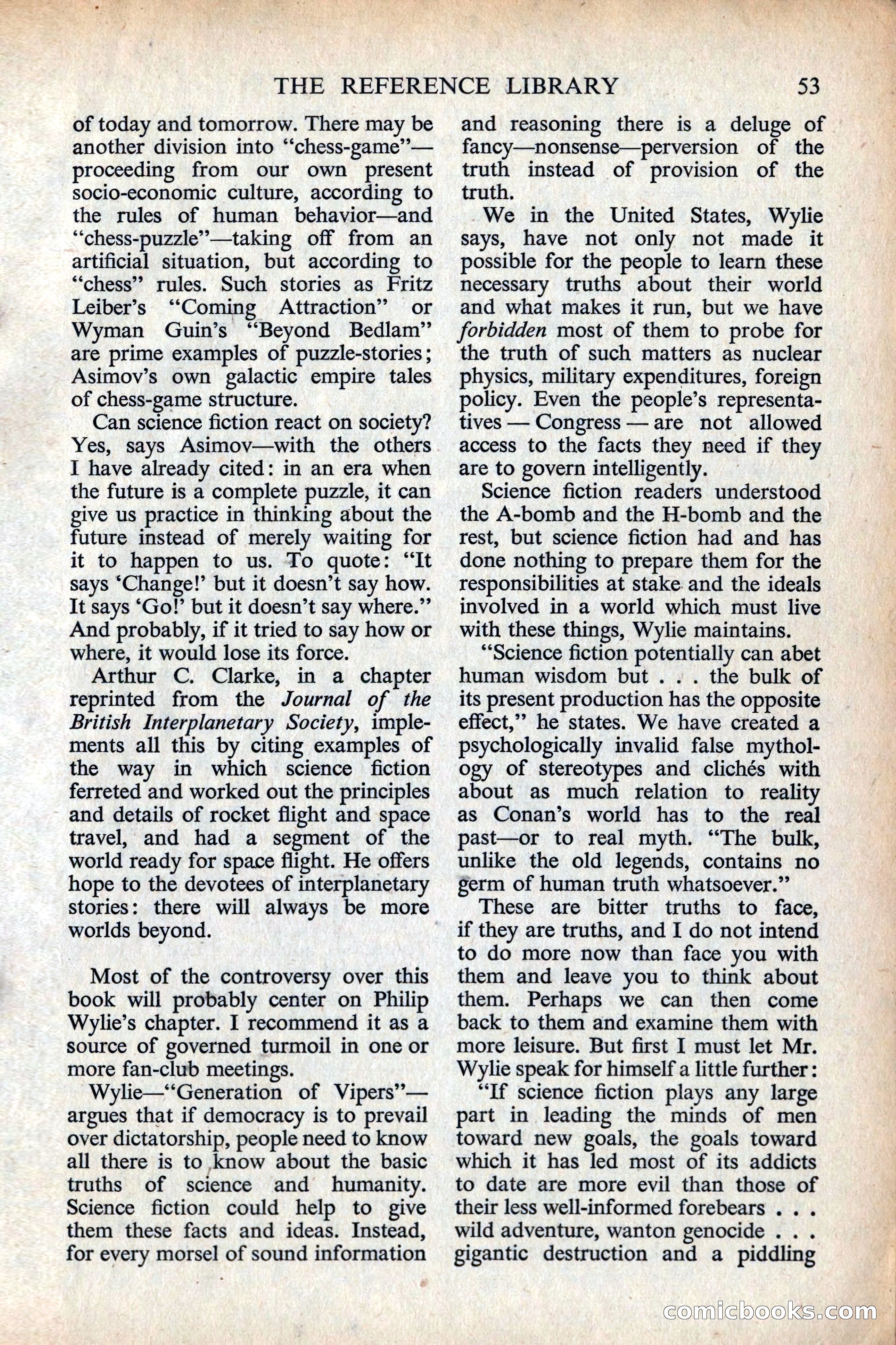
A restored page from Pulp Fiction, 1953. Page through the whole issue in the reader above.
📄 Transcribed text from this page (OCR, searchable)
Machine-transcribed from the original scan — historical spelling and the odd misread are preserved.
THE REFERENCE LIBRARY of today and tomorrow. There may be another division into “‘chess-game”’— proceeding from our own present socio-economic culture, according to the rules of human behavior—and “‘chess-puzzle”—taking off from an artificial situation, but according to “chess” rules. Such stories as Fritz Leiber’s “Coming Attraction” or Wyman Guin’s “Beyond Bedlam” are prime examples of puzzle-stories ; Asimov’s own galactic empire tales of chess-game structure. Can science fiction react on society? Yes, says Asimov—with the others I have already cited: in an era when the future is a complete puzzle, it can give us practice in thinking about the future instead of merely waiting for it to happen to us. To quote: “It says “Change!” but it doesn’t say how. It says ‘Go!’ but it doesn’t say where.” And probably, if it tried to say how or where, it would lose its force. Arthur C. Clarke, in a chapter reprinted from the Journal of the British Interplanetary Society, imple- ments all this by citing examples of the way in which science fiction ferreted and worked out the principles and details of rocket flight and space travel, and had a segment of the world ready for space flight. He offers hope to the devotees of interplanetary stories: there will always be more worlds beyond. Most of the controversy over this book will probably center on Philip Wylie’s chapter. I recommend it as a source of governed turmoil in one or more fan-club meetings. Wylie—“Generation of Vipers’”— argues that if democracy is to prevail over dictatorship, people need to know all there is to know about the basic truths of science and humanity. Science fiction could help to give them these facts and ideas. Instead, for every morsel of sound information 53 and reasoning there is a deluge of fancy—nonsense—perversion of the truth instead of provision of the truth. We in the United States, Wylie says, have not only not made it possible for the people to learn these necessary truths about their world and what makes it run, but we have forbidden most of them to probe for the truth of such matters as nuclear physics, military expenditures, foreign policy. Even the people’s representa- tives — Congress — are not allowed access to the facts they need if they are to govern intelligently. Science fiction readers understood the A-bomb and the H-bomb and the rest, but science fiction had and has done nothing to prepare them for the responsibilities at stake and the ideals involved in a world which must live with these things, Wylie maintains. “Science fiction potentially can abet human wisdom but . . . the bulk of its present production has the opposite effect,” he states. We have created a psychologically invalid false mythol- ogy of stereotypes and clichés with about as much relation to reality as Conan’s world has to the real past—or to real myth. “The bulk, unlike the old legends, contains no germ of human truth whatsoever.” These are bitter truths to face, if they are truths, and I do not intend to do more now than face you with them and leave you to think about them. Perhaps we can then come back to them and examine them with more leisure. But first I must let Mr. Wylie speak for himself a little further : “If science fiction plays any large part in leading the minds of men toward new goals, the goals toward which it has led most of its addicts to date are more evil than those of their less well-informed forebears .. . wild adventure, wanton genocide . . gigantic destruction and a piddling Connicloooks com