
Pulp Fiction, 1953 · page 54 of 132
Astounding Science Fiction, British Edition — page 54: what you’re looking at
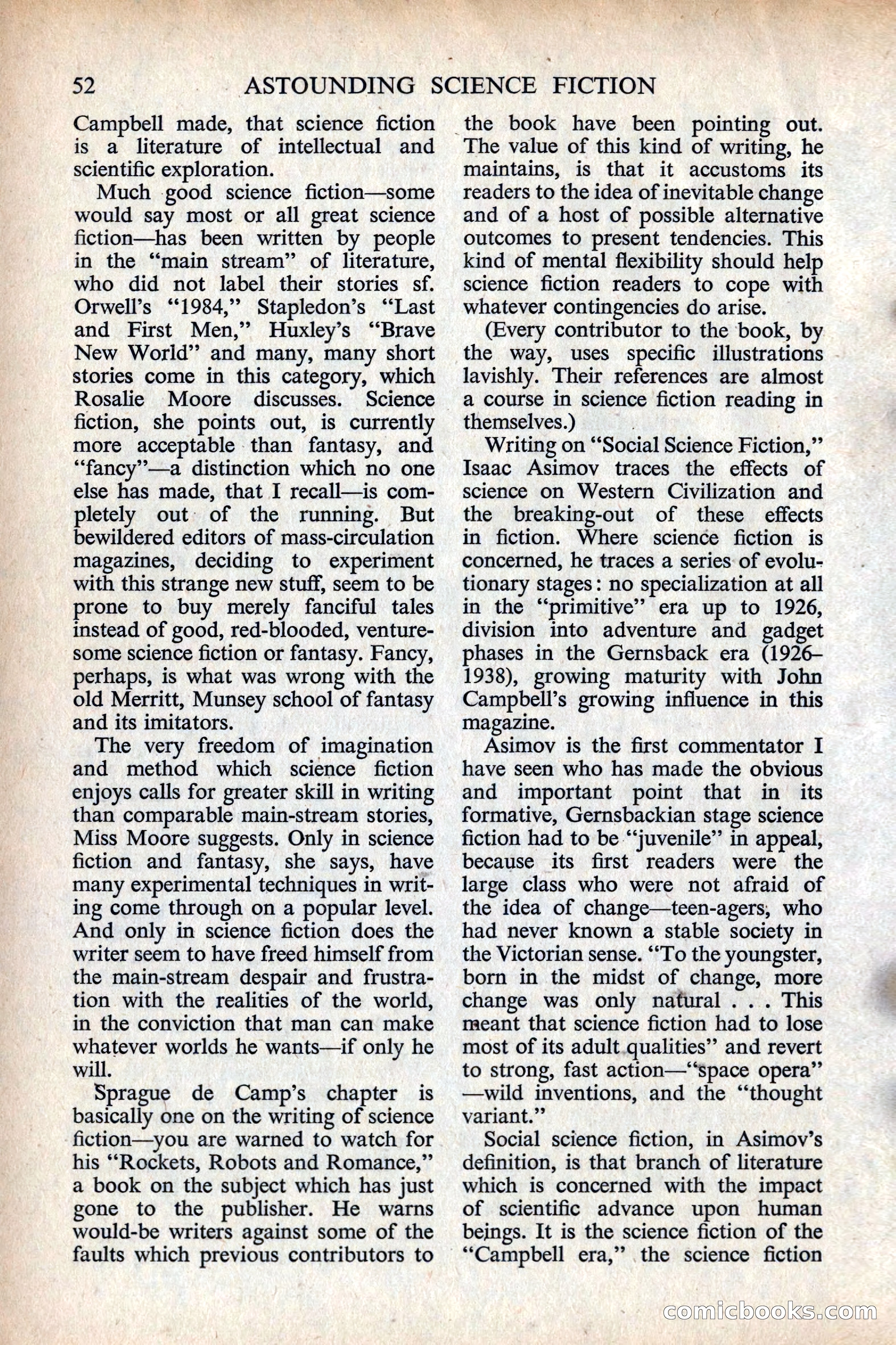
A restored page from Pulp Fiction, 1953. Page through the whole issue in the reader above.
📄 Transcribed text from this page (OCR, searchable)
Machine-transcribed from the original scan — historical spelling and the odd misread are preserved.
52 Campbell made, that science fiction is a literature of intellectual and scientific exploration. Much -good science fiction—some would say most or all great science fiction—has been written by people in the “main stream” of literature, who did not label their stories sf. Orwell’s “1984,” Stapledon’s “Last and First Men,” Huxley’s “Brave New World’ and many, many short stories come in this category, which Rosalie Moore discusses. Science fiction, she points out, is currently more acceptable than fantasy, and ““fancy’—a distinction which no one else has made, that I recall—is com- pletely out of the running. But bewildered editors of mass-circulation magazines, deciding to experiment with this strange new stuff, seem to be prone to buy merely fanciful tales instead of good, red-blooded, venture- some science fiction or fantasy. Fancy, perhaps, is what was wrong with the old Merritt, Munsey school of fantasy and its imitators. The very freedom of imagination and method which science fiction enjoys calls for greater skill in writing than comparable main-stream stories, Miss Moore suggests. Only in science fiction and fantasy, she says, have many experimental techniques in writ- ing come through on a popular level. And only in science fiction does the writer seem to have freed himself from the main-stream despair and frustra- tion with the realities of the world, in the conviction that man can make whatever worlds he wants—if only he will. Sprague de Camp’s chapter is basically one on the writing of science fiction—you are warned to watch for his “‘Rockets, Robots and Romance,” a book on the subject which has just gone to the publisher. He warns would-be writers against some of the faults which previous contributors to ASTOUNDING SCIENCE FICTION _the book have been pointing out. The value of this kind of writing, he maintains, is that it accustoms its readers to the idea of inevitable change and of a host of possible alternative outcomes to present tendencies. This kind of mental flexibility should help science fiction readers to cope with whatever contingencies do arise. (Every contributor to the book, by the way, uses specific illustrations lavishly. Their references are almost a course in science fiction reading in themselves.) Writing on “Social Science Fiction,” Isaac Asimov traces the effects of science on Western Civilization and the breaking-out of these effects in fiction. Where science fiction is concerned, he traces a series of evolu- tionary stages: no specialization at all in the “primitive” era up to 1926, division into adventure and gadget phases in the Gernsback era (1926- 1938), growing maturity with John Campbell’s growing influence in this magazine. Asimov is the first commentator I have seen who has made the obvious and important point that in its formative, Gernsbackian stage science fiction had to be “‘juvenile’’ in appeal, because its first readers were the large class who were not afraid of the idea of change—teen-agers, who had never known a stable society in the Victorian sense. ““To the youngster, born in the midst of change, more change was only natural... This meant that science fiction had to lose most of its adult.qualities’’ and revert to strong, fast action—‘‘space opera” —wild inventions, and the “thought variant.” Social science fiction, in Asimov’s definition, is that branch of literature which is concerned with the impact of scientific advance upon human beings. It is the science fiction of the “Campbell era,” the science fiction Connicloooks CON