
Pulp Fiction, 1953 · page 53 of 132
Astounding Science Fiction, British Edition — page 53: what you’re looking at
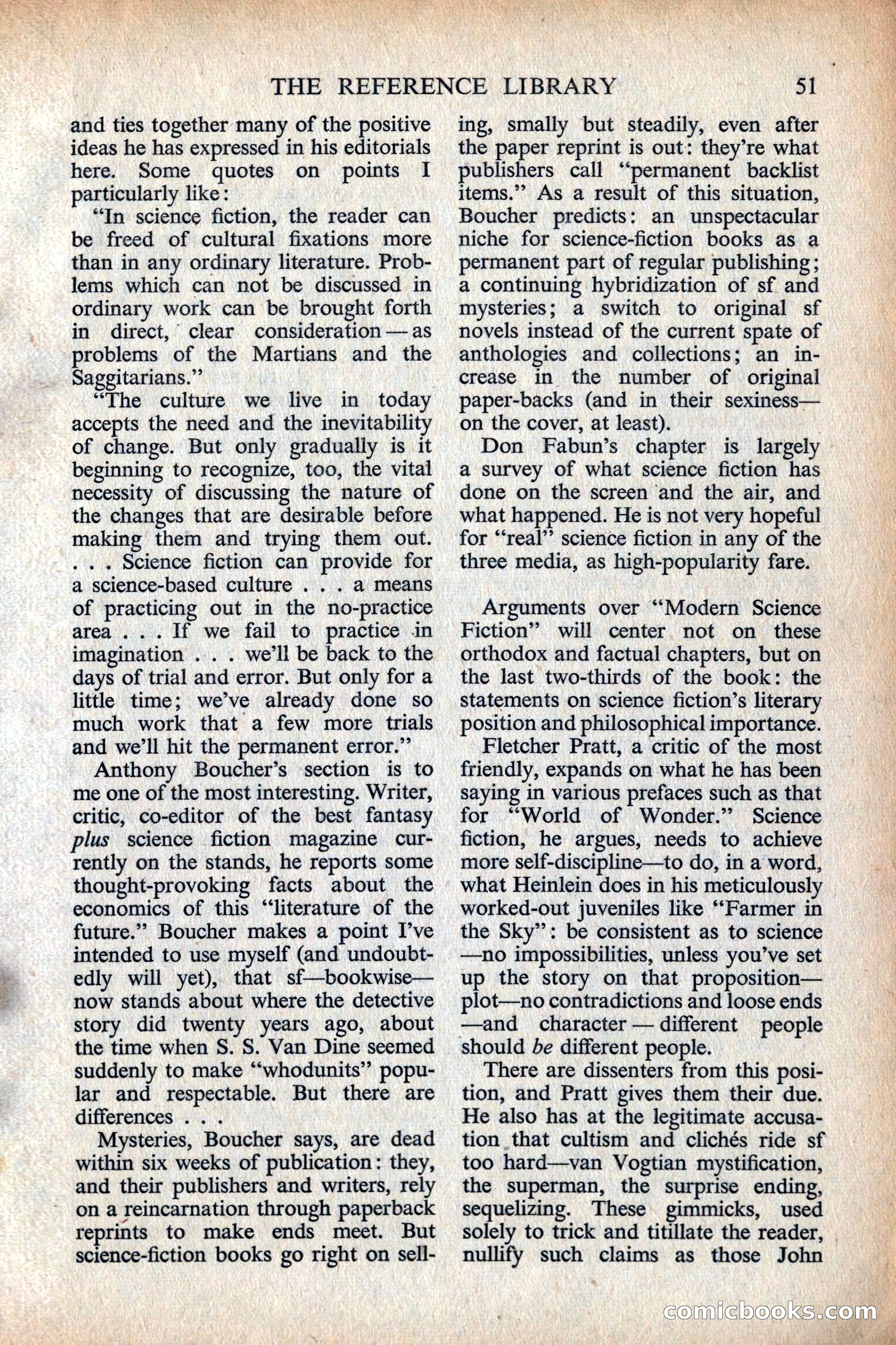
A restored page from Pulp Fiction, 1953. Page through the whole issue in the reader above.
📄 Transcribed text from this page (OCR, searchable)
Machine-transcribed from the original scan — historical spelling and the odd misread are preserved.
THE REFERENCE LIBRARY 5] and ties together many of the positive ideas he has expressed in his editorials here. Some quotes on points I particularly like: “In science fiction, the reader can be freed of cultural fixations more than in any ordinary literature. Prob- lems which can not be discussed in ordinary work can be brought forth in direct, clear consideration — as problems of the Martians and the Saggitarians.” “The culture we live in today accepts the need and the inevitability of change. But only gradually is it beginning to recognize, too, the vital necessity of discussing the nature of the changes that are desirable before making them and trying them out. . . . Science fiction can provide for a science-based culture . . . a means of practicing out in the no-practice area... If we fail to practice in imagination . . . we'll be back to the days of trial and error. But only for a little time; we’ve already done so much work that a few more trials and we'll hit the permanent error.” Anthony Boucher’s section is to me one of the most interesting. Writer, critic, co-editor of the best fantasy plus science fiction magazine cur- rently on the stands, he reports some thought-provoking facts about the economics of this “literature of the future.’’ Boucher makes a point I’ve intended to use myself (and undoubt- edly will yet), that sf—bookwise— now stands about where the detective story did twenty years ago, about the time when S. S. Van Dine seemed suddenly to make “whodunits” popu- lar and respectable. But there are differences ... Mysteries, Boucher says, are dead within six weeks of publication: they, and their publishers and writers, rely on a reincarnation through paperback reprints to make ends meet. But science-fiction books go right on sell- ing, smally but steadily, even after the paper reprint is out: they’re what publishers call “‘permanent backlist items.”’ As a result of this situation, Boucher predicts: an unspectacular niche for science-fiction books as a permanent part of regular publishing ; a continuing hybridization of sf and mysteries; a switch to original sf novels instead of the current spate of anthologies and collections; an in- crease in the number of original paper-backs (and in their sexiness— on the cover, at least). 3 Don Fabun’s chapter is largely a survey of what science fiction has done on the screen and the air, and what happened. He is not very hopeful for “‘real’”’ science fiction in any of the three media, as high-popularity fare. Arguments over ‘“‘Modern Science Fiction” will center not on _ these orthodox and factual chapters, but on the last two-thirds of the book: the statements on science fiction’s literary position and philosophical importance. Fletcher Pratt, a critic of the most friendly, expands on what he has been saying in various prefaces such as that for “World of Wonder.’’ Science fiction, he argues, needs to achieve more self-discipline—to do, in a word, what Heinlein does in his meticulously worked-out juveniles like “‘Farmer in the Sky”: be consistent as to science —no impossibilities, unless you’ve set up the story on that proposition— plot—no contradictions and loose ends —and character — different people should be different people. There are dissenters from this posi- tion, and Pratt gives them their due. He also has at the legitimate accusa- tion that cultism and clichés ride sf too hard—van Vogtian mystification, the superman, the surprise ending, sequelizing. These gimmicks, used solely to trick and titillate the reader, . nullify such claims as those John COMIEOOOKS aol