
Pulp Fiction, 1953 · page 128 of 132
Astounding Science Fiction, British Edition — page 128: what you’re looking at
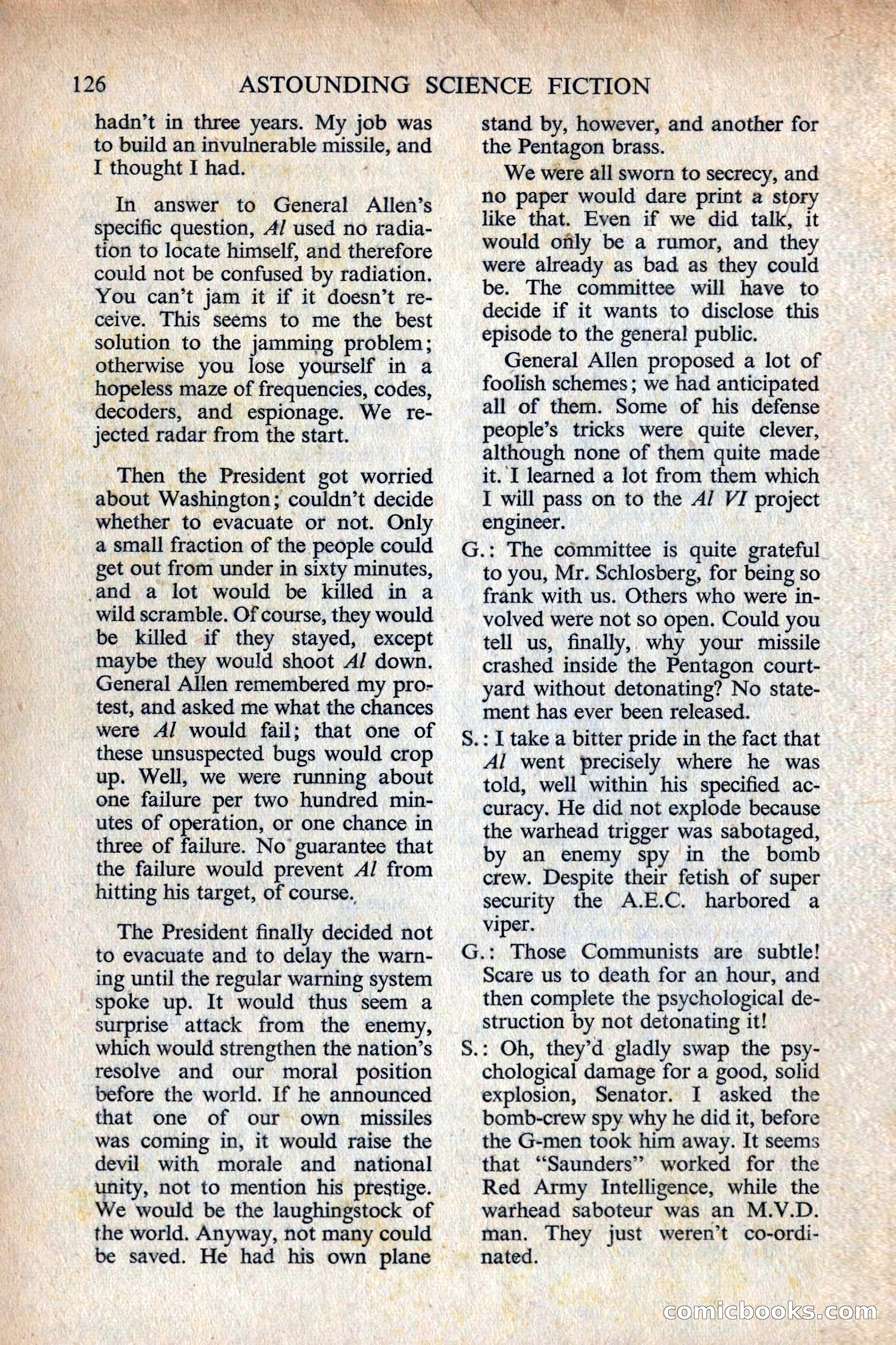
A restored page from Pulp Fiction, 1953. Page through the whole issue in the reader above.
📄 Transcribed text from this page (OCR, searchable)
Machine-transcribed from the original scan — historical spelling and the odd misread are preserved.
126 hadn’t in three years. My job was to build an invulnerable oe and I thought I had. In answer to General Allen’s specific question, A/ used no radia- tion to locate himself, and therefore could not be confused by radiation. You can’t jam it if it doesn’t re- ceive. This seems to me the best solution to the jamming problem; otherwise you lose yourself in a hopeless maze of frequencies, codes, decoders, and espionage. We re- jected radar from the start. Then the President got worried about Washington; couldn’t decide whether to evacuate or not. Only a small fraction of the people could get out from under in sixty minutes, and a lot would be killed in a wild scramble. Of course, they would be killed if they stayed, except maybe they would shoot A/ down. General Allen remembered my pro- test, and asked me what the chances were Al would fail; that one of these unsuspected bugs would crop up. Well, we were running about one failure per two hundred min- utes of operation, or one chance in three of failure. No guarantee that the failure would prevent Al from hitting his target, of course. The President finally decided not to evacuate and to delay the warn- ing until the regular warning system Spoke up. It would thus seem a surprise attack from the enemy, which would strengthen the nation’s resolve and our moral position before the world. If he announced that one of our own missiles was coming in, it would raise the devil with morale and national unity, not to mention his prestige. We would be the laughingstock of the world. Anyway, not many could be saved. He had his own plane ASTOUNDING SCIENCE FICTION stand by, however, and another for the Pentagon brass. We were all sworn to secrecy, and no paper would dare print a story like that. Even if we did talk, it would only be a rumor, and they were already as bad as they could be. The committee will have to decide if it wants to disclose this episode to the general public. General Allen proposed a lot of foolish schemes ; we had anticipated all of them. Some of his defense people’s tricks were quite clever, although none of them quite made it. I learned a lot from them which I will pass on to the Al VI project engineer. G.; The committee is quite grateful to you, Mr. Schlosberg, for being so frank with us. Others who were in- volved were not so open. Could you tell us, finally, why your missile crashed inside the Pentagon court- yard without detonating? No state- ment has ever been released. S.: I take a bitter pride in the fact that Al went precisely where he was told, well within his specified ac- curacy. He did not explode because the warhead trigger was sabotaged, by an enemy spy in the bomb crew. Despite their fetish of super security the A.E.C. harbored a viper. G.: Those Communists are subtle! Scare us to death for an hour, and then complete the psychological de- struction by not detonating it! S.: Oh, they’d gladly swap the psy- chological damage for a good, solid explosion, Senator. I asked the bomb-crew spy why he did it, before the G-men took him away. It seems that “Saunders” worked for the Red Army Intelligence, while the warhead saboteur was an M.V.D. man. They just weren’t co-ordi- nated. CoOMUIGcaoOoks - Ae ok BLT 7h [. ~** = : Woon 's).. AR Ve ‘ee? all COLA