
Pulp Fiction, 1953 · page 127 of 132
Astounding Science Fiction, British Edition — page 127: what you’re looking at
A restored page from Pulp Fiction, 1953. Page through the whole issue in the reader above.
📄 Transcribed text from this page (OCR, searchable)
Machine-transcribed from the original scan — historical spelling and the odd misread are preserved.
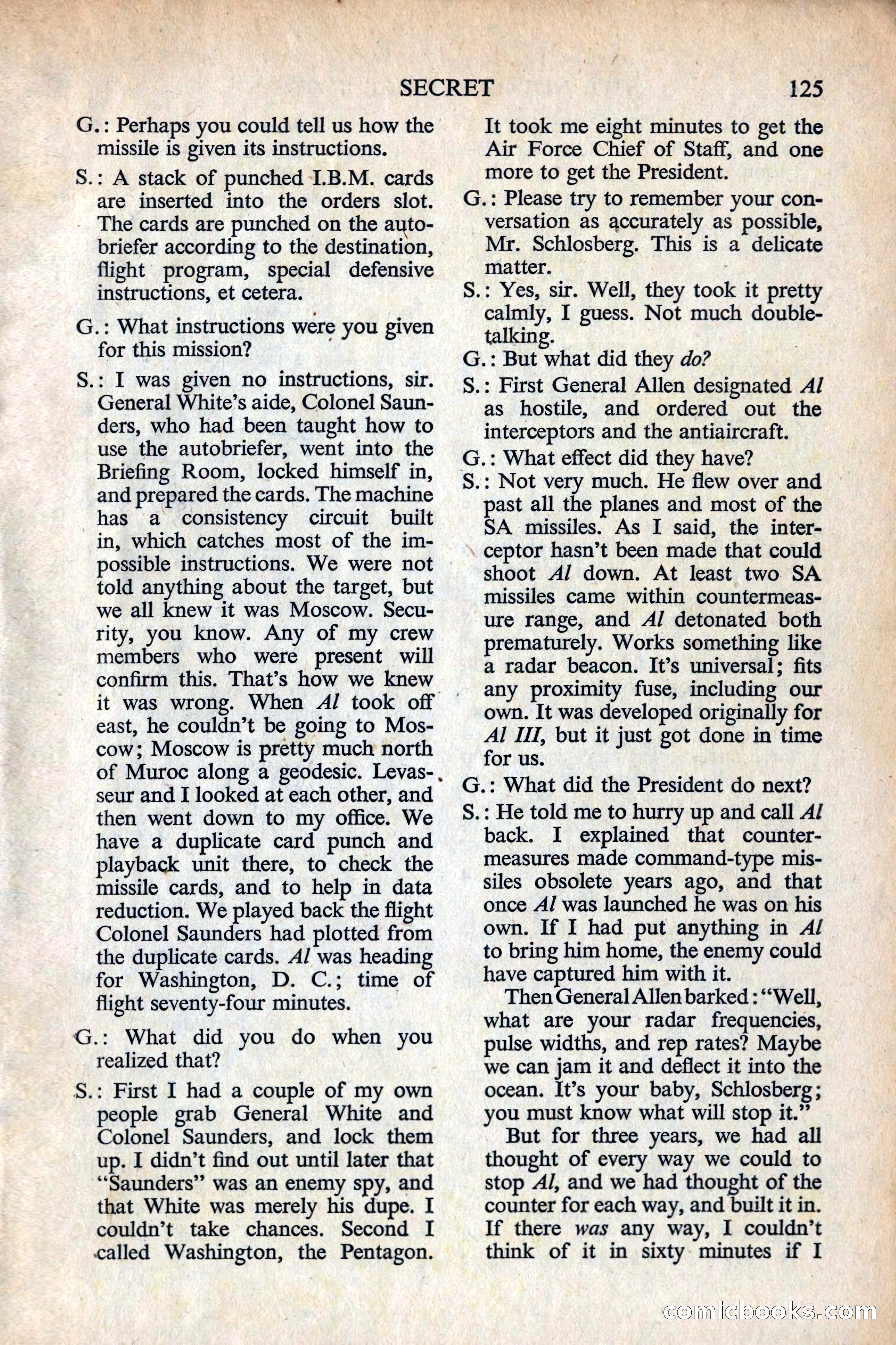
SECRET G.: Perhaps you could tell us how the missile is given its instructions. S.: A stack of punched I.B.M. cards are inserted into the orders slot. - The cards are punched on the auto- briefer according to the destination, flight program, special defensive 125 It took me eight minutes to get the Air Force Chief of Staff, and one more to get the President. G.: Please try to remember your con- versation as accurately as possible, Mr. Schlosberg. This is a delicate matter. S.: Yes, sir. Well, they took it pretty instructions, et cetera. calmly, I guess. Not much double- G.: What instructions were you given for this mission? talking. G.: But what did they do? S.: I was given no instructions, sir. S.: First General Allen designated Al General White’s aide, Colonel Saun- ders, who had been taught how to use the autobriefer, went into the Briefing Room, locked himself in, and prepared the cards. The machine has a consistency circuit built in, which catches most of the im- possible instructions. We were not told anything about the target, but we all knew it was Moscow. Secu- rity, you know. Any of my crew members who were present will confirm this. That’s how we knew it was wrong. When A/ took off © east, he couldn’t be going to Mos- cow; Moscow is pretty much north of Muroc along a geodesic. Levas-, seur and I looked at each other, and then went down to my office. We have a duplicate card punch and playback unit there, to check the missile cards, and to help in data reduction. We played back the flight Colonel Saunders had plotted from the duplicate cards. A/ was heading for Washington, D. C.; time of flight seventy-four minutes. G.: What did you do when you realized that? S.: First I had a couple of my own people grab General White and Colonel Saunders, and lock them up. I didn’t find out until later that “Saunders” was an enemy spy, and that White was merely his dupe. I couldn’t take chances. Second I called Washington, the Pentagon. as hostile, and ordered out the interceptors and the antiaircraft. G.: What effect did they have? S.: Not very much. He flew over and past all the planes and most of the SA missiles. As I said, the inter- ceptor hasn’t been made that could shoot A/ down. At least two SA missiles came within countermeas- ure range, and A/ detonated both prematurely. Works something like a radar beacon. It’s universal; fits any proximity fuse, including our own. It was developed originally for Al III, but it just got done in time for us. G.: What did the President do next? S.: He told me to hurry up and call Al back. I explained that counter- measures made command-type mis- siles obsolete years ago, and that once A/ was launched he was on his own. If I had put anything in A/ to bring him home, the enemy could have captured him with it. Then General Allen barked : ““Well, what are your radar frequencies, pulse widths, and rep rates? Maybe we can jam it and deflect it into the ocean. It’s your baby, Schlosberg ; you must know what will stop it.” But for three years, we had all thought of every way we could to stop A/, and we had thought of the counter for each way, and built it in. If there was any way, I couldn’t think of it in sixty minutes if I Connicloooks COLA