
Pulp Fiction, 1953 · page 126 of 132
Astounding Science Fiction, British Edition — page 126: what you’re looking at
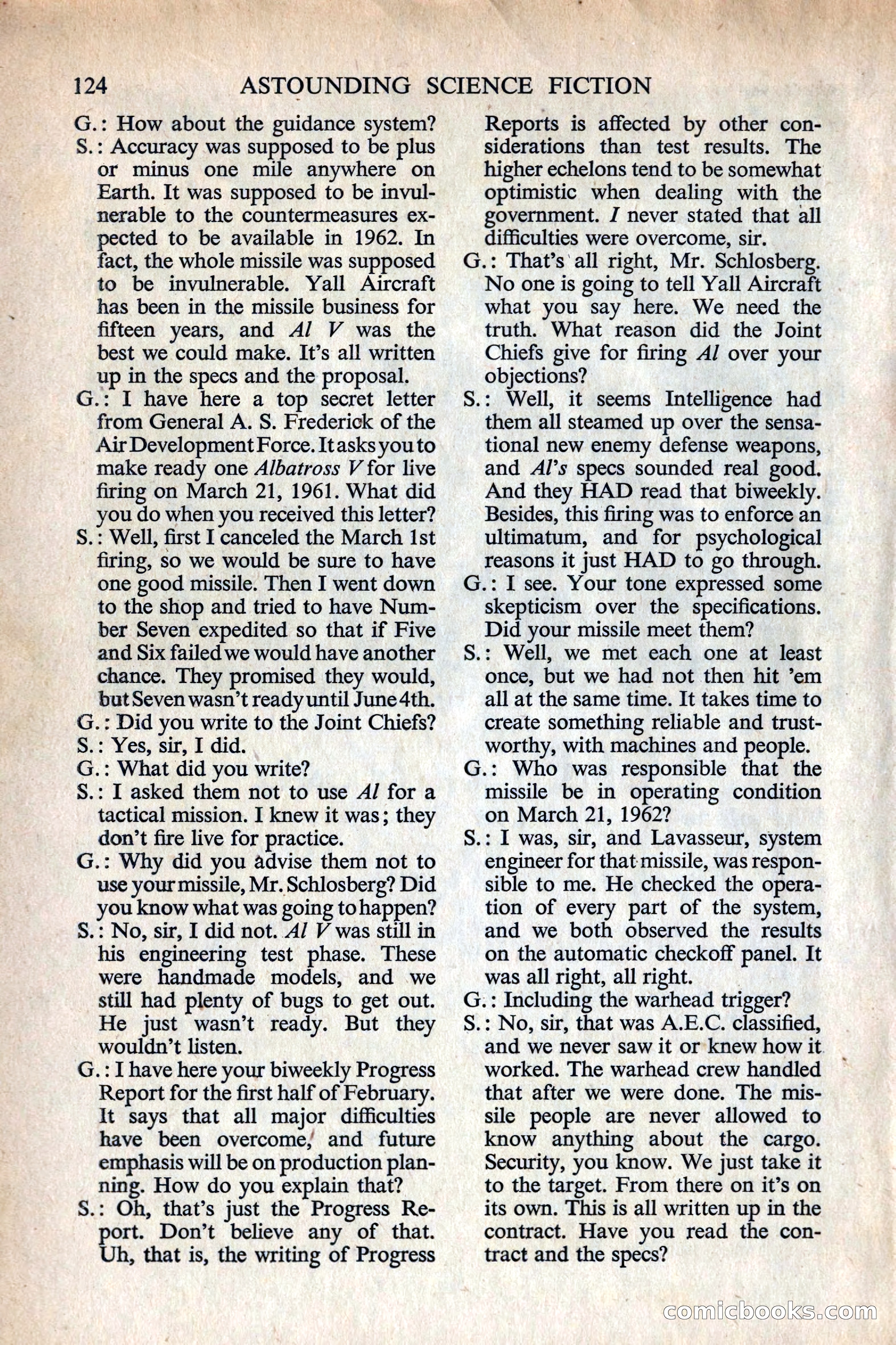
A restored page from Pulp Fiction, 1953. Page through the whole issue in the reader above.
📄 Transcribed text from this page (OCR, searchable)
Machine-transcribed from the original scan — historical spelling and the odd misread are preserved.
124 ASTOUNDING SCIENCE FICTION Reports is affected by other con- siderations than test results. The G.: How about the guidance system? S.: Accuracy was supposed to be plus or minus one mile anywhere on Earth. It was supposed to be invul- nerable to the countermeasures ex- pected to be available in 1962. In fact, the whole missile was supposed to be invulnerable. Yall Aircraft has been in the missile business for fifteen years, and Al V was the best we could make. It’s all written up in the specs and the proposal. : I have here a top secret letter from General A. S. Frederick of the Air Development Force. Itasks you to make ready one Albatross V for live firing on March 21, 1961. What did you do when you received this letter? S.: Well, first I canceled the March 1st firing, so we would be sure to have one good missile. Then I went down to the shop and tried to have Num- ber Seven expedited so that if Five and Six failed we would have another chance. They promised they would, but Seven wasn’t ready until June 4th. higher echelons tend to be somewhat optimistic when dealing with the government. J never stated that all difficulties were overcome, sir. G.: That’s all right, Mr. Schlosberg. No one is going to tell Yall Aircraft what you say here. We need the truth. What reason did the Joint Chiefs give for firing Al over your objections? S.: Well, it seems Intelligence had them all steamed up over the sensa- tional new enemy defense weapons, and Al’s specs sounded real good. And they HAD read that biweekly. Besides, this firing was to enforce an ultimatum, and for psychological reasons it just HAD to go through. G.: I see. Your tone expressed some skepticism over the specifications. Did your missile meet them? S.: Well, we met each one at least once, but we had not then hit ’em all at the same time. It takes time to G.: Did you write to the Joint Chiefs? S.: Yes, sir, I did. G.: What did you write? S.: I asked them not to use Al for a tactical mission. I knew it was; they don’t fire live for practice. G.: Why did you advise them not to create something reliable and trust- worthy, with machines and people. G.: Who was responsible that the missile be in operating condition on March 21, 1962? S.: I was, sir, and Lavasseur, system engineer for that missile, was respon- use your missile, Mr. Schlosberg? Did you know what was going tohappen? S.: No, sir, I did not. Al V was still in his engineering test phase. These were handmade models, and we still had plenty of bugs to get out. He just wasn’t ready. But they wouldn’t listen. G.: I have here your biweekly Progress Report for the first half of February. It says that all major difficulties have been overcome, and future emphasis will be on production plan- ning. How do you explain that? S.: Oh, that’s just the Progress Re- port. Don’t believe any of that. Uh, that is, the writing of Progress sible to me. He checked the opera- tion of every part of the system, and we both observed the results on the automatic checkoff panel. It was all right, all right. G.: Including the warhead trigger? S.: No, sir, that was A.E.C. classified, and we never saw it or knew how it. worked. The warhead crew handled that after we were done. The mis- sile people are never allowed to know anything about the cargo. Security, you know. We just take it to the target. From there on it’s on its own. This is all written up in the contract. Have you read the con- tract and the specs? Cconnicloooks COTM