
Pulp Fiction, 1955 · page 68 of 133
Astounding Science Fiction, British Edition, December 1955 — page 68: what you’re looking at
A restored page from Pulp Fiction, 1955. Page through the whole issue in the reader above.
📄 Transcribed text from this page (OCR, searchable)
Machine-transcribed from the original scan — historical spelling and the odd misread are preserved.
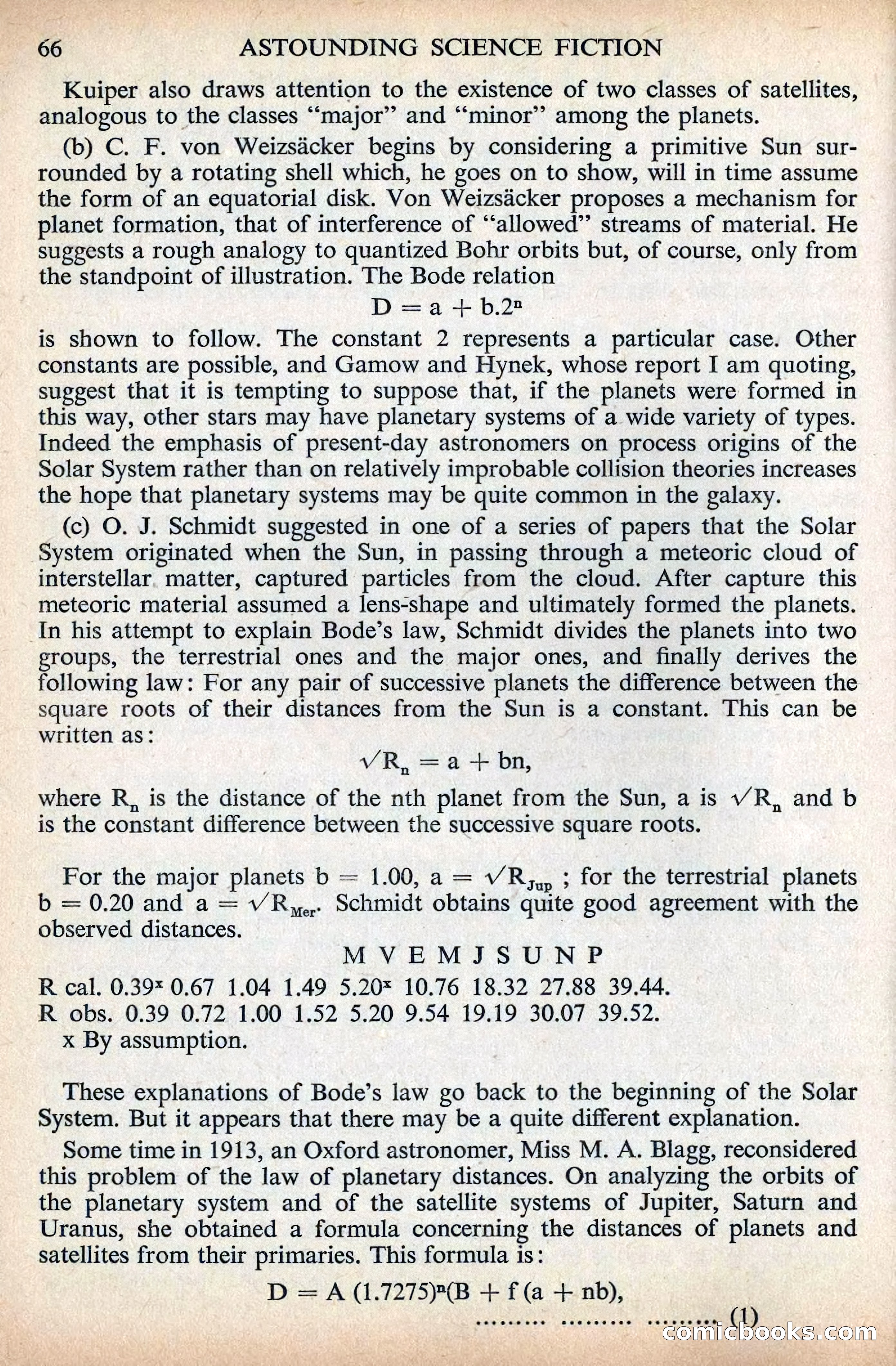
66 ASTOUNDING SCIENCE FICTION Kuiper also draws attention to the existence of two classes of satellites, analogous to the classes “major” and “minor”? among the planets. (b) C. F. von Weizsadcker begins by considering a primitive Sun sur- rounded by a rotating shell which, he goes on to show, will in time assume the form of an equatorial disk. Von Weizsacker proposes a mechanism for planet formation, that of interference of “‘allowed’’ streams of material. He suggests a rough analogy to quantized Bohr orbits but, of course, only from the standpoint of illustration. The Bode relation D=a + b.22 is shown to follow. The constant 2 represents a particular case. Other constants are possible, and Gamow and Hynek, whose report I am quoting, suggest that it is tempting to suppose that, if the planets were formed in this way, other stars may have planetary systems of a wide variety of types. Indeed the emphasis of present-day astronomers on process origins of the Solar System rather than on relatively improbable collision theories increases the hope that planetary systems may be quite common in the galaxy. (c) O. J. Schmidt suggested in one of a series of papers that the Solar System originated when the Sun, in passing through a meteoric cloud of interstellar. matter, captured particles from the cloud. After capture this meteoric material assumed a lens-shape and ultimately formed the planets. In his attempt to explain Bode’s law, Schmidt divides the planets into two groups, the terrestrial ones and the major ones, and finally derives the following law: For any pair of successive planets the difference between the square roots of their distances from the Sun is a constant. This can be written as: VR, =a -+ bn, where R,, is the distance of the nth planet from the Sun, a is VR, and b is the constant difference between the successive square roots. For the major planets b = 1.00, a = VR,,, ; for the terrestrial planets b = 0.20 and a = VR,,,,. Schmidt obtains quite good agreement with the observed distances. : MVEMJSUNP R cal. 0.39* 0.67 1.04 1.49 5.20* 10.76 18.32 27.88 39.44. R obs. 0.39 0.72 1.00 1.52 5.20 9.54 19.19 30.07 39.52. x By assumption. These explanations of Bode’s law go back to the beginning of the Solar System. But it appears that there may be a quite different explanation. Some time in 1913, an Oxford astronomer, Miss M. A. Blagg, reconsidered this problem of the law of planetary distances. On analyzing the orbits of the planetary system and of the satellite systems of Jupiter, Saturn and Uranus, she obtained a formula concerning the distances of planets and satellites from their primaries. This formula is: D = A (1.7275)%B + f (a + nb), fab egies a a's ie i Seomicbooks con |