
Pulp Fiction, 1955 · page 69 of 133
Astounding Science Fiction, British Edition, December 1955 — page 69: what you’re looking at
A restored page from Pulp Fiction, 1955. Page through the whole issue in the reader above.
📄 Transcribed text from this page (OCR, searchable)
Machine-transcribed from the original scan — historical spelling and the odd misread are preserved.
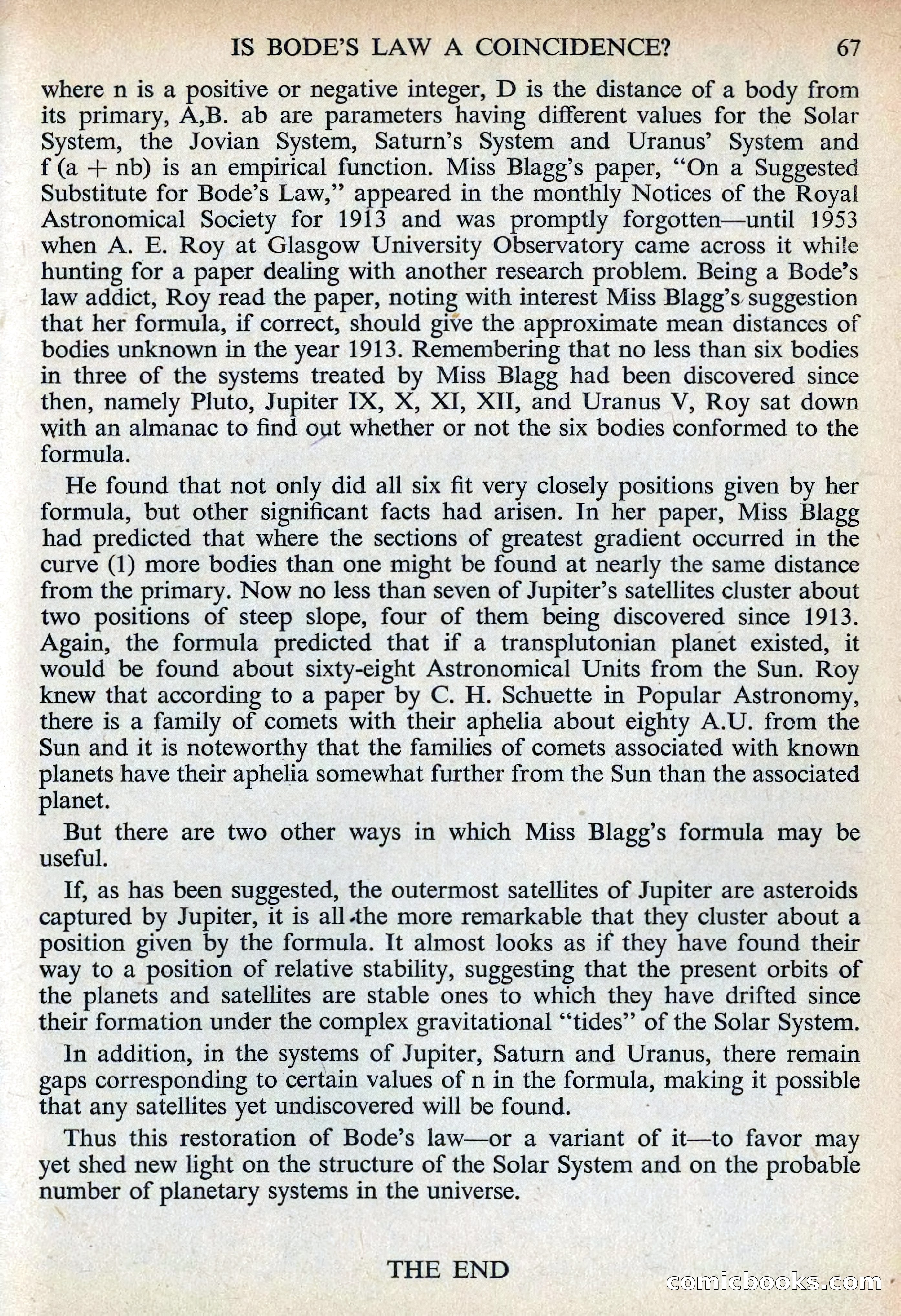
IS BODE’S LAW A COINCIDENCE? 67 where n is a positive or negative integer, D is the distance of a body from its primary, A,B. ab are parameters having different values for the Solar System, the Jovian System, Saturn’s System and Uranus’ System and f(a + nb) is an empirical function. Miss Blagg’s paper, “On a Suggested Substitute for Bode’s Law,” appeared in the monthly Notices of the Royal Astronomical Society for 1913 and was promptly forgotten—until 1953 when A. E. Roy at Glasgow University Observatory came across it while hunting for a paper dealing with another research problem. Being a Bode’s law addict, Roy read the paper, noting with interest Miss Blagg’s suggestion that her formula, if correct, should give the approximate mean distances of bodies unknown in the year 1913. Remembering that no less than six bodies in three of the systems treated by Miss Blagg had been discovered since then, namely Pluto, Jupiter IX, X, XI, XII, and Uranus V, Roy sat down with an almanac to find out whether or not the six bodies conformed to the formula. He found that not only did all six fit very closely positions given by her formula, but other significant facts had arisen. In her paper, Miss Blagg had predicted that where the sections of greatest gradient occurred in the curve (1) more bodies than one might be found at nearly the same distance from the primary. Now no less than seven of Jupiter’s satellites cluster about two positions of steep slope, four of them being discovered since 1913. Again, the formula predicted that if a transplutonian planet existed, it would be found about sixty-eight Astronomical Units from the Sun. Roy knew that according to a paper by C. H. Schuette in Popular Astronomy, there is a family of comets with their aphelia about eighty A.U. from the Sun and it is noteworthy that the families of comets associated with known planets have their aphelia somewhat further from the Sun than the associated planet. But there are two other ways in which Miss Blagg’s formula may be useful. If, as has been suggested, the outermost satellites of Jupiter are asteroids captured by Jupiter, it is all-the more remarkable that they cluster about a position given by the formula. It almost looks as if they have found their way to a position of relative stability, suggesting that the present orbits of the planets and satellites are stable ones to which they have drifted since their formation under the complex gravitational “tides” of the Solar System. In addition, in the systems of Jupiter, Saturn and Uranus, there remain gaps corresponding to certain values of n in the formula, making it possible that any satellites yet undiscovered will be found. Thus this restoration of Bode’s law—or a variant of it—to favor may yet shed new light on the structure of the Solar System and on the probable number of planetary systems in the universe. THE END Conmmicbooks.com °