
Pulp Fiction, 1955 · page 67 of 133
Astounding Science Fiction, British Edition, December 1955 — page 67: what you’re looking at
A restored page from Pulp Fiction, 1955. Page through the whole issue in the reader above.
📄 Transcribed text from this page (OCR, searchable)
Machine-transcribed from the original scan — historical spelling and the odd misread are preserved.
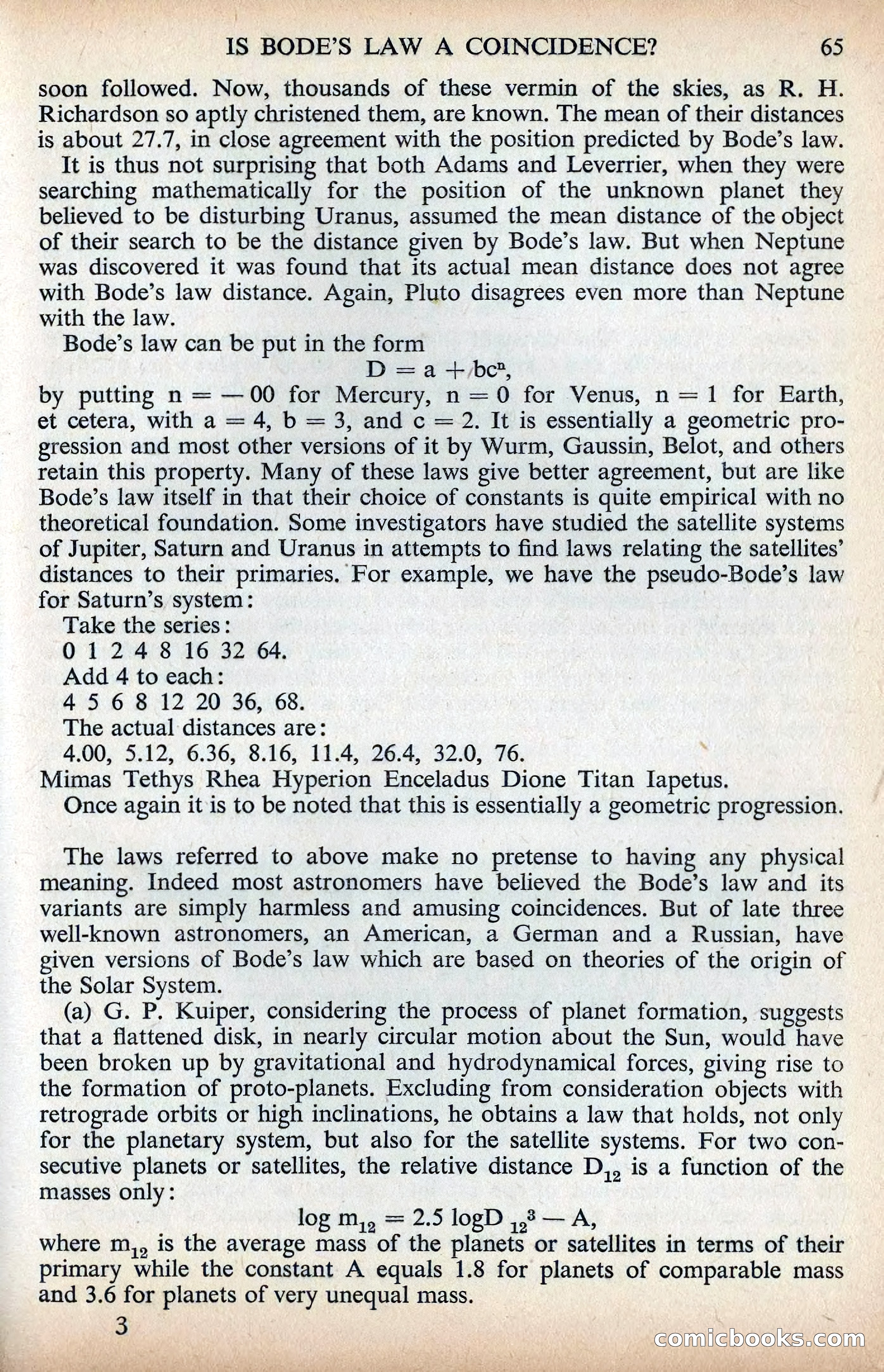
IS BODE’S LAW A COINCIDENCE? 65 soon followed. Now, thousands of these vermin of the skies, as R. H. Richardson so aptly christened them, are known. The mean of their distances is about 27.7, in close agreement with the position predicted by Bode’s law. It is thus not surprising that both Adams and Leverrier, when they were searching mathematically for the position of the unknown planet they believed to be disturbing Uranus, assumed the mean distance of the object of their search to be the distance given by Bode’s law. But when Neptune was discovered it was found that its actual mean distance does not agree with Bode’s law distance. Again, Pluto disagrees even more than Neptune with the law. Bode’s law can be put in the form D=a-+ bc, by putting n = — 00 for Mercury, n=0 for Venus, n = 1 for Earth, et cetera, with a = 4, b = 3, and c = 2. It is essentially a geometric pro- gression and most other versions of it by Wurm, Gaussin, Belot, and others retain this property. Many of these laws give better agreement, but are like Bode’s law itself in that their choice of constants is quite empirical with no theoretical foundation. Some investigators have studied the satellite systems of Jupiter, Saturn and Uranus in attempts to find laws relating the satellites’ distances to their primaries. For example, we have the pseudo-Bode’s law for Saturn’s system: Take the series: 0124 8 16 32 64, Add 4 to each: 45 6 8 12 20 36, 68. The actual distances are: 4.00, 5.12, 6.36, 8.16, 11.4, 26.4, 32.0, 76. Mimas Tethys Rhea Hyperion Enceladus Dione Titan Iapetus. Once again it is to be noted that this is essentially a geometric progression. The laws referred to above make no pretense to having any physical meaning. Indeed most astronomers have believed the Bode’s law and its variants are simply harmless and amusing coincidences. But of late three well-known astronomers, an American, a German and a Russian, have given versions of Bode’s law which are based on theories of the origin of the Solar System. (a) G. P. Kuiper, considering the process of planet formation, suggests that a flattened disk, in nearly circular motion about the Sun, would have been broken up by gravitational and hydrodynamical forces, giving rise to the formation of proto-planets. Excluding from consideration objects with retrograde orbits or high inclinations, he obtains a law that holds, not only for the planetary system, but also for the satellite systems. For two con- secutive planets or satellites, the relative distance D,, is a function of the masses only: log m,, = 2.5 logD ,,.2 — A, where m,, is the average mass of the planets or satellites in terms of their primary while the constant A equals 1.8 for planets of comparable mass and 3.6 for planets of very unequal mass. 3 Comicbooks;com