
Pulp Fiction, 1955 · page 66 of 133
Astounding Science Fiction, British Edition, December 1955 — page 66: what you’re looking at
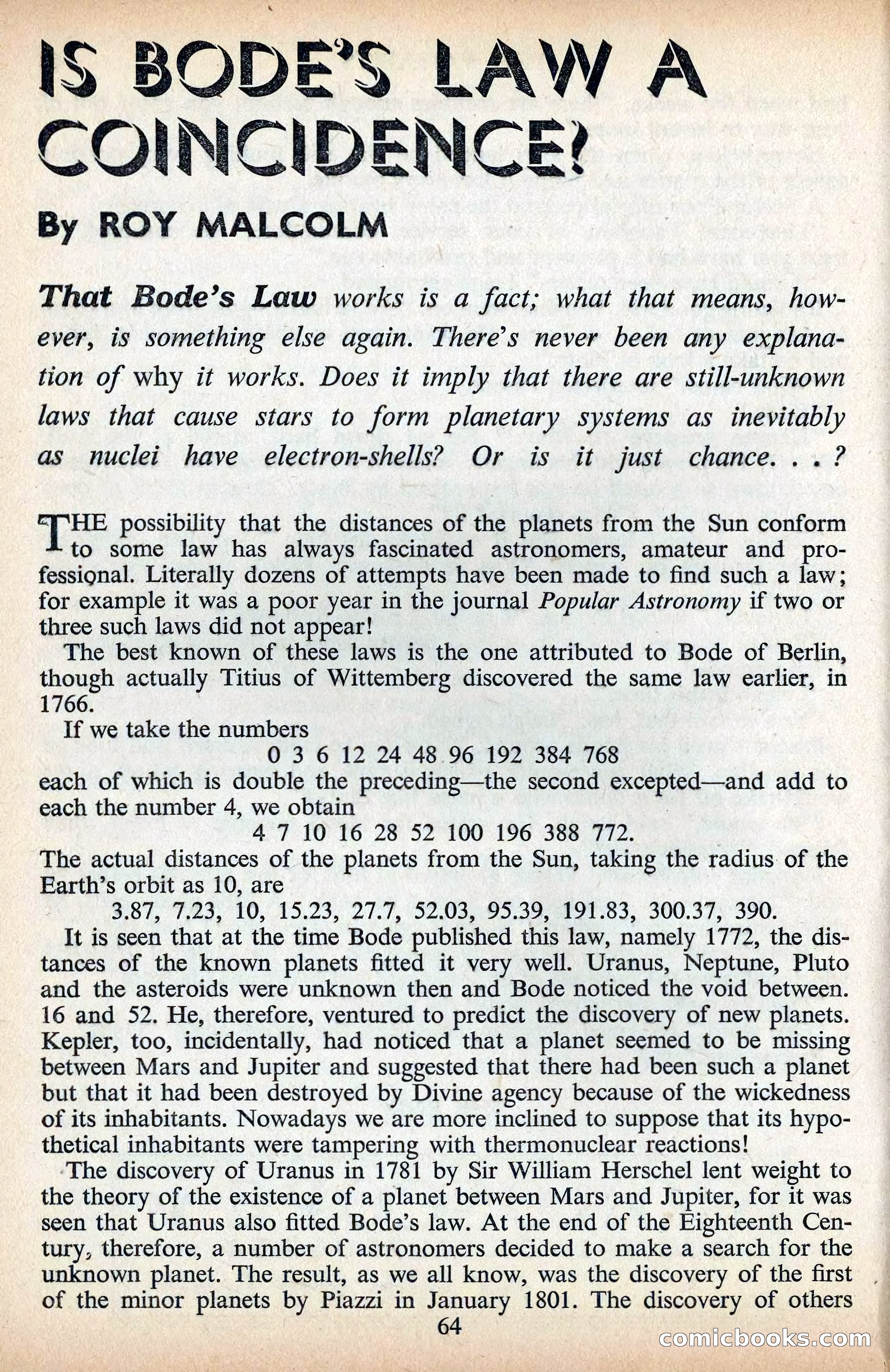
A restored page from Pulp Fiction, 1955. Page through the whole issue in the reader above.
📄 Transcribed text from this page (OCR, searchable)
Machine-transcribed from the original scan — historical spelling and the odd misread are preserved.
ad BODe’s L mary A By ROY MALCOLM That Bode’s Law works is a fact; what that means, how- ever, is something else again. There’s never been any explana- tion of why it works. Does it imply that there are still-unknown laws that cause stars to form planetary systems as inevitably as nuclei have electron-shells? Or is it just chance... ? oe possibility that the distances of the planets from the Sun conform to some law has always fascinated astronomers, amateur and pro- fessional. Literally dozens of attempts have been made to find such a law; for example it was a poor year in the journal Popular Astronomy if two or three such laws did not appear! The best known of these laws is the one attributed to Bode of Berlin, though actually Titius of Wittemberg discovered the same law earlier, in 1766. If we take the numbers 0 3 6 12 24 48 96 192 384 768 each of which is double the preceding—the second cane aii add to each the number 4, we obtain 4 7 10 16 28 52 100 196 388 772. The actual distances of the planets from the Sun, taking the radius of the Earth’s orbit as 10, are 3.87, ied, 10,195.25, 27.7, 52.03, 95,39 2191.03, 300.37; 390. It is seen that at the time Bode published this law, namely 1772, the dis- tances of the known planets fitted it very well. Uranus, Neptune, Pluto and the asteroids were unknown then and Bode noticed the void between. 16 and 52. He, therefore, ventured to predict the discovery of new planets. Kepler, too, incidentally, had noticed that a planet seemed to be missing between Mars and Jupiter and suggested that there had been such a planet but that it had been destroyed by Divine agency because of the wickedness of its inhabitants. Nowadays we are more inclined to suppose that its hypo- thetical inhabitants were tampering with thermonuclear reactions! ‘The discovery of Uranus in 1781 by Sir William Herschel lent weight to the theory of the existence of a planet between Mars and Jupiter, for it was seen that Uranus also fitted Bode’s law. At the end of the Eighteenth Cen- tury, therefore, a number of astronomers decided to make a search for the unknown planet. The result, as we all know, was the discovery of the first of the minor planets by Piazzi in January 1801. The discovery of others 64 Commicoooks. conn