
Pulp Fiction, 1955 · page 126 of 133
Astounding Science Fiction, British Edition, December 1955 — page 126: what you’re looking at
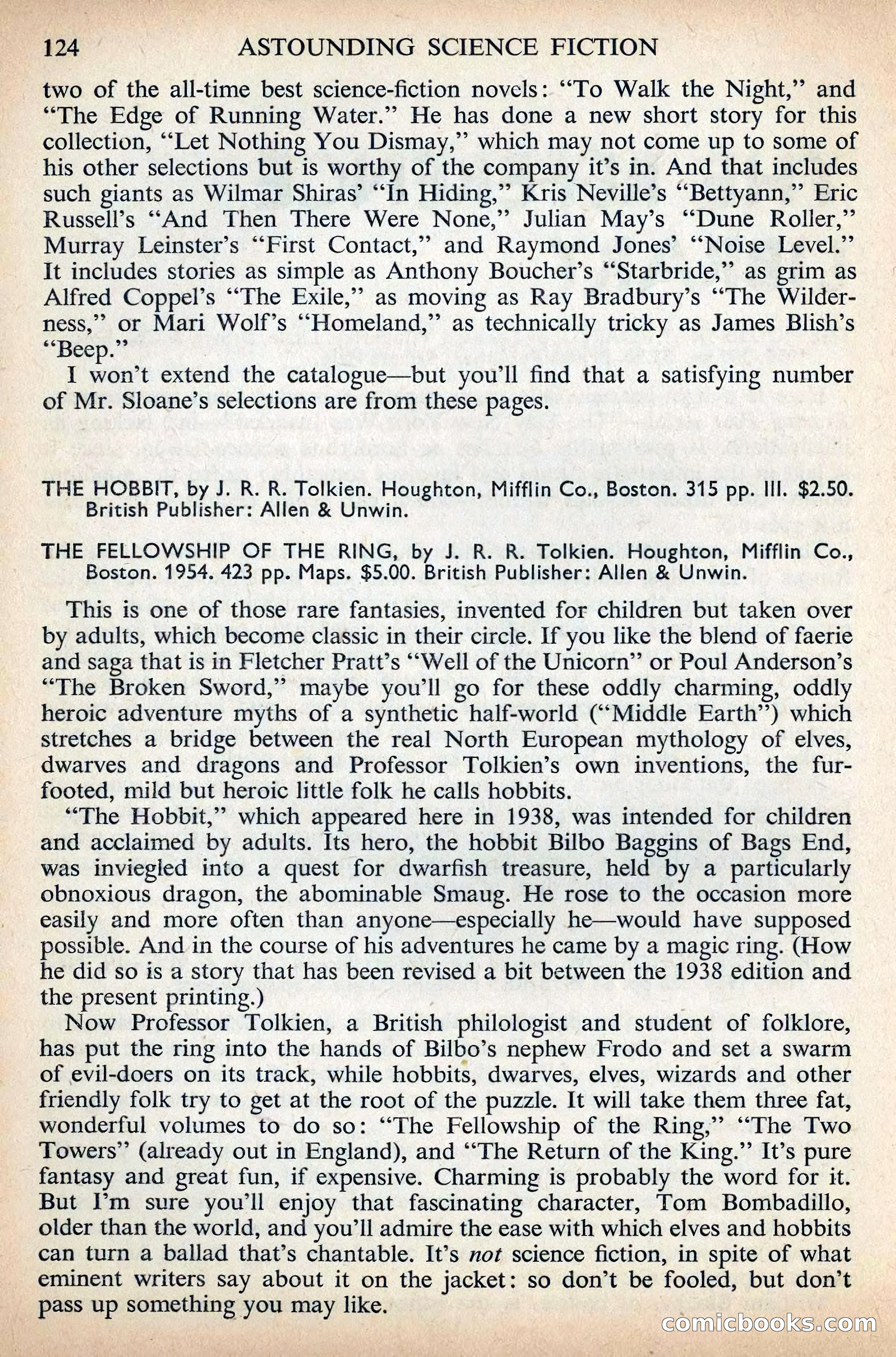
A restored page from Pulp Fiction, 1955. Page through the whole issue in the reader above.
📄 Transcribed text from this page (OCR, searchable)
Machine-transcribed from the original scan — historical spelling and the odd misread are preserved.
124 ASTOUNDING SCIENCE FICTION two of the all-time best science-fiction novels: ‘““To Walk the Night,” and “The Edge of Running Water.” He has done a new short story for this collection, ““Let Nothing You Dismay,’’ which may not come up to some of his other selections but is worthy of the company it’s in. And that includes such giants as Wilmar Shiras’ “In Hiding,” Kris Neville’s ““Bettyann,” Eric Russell’s “And Then There Were None,” Julian May’s “Dune Roller,” Murray Leinster’s “First Contact,” and Raymond Jones’ “Noise Level.” It includes stories as simple as Anthony Boucher’s “Starbride,”’ as grim as Alfred Coppel’s ““The Exile,” as moving as Ray Bradbury’s “The Wilder- ness,” or Mari Wolf’s “Homeland,” as technically tricky as James Blish’s “Beep.” I won’t extend the catalogue—but you'll find that a satisfying number of Mr. Sloane’s selections are from these pages. THE HOBBIT, by J. R. R. Tolkien. Houghton, Mifflin Co., Boston. 315 pp. Ill. $2.50. British Publisher: Allen & Unwin. THE FELLOWSHIP OF THE RING, by J. R. R. Tolkien. Houghton, Mifflin Co., Boston. 1954. 423 pp. Maps. $5.00. British Publisher: Allen & Unwin. This is one of those rare fantasies, invented for children but taken over by adults, which become classic in their circle. If you like the blend of faerie and saga that is in Fletcher Pratt’s ““Well of the Unicorn” or Poul Anderson’s “The Broken Sword,” maybe you'll go for these oddly charming, oddly heroic adventure myths of a synthetic half-world (“Middle Earth’) which stretches a bridge between the real North European mythology of elves, dwarves and dragons and Professor Tolkien’s own inventions, the fur- footed, mild but heroic little folk he calls hobbits. “The Hobbit,” which appeared here in 1938, was intended for children and acclaimed by adults. Its hero, the hobbit Bilbo Baggins of Bags End, was inviegied into a quest for dwarfish treasure, held by a particularly obnoxious dragon, the abominable Smaug. He rose to the occasion more easily and more often than anyone—especially he—would have supposed possible. And in the course of his adventures he came by a magic ring. (How he did so is a story that has been revised a bit between the 1938 edition and the present printing.) Now Professor Tolkien, a British philologist and student of folklore, has put the ring into the hands of Bilbo’s nephew Frodo and set a swarm of evil-doers on its track, while hobbits, dwarves, elves, wizards and other friendly folk try to get at the root of the puzzle. It will take them three fat, wonderful volumes to do so: “The Fellowship of the Ring,” “The Two Towers” (already out in England), and ““The Return of the King.”’ It’s pure fantasy and great fun, if expensive. Charming is probably the word for it. But I’m sure you'll enjoy that fascinating character, Tom Bombadillo, older than the world, and you’ll admire the ease with which elves and hobbits can turn a ballad that’s chantable. It’s not science fiction, in spite of what eminent writers say about it on the jacket: so don’t be fooled, but don’t ass up something you may like. P P : ey 7 COMME DOOKS.COM