
Pulp Fiction, 1955 · page 127 of 133
Astounding Science Fiction, British Edition, December 1955 — page 127: what you’re looking at
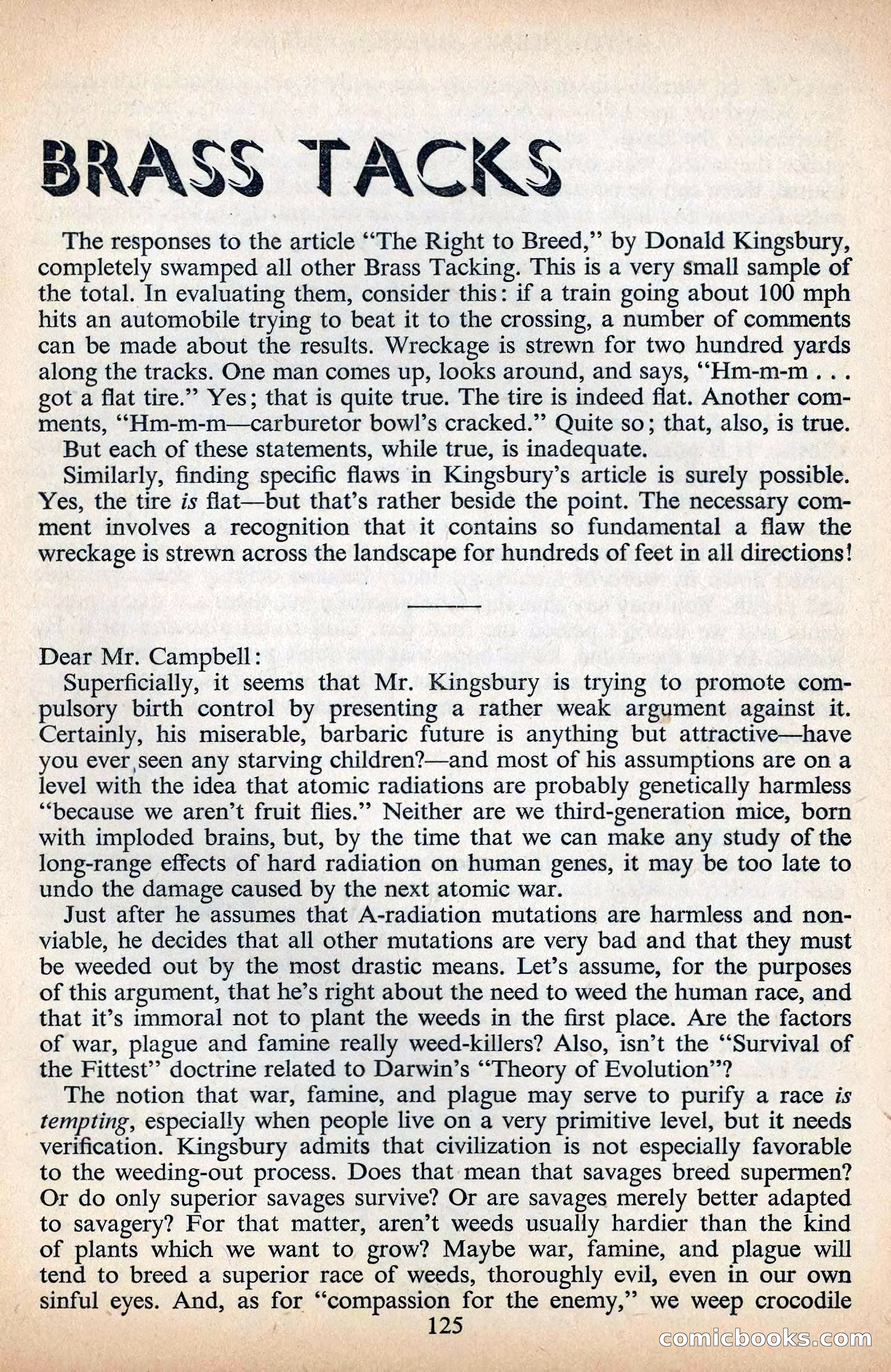
A restored page from Pulp Fiction, 1955. Page through the whole issue in the reader above.
📄 Transcribed text from this page (OCR, searchable)
Machine-transcribed from the original scan — historical spelling and the odd misread are preserved.
BRASS TACKS The responses to the article “The Right to Breed,”’ by Donald Kingsbury, completely swamped all other Brass Tacking. This is a very small sample of the total. In evaluating them, consider this: if a train going about 100 mph hits an automobile trying to beat it to the crossing, a number of comments can be made about the results. Wreckage is strewn for two hundred yards along the tracks. One man comes up, looks around, and says, ““Hm-m-m... got a flat tire.” Yes; that is quite true. The tire is indeed flat. Another com- ments, ‘‘Hm-m-m—carburetor bowl’s cracked.’’ Quite so; that, also, is true. But each of these statements, while true, is inadequate. Similarly, finding specific flaws in Kingsbury’s article is surely possible. Yes, the tire is flat—but that’s rather beside the point. The necessary com- ment involves a recognition that it contains so fundamental a flaw the wreckage is strewn across the landscape for hundreds of feet in all directions! — Dear Mr. Campbell : Superficially, it seems that Mr. Kingsbury is trying to promote com- pulsory birth control by presenting a rather weak argument against it. Certainly, his miserable, barbaric future is anything but attractive—have you ever seen any starving children?—and most of his assumptions are on a level with the idea that atomic radiations are probably genetically harmless “because we aren’t fruit flies.” Neither are we third-generation mice, born with imploded brains, but, by the time that we can make any study of the long-range effects of hard radiation on human genes, it may be too late to undo the damage caused by the next atomic war. Just after he assumes that A-radiation mutations are harmless and non- viable, he decides that all other mutations are very bad and that they must be weeded out by the most drastic means. Let’s assume, for the purposes of this argument, that he’s right about the need to weed the human race, and that it’s immoral not to plant the weeds in the first place. Are the factors of war, plague and famine really weed-killers? Also, isn’t the “Survival of the Fittest”? doctrine related to Darwin’s “Theory of Evolution”? The notion that war, famine, and plague may serve to purify a race is tempting, especially when people live on a very primitive level, but it needs verification. Kingsbury admits that civilization is not especially favorable to the weeding-out process. Does that mean that savages breed supermen? Or do only superior savages survive? Or are savages merely better adapted. to savagery? For that matter, aren’t weeds usually hardier than the kind of plants which we want to grow? Maybe war, famine, and plague will tend to breed a superior race of weeds, thoroughly evil, even in our own sinful eyes. And, as for “compassion for the enemy,’’ we weep crocodile 125 ConmiclooOoks. conn