
Pulp Fiction, 1955 · page 125 of 133
Astounding Science Fiction, British Edition, December 1955 — page 125: what you’re looking at
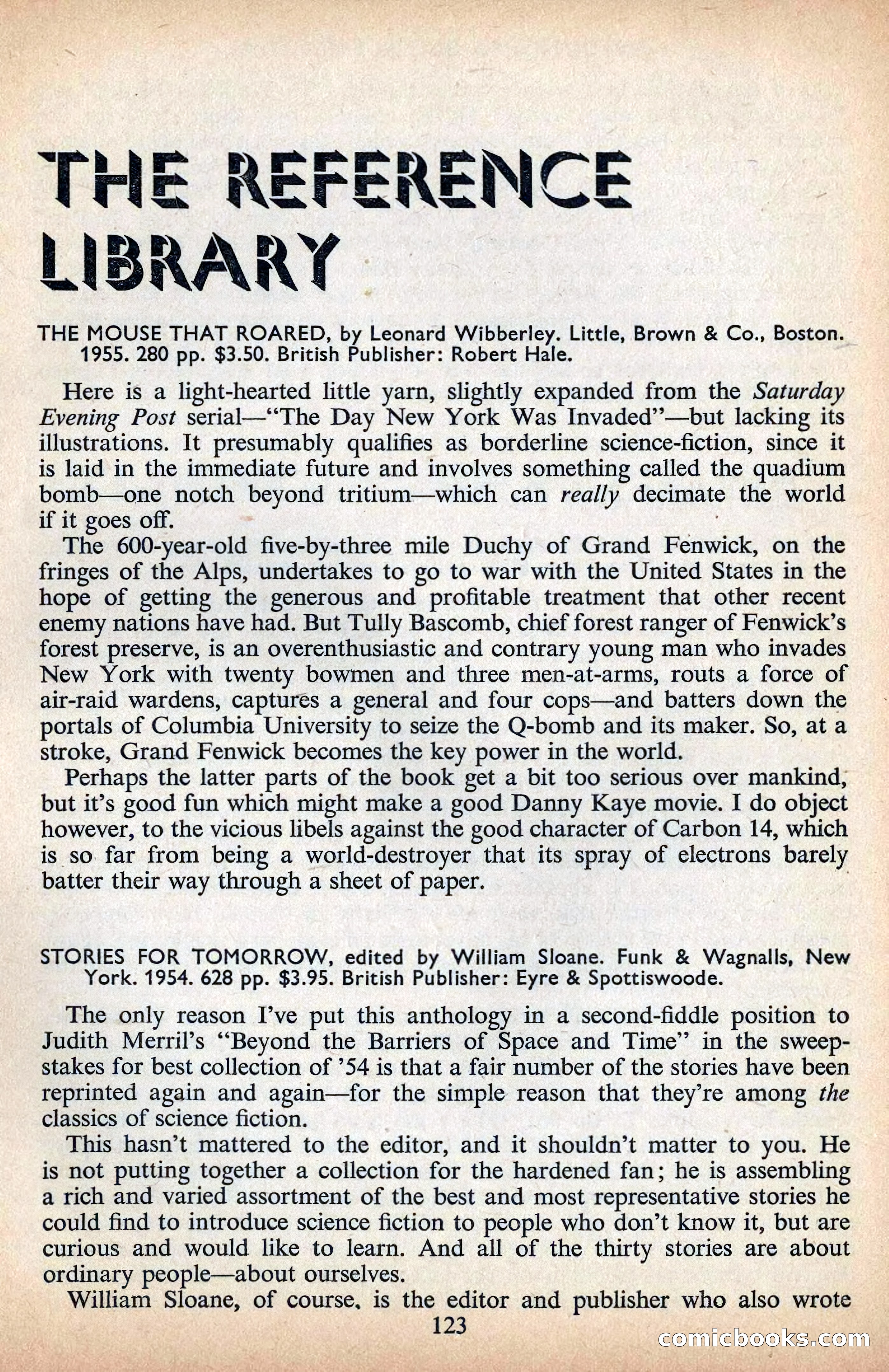
A restored page from Pulp Fiction, 1955. Page through the whole issue in the reader above.
📄 Transcribed text from this page (OCR, searchable)
Machine-transcribed from the original scan — historical spelling and the odd misread are preserved.
THe REFERENCE LIBRARY THE MOUSE THAT ROARED, by Leonard Wibberley. Little, Brown & Co., Boston. 1955. 280 pp. $3.50. British Publisher: Robert Hale. Here is a light-hearted little yarn, slightly expanded from the Saturday Evening Post serial—“The Day New York Was Invaded’”’—but lacking its illustrations. It presumably qualifies as borderline science-fiction, since it is laid in the immediate future and involves something called the quadium bomb—one notch beyond tritium—which can really decimate the world if it goes off. The 600-year-old five-by-three mile Duchy of Grand Fenwick, on the fringes of the Alps, undertakes to go to war with the United States in the hope of getting the generous and profitable treatment that other recent enemy nations have had. But Tully Bascomb, chief forest ranger of Fenwick’s forest preserve, is an overenthusiastic and contrary young man who invades New York with twenty bowmen and three men-at-arms, routs a force of air-raid wardens, captures a general and four cops—and batters down the portals of Columbia University to seize the Q-bomb and its maker. So, at a stroke, Grand Fenwick becomes the key power in the world. Perhaps the latter parts of the book get a bit too serious over mankind, but it’s good fun which might make a good Danny Kaye movie. I do object however, to the vicious libels against the good character of Carbon 14, which is so far from being a world-destroyer that its spray of electrons barely batter their way through a sheet of paper. STORIES FOR TOMORROW, edited by William Sloane. Funk & Wagnalls, New York. 1954. 628 pp. $3.95. British Publisher: Eyre & Spottiswoode. The only reason I’ve put this anthology in a second-fiddle position to Judith Merril’s “Beyond the Barriers of Space and Time” in the sweep- stakes for best collection of ’54 is that a fair number of the stories have been reprinted again and again—for the simple reason that they’re among the classics of science fiction. This hasn’t mattered to the editor, and it shouldn’t matter to you. He is not putting together a collection for the hardened fan; he is assembling a rich and varied assortment of the best and most representative stories he could find to introduce science fiction to people who don’t know it, but are curious and would like to learn. And all of the thirty stories are about ordinary people—about ourselves. William Sloane, of course, is the editor and publisher who also wrote 123 Comicbooks com