
Pulp Fiction, 1955 · page 102 of 133
Astounding Science Fiction, British Edition, December 1955 — page 102: what you’re looking at
A restored page from Pulp Fiction, 1955. Page through the whole issue in the reader above.
📄 Transcribed text from this page (OCR, searchable)
Machine-transcribed from the original scan — historical spelling and the odd misread are preserved.
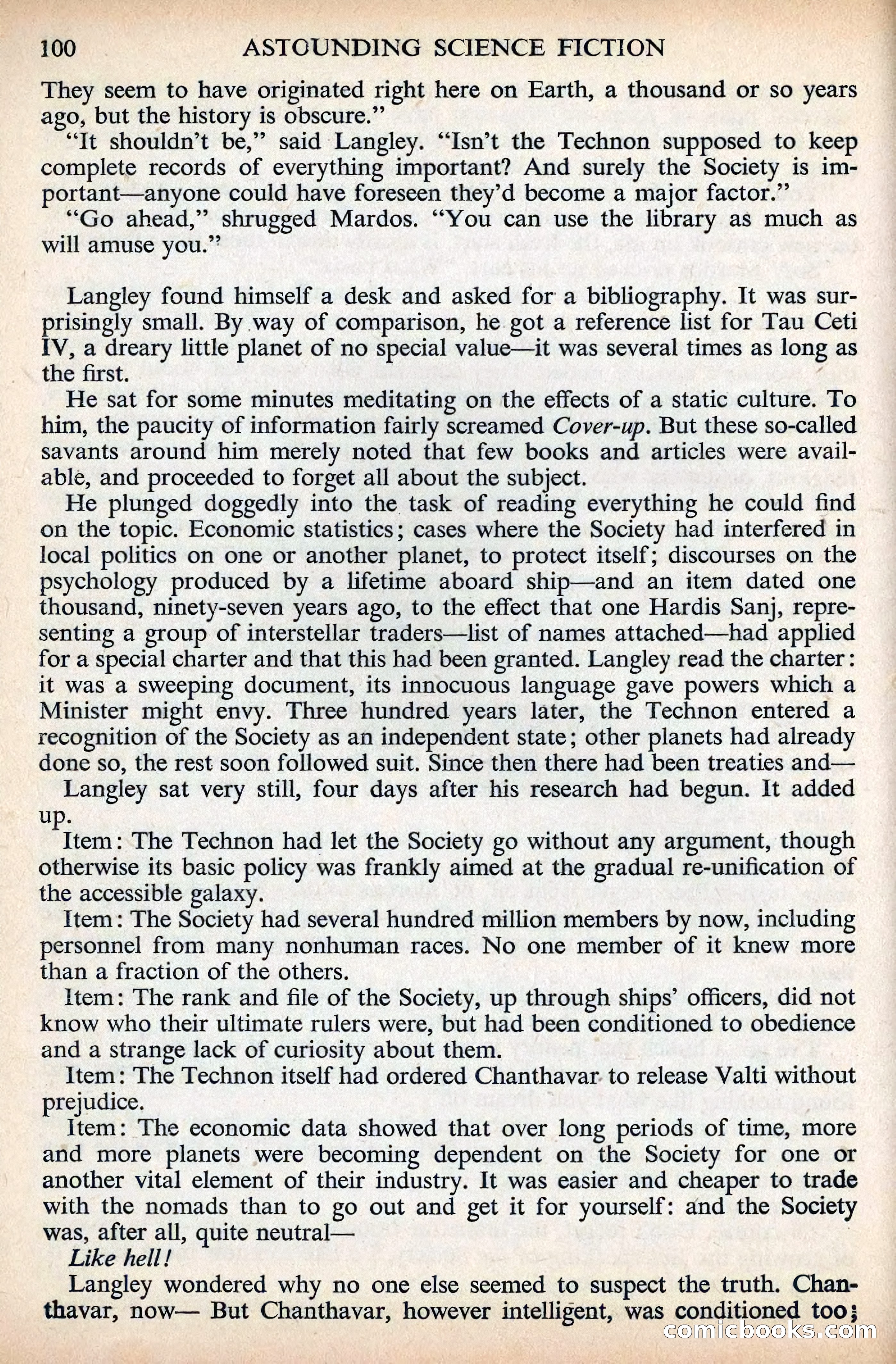
100 ASTOUNDING SCIENCE FICTION They seem to have originated right here on Earth, a thousand or so years ago, but the history is obscure.” “It shouldn’t be,” said Langley. “Isn’t the Technon supposed to keep complete records of everything important? And surely the Society is im- portant—anyone could have foreseen they’d become a major factor.” “Go ahead,” shrugged Mardos. “You can use the library as much as will amuse you.” Langley found himself a desk and asked for a bibliography. It was sur- prisingly small. By way of comparison, he got a reference list for Tau Ceti IV, a dreary little planet of no special value—it was several times as long as the first. He sat for some minutes meditating on the effects of a static culture. To him, the paucity of information fairly screamed Cover-up. But these so-called savants around him merely noted that few books and articles were avail- able, and proceeded to forget all about the subject. He plunged doggedly into the task of reading everything he could find on the topic. Economic statistics; cases where the Society had interfered in local politics on one or another planet, to protect itself; discourses on the psychology produced by a lifetime aboard ship—and an item dated one thousand, ninety-seven years ago, to the effect that one Hardis Sanj, repre- senting a group of interstellar traders—list of names attached—had applied for a special charter and that this had been granted. Langley read the charter: it was a sweeping document, its innocuous language gave powers which a Minister might envy. Three hundred years later, the Technon entered a recognition of the Society as an independent state; other planets had already done so, the rest soon followed suit. Since then there had been treaties and— Langley sat very still, four days after his research had begun. It added up. re The Technon had let the Society go without any argument, though otherwise its basic policy was frankly aimed at the gradual re-unification of the accessible galaxy. Item: The Society had several hundred million members by now, including personnel from many nonhuman races. No one member of it knew more than a fraction of the others. Item: The rank and file of the Society, up through ships’ officers, did not know who their ultimate rulers were, but had been conditioned to obedience and a strange lack of curiosity about them. Item: The Technon itself had ordered Chanthavar to release Valti without prejudice. Item: The economic data showed that over long periods of time, more and more planets were becoming dependent on the Society for one or another vital element of their industry. It was easier and cheaper to trade with the nomads than to go out and get it for yourself: and the Society was, after all, quite neutral— | Like hell! Langley wondered why no one else seemed to suspect the truth. Chan- thavar, now— But Chanthavar, however intelligent, was conditioned too; CONNIE DOOXS.GOLM