
Pulp Fiction, 1955 · page 103 of 133
Astounding Science Fiction, British Edition, December 1955 — page 103: what you’re looking at
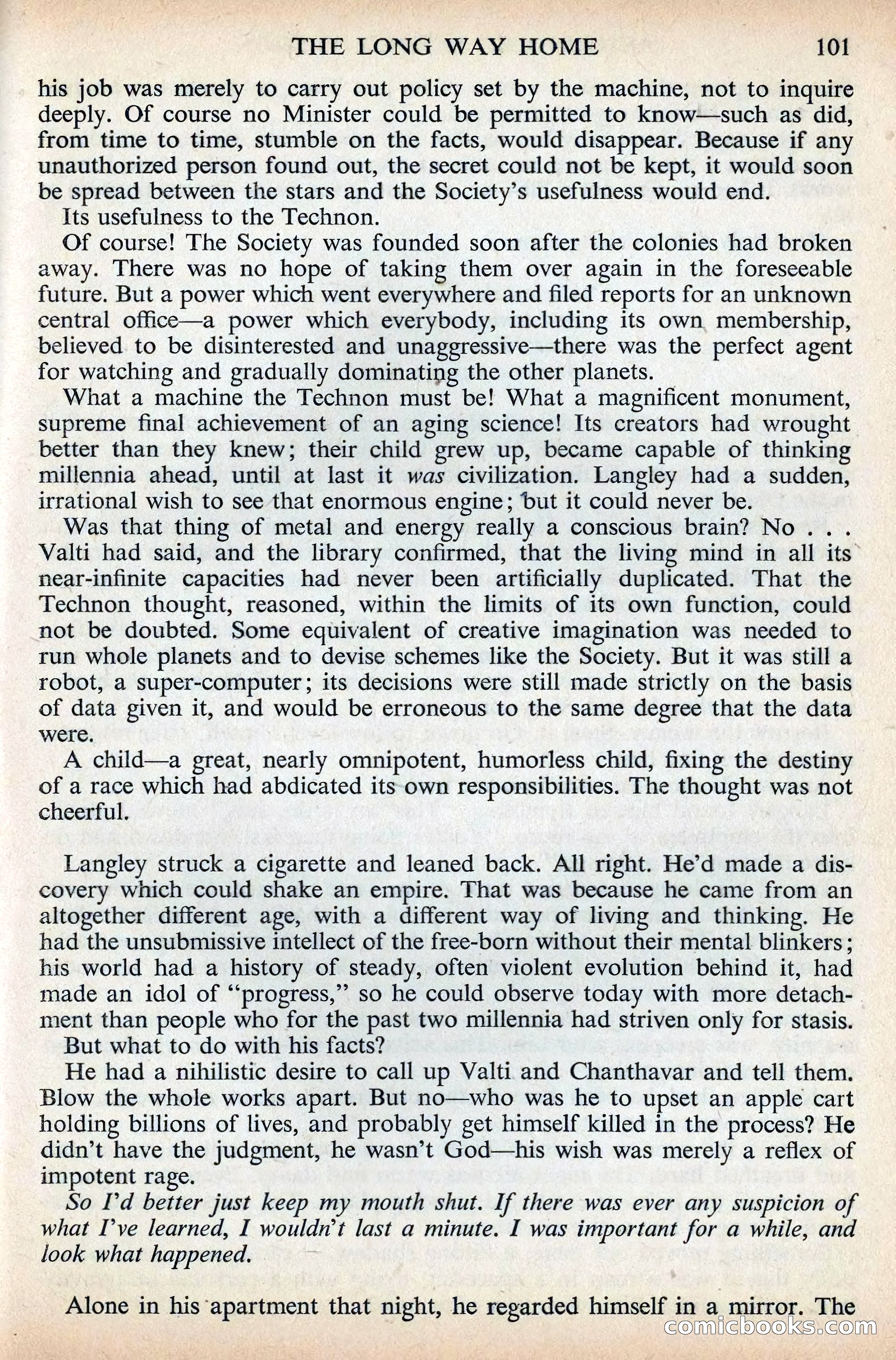
A restored page from Pulp Fiction, 1955. Page through the whole issue in the reader above.
📄 Transcribed text from this page (OCR, searchable)
Machine-transcribed from the original scan — historical spelling and the odd misread are preserved.
THE LONG WAY HOME 101 his job was merely to carry out policy set by the machine, not to inquire deeply. Of course no Minister could be permitted to know—such as did, from time to time, stumble on the facts, would disappear. Because if any unauthorized person found out, the secret could not be kept, it would soon be spread between the stars and the Society’s usefulness would end. Its usefulness to the Technon. Of course! The Society was founded soon after the colonies had broken away. There was no hope of taking them over again in the foreseeable future. But a power which went everywhere and filed reports for an unknown central office—a power which everybody, including its own membership, believed to be disinterested and unaggressive—there was the perfect agent for watching and gradually dominating the other planets. What a machine the Technon must be! What a magnificent monument, supreme final achievement of an aging science! Its creators had wrought better than they knew; their child grew up, became capable of thinking millennia ahead, until at last it was civilization. Langley had a sudden, irrational wish to see that enormous engine; but it could never be. Was that thing of metal and energy really a conscious brain? No... Valti had said, and the library confirmed, that the living mind in all its near-infinite capacities had never been artificially duplicated. That the Technon thought, reasoned, within the limits of its own function, could not be doubted. Some equivalent of creative imagination was needed to run whole planets and to devise schemes like the Society. But it was still a robot, a super-computer; its decisions were still made strictly on the basis of data given it, and would be erroneous to the same degree that the data were. A child—a great, nearly omnipotent, humorless child, fixing the destiny of a race which had abdicated its own responsibilities. The thought was not cheerful. Langley struck a cigarette and leaned back. All right. He’d made a dis- covery which could shake an empire. That was because he came from an altogether different age, with a different way of living and thinking. He had the unsubmissive intellect of the free-born without their mental blinkers; his world had a history of steady, often violent evolution behind it, had made an idol of “‘progress,” so he could observe today with more detach- ment than people who for the past two millennia had striven only for stasis. But what to do with his facts? He had a nihilistic desire to call up Valti and Chanthavar and tell them. Blow the whole works apart. But no—who was he to upset an apple cart holding billions of lives, and probably get himself killed in the process? He didn’t have the judgment, he wasn’t God—his wish was merely a reflex of impotent rage. So I'd better just keep my mouth shut. If there was ever any suspicion of what I’ve learned, I wouldn’t last a minute. I was important for a while, and look. what happened. Alone in his ‘apartment that night, he regarded himself in a mirror. The COME OOOKS, COM