
Pulp Fiction, 1955 · page 101 of 133
Astounding Science Fiction, British Edition, December 1955 — page 101: what you’re looking at
A restored page from Pulp Fiction, 1955. Page through the whole issue in the reader above.
📄 Transcribed text from this page (OCR, searchable)
Machine-transcribed from the original scan — historical spelling and the odd misread are preserved.
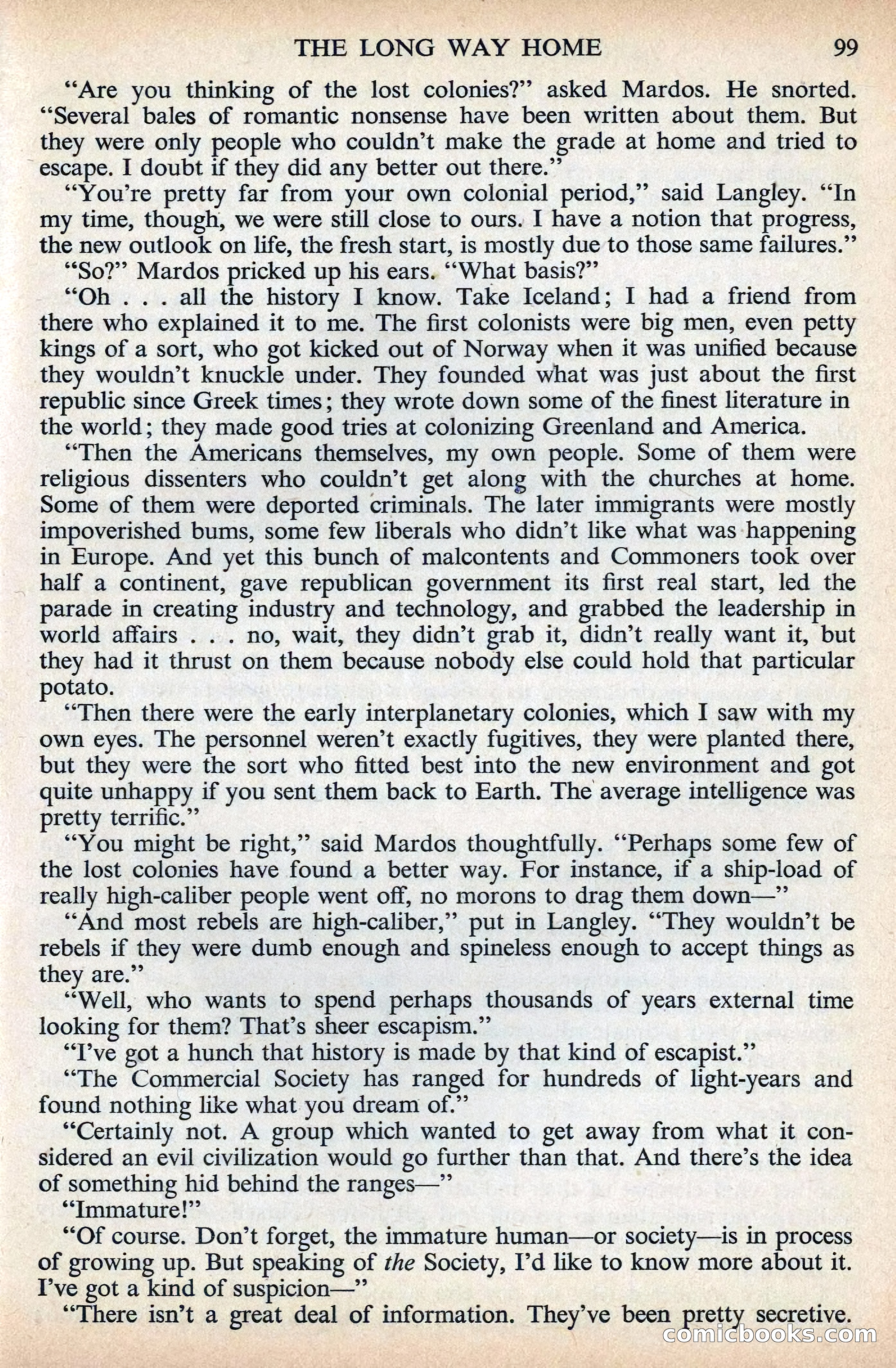
THE LONG WAY HOME 99 “Are you thinking of the lost colonies?” asked Mardos. He snorted. “Several bales of romantic nonsense have been written about them. But they were only people who couldn’t make the grade at home and tried to escape. I doubt if they did any better out there.” “You’re pretty far from your own colonial period,” said Langley. “In my time, though, we were still close to ours. I have a notion that progress, the new outlook on life, the fresh start, is mostly due to those same failures.”’ “So?” Mardos pricked up his ears. ““What basis?” “Oh ... all the history I know. Take Iceland; I had a friend from there who explained it to me. The first colonists were big men, even petty kings of a sort, who got kicked out of Norway when it was unified because they wouldn’t knuckle under. They founded what was just about the first republic since Greek times; they wrote down some of the finest literature in the world; they made good tries at colonizing Greenland and America. “Then the Americans themselves, my own people. Some of them were religious dissenters who couldn’t get along with the churches at home. Some of them were deported criminals. The later immigrants were mostly impoverished bums, some few liberals who didn’t like what was happening in Europe. And yet this bunch of malcontents and Commoners took over half a continent, gave republican government its first real start, led the parade in creating industry and technology, and grabbed the leadership in world affairs . . . no, wait, they didn’t grab it, didn’t really want it, but they had it thrust on them because nobody else could hold that particular potato. “Then there were the early interplanetary colonies, which I saw with my own eyes. The personnel weren’t exactly fugitives, they were planted there, but they were the sort who fitted best into the new environment and got quite unhappy if you sent them back to Earth. The average intelligence was pretty terrific.” “You might be right,’ said Mardos thoughtfully. “Perhaps some few of the lost colonies have found a better way. For instance, if a ship-load of really high-caliber people went off, no morons to drag them down—”’ ‘And most rebels are high-caliber,” put in Langley. “They wouldn’t be rebels if they were dumb enough and spineless enough to accept things as they are.” Well, who wants to spend perhaps thousands of years external time looking for them? That’s sheer escapism.”’ “T’ve got a hunch that history is made by that kind of escapist.”’ “The Commercial Society has ranged for hundreds of light-years and found nothing like what you dream of.” “Certainly not. A group which wanted to get away from what it con- sidered an evil civilization would go further than that. And there’s the idea of something hid behind the ranges—” **Immature!”’ “Of course. Don’t forget, the immature human—or society—is in process of growing up. But speaking of the Society, Id like to know more about it. I’ve got a kind of suspicion—”’ “There isn’t a great deal of information. They’ve been 1 pretty secretive. NOOKS.COR