
Pulp Fiction, 1955 · page 100 of 133
Astounding Science Fiction, British Edition, December 1955 — page 100: what you’re looking at
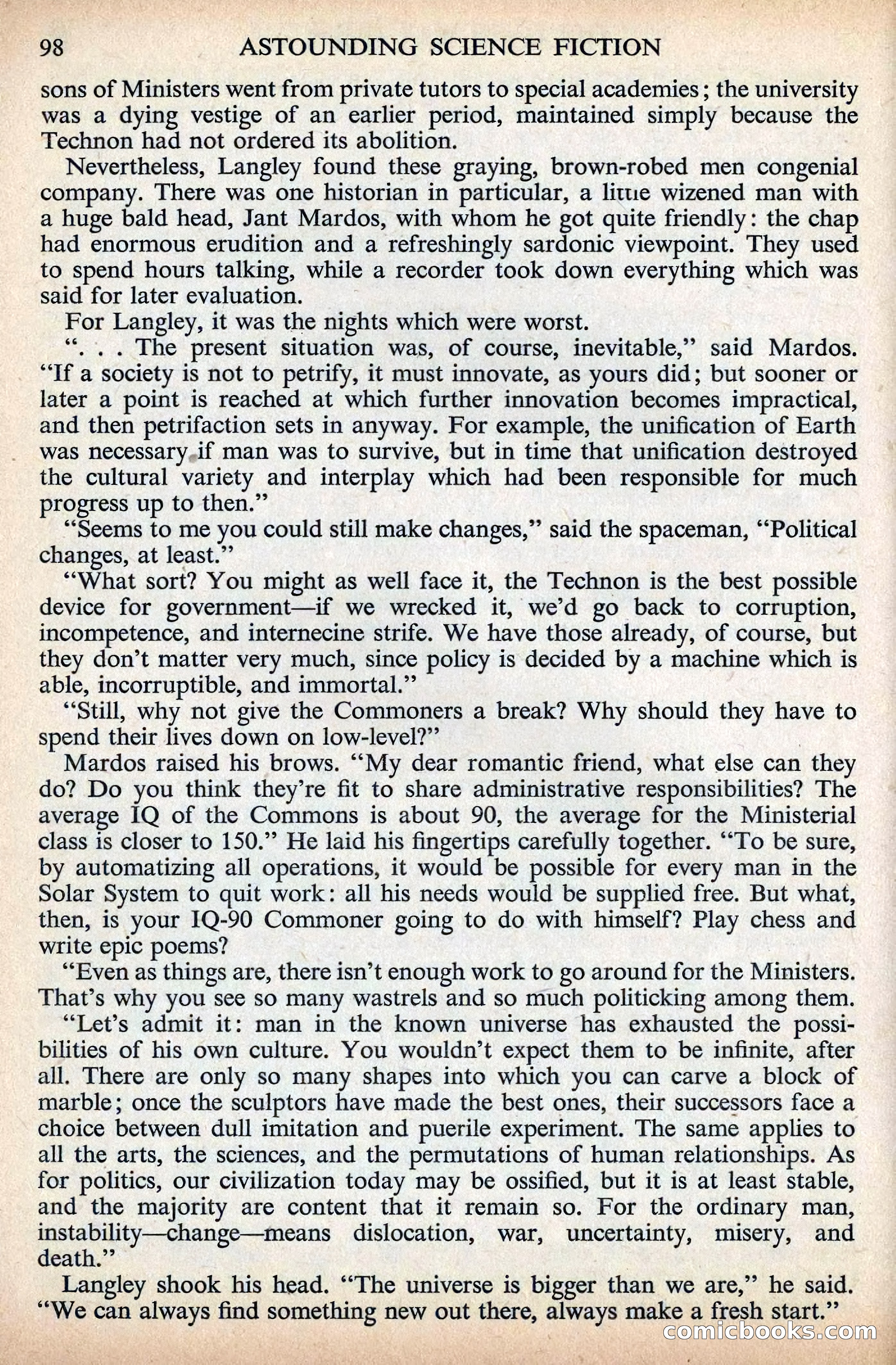
A restored page from Pulp Fiction, 1955. Page through the whole issue in the reader above.
📄 Transcribed text from this page (OCR, searchable)
Machine-transcribed from the original scan — historical spelling and the odd misread are preserved.
98 ASTOUNDING SCIENCE FICTION sons of Ministers went from private tutors to special academies ; the university was a dying vestige of an earlier period, maintained simply because the Technon had not ordered its abolition. Nevertheless, Langley found these graying, brown-robed men congenial company. There was one historian in particular, a lite wizened man with a huge bald head, Jant Mardos, with whom he got quite friendly: the chap had enormous erudition and a refreshingly sardonic viewpoint. They used to spend hours talking, while a recorder took down everything which was said for later evaluation. For Langley, it was the nights which were worst. ‘*. . . The present situation was, of course, inevitable,” said Mardos. “If a society is not to petrify, it must innovate, as yours did; but sooner or later a point is reached at which further innovation becomes impractical, and then petrifaction sets in anyway. For example, the unification of Earth was necessary,jf man was to survive, but in time that unification destroyed the cultural variety and interplay which had been responsible for much progress up to then.” “Seems to me you could still make changes,” said the spaceman, “Political changes, at least.” ‘“‘What sort? You might as well face it, the Technon is the best possible device for government—if we wrecked it, we’d go back to corruption, incompetence, and internecine strife. We have those already, of course, but they don’t matter very much, since policy is decided by a machine which is able, incorruptible, and immortal.” “Still, why not give the Commoners a break? Why should they have to spend their lives down on low-level?” Mardos raised his brows. “My dear romantic friend, what else can they do? Do you think they’re fit to share administrative responsibilities? The average IQ of the Commons is about 90, the average for the Ministerial class is closer to 150.’ He laid his fingertips carefully together. ““To be sure, by automatizing all operations, it would be possible for every man in the Solar System to quit work: all his needs would be supplied free. But what, then, is your IQ-90 Commoner going to do with himself? Play chess and write epic poems? ““Rven as things are, there isn’t enough work to go around for the Ministers. That’s why you see so many wastrels and so much politicking among them. “Let’s admit it: man in the known universe has exhausted the possi- bilities of his own culture. You wouldn’t expect them to be infinite, after all. There are only so many shapes into which you can carve a block of marble; once the sculptors have made the best ones, their successors face a choice between dull imitation and puerile experiment. The same applies to all the arts, the sciences, and the permutations of human relationships. As for politics, our civilization today may be ossified, but it is at least stable, and the majority are content that it remain so. For the ordinary man, instability—change—means dislocation, war, uncertainty, misery, and death.” Langley shook his head. “The universe is bigger than we are,” he said. “We can always find something new out there, always make a fresh start.” Comicbooksieom q