
Pulp Fiction, 1955 · page 99 of 133
Astounding Science Fiction, British Edition, December 1955 — page 99: what you’re looking at
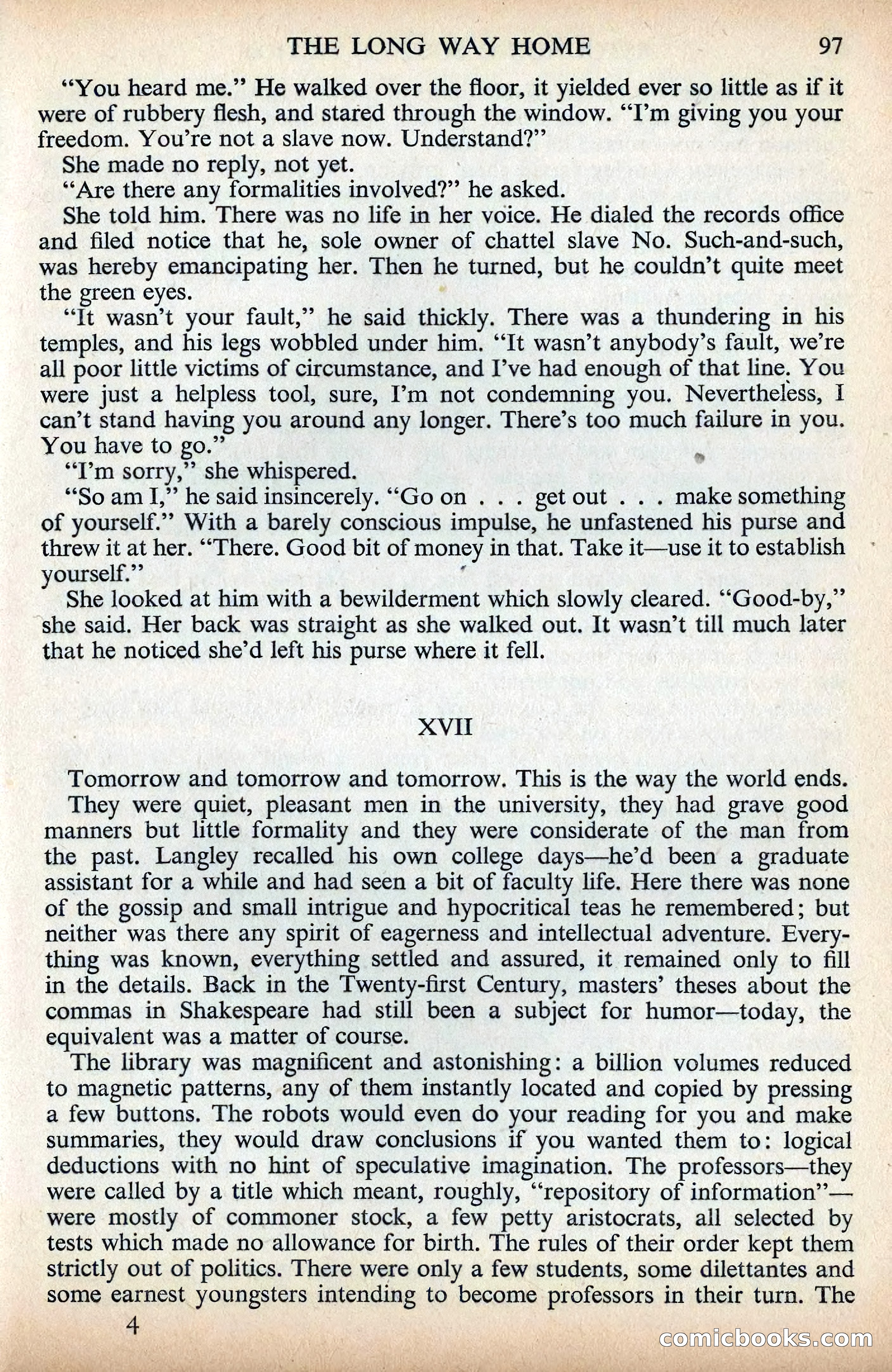
A restored page from Pulp Fiction, 1955. Page through the whole issue in the reader above.
📄 Transcribed text from this page (OCR, searchable)
Machine-transcribed from the original scan — historical spelling and the odd misread are preserved.
THE LONG WAY HOME 97 ‘“You heard me.”’ He walked over the floor, it yielded ever so little as if it were of rubbery flesh, and stared through the window. “I’m giving you your freedom. You’re not a slave now. Understand?” She made no reply, not yet. ‘Are there any formalities involved?” he asked. She told him. There was no life in her voice. He dialed the records office and filed notice that he, sole owner of chattel slave No. Such-and-such, was hereby emancipating her. Then he turned, but he couldn’t quite meet the green eyes. “It wasn’t your fault,” he said thickly. There was a thundering in his temples, and his legs wobbled under him. “It wasn’t anybody’s fault, we’re all poor little victims of circumstance, and I’ve had enough of that line. You were just a helpless tool, sure, ’m not condemning you. Nevertheless, I can’t stand having you around any longer. There’s too much failure in you. You have to go.” “’m sorry,’ she whispered. “So am I,” he said insincerely. “Goon... getout .. . make something of yourself.’’ With a barely conscious impulse, he unfastened his purse and threw it at her. “There. Good bit of money in that. Take it—use it to establish yourself.”’ : She looked at him with a bewilderment which slowly cleared. ““Good-by,” she said. Her back was straight as she walked out. It wasn’t till much later that he noticed she’d left his purse where it fell. ~ XVIT Tomorrow and tomorrow and tomorrow. This is the way the world ends. They were quiet, pleasant men in the university, they had grave good manners but little formality and they were considerate of the man from the past. Langley recalled his own college days—he’d been a graduate assistant for a while and had seen a bit of faculty life. Here there was none of the gossip and small intrigue and hypocritical teas he remembered; but neither was there any spirit of eagerness and intellectual adventure. Every- thing was known, everything settled and assured, it remained only to fill in the details. Back in the Twenty-first Century, masters’ theses about the commas in Shakespeare had still been a subject for humor—today, the equivalent was a matter of course. The library was magnificent and astonishing: a billion volumes reduced to magnetic patterns, any of them instantly located and copied by pressing a few buttons. The robots would even do your reading for you and make summaries, they would draw conclusions if you wanted them to: logical deductions with no hint of speculative imagination. The professors—they were called by a title which meant, roughly, “repository of information’’— were mostly of commoner stock, a few petty aristocrats, all selected by tests which made no allowance for birth. The rules of their order kept them strictly out of politics. There were only a few students, some dilettantes and some earnest youngsters intending to become professors in their turn. The 4 | COMMIG DOO <S COM)