
Pulp Fiction, 1955 · page 12 of 67
Astounding Science Fiction, British Edition — page 12: what you’re looking at
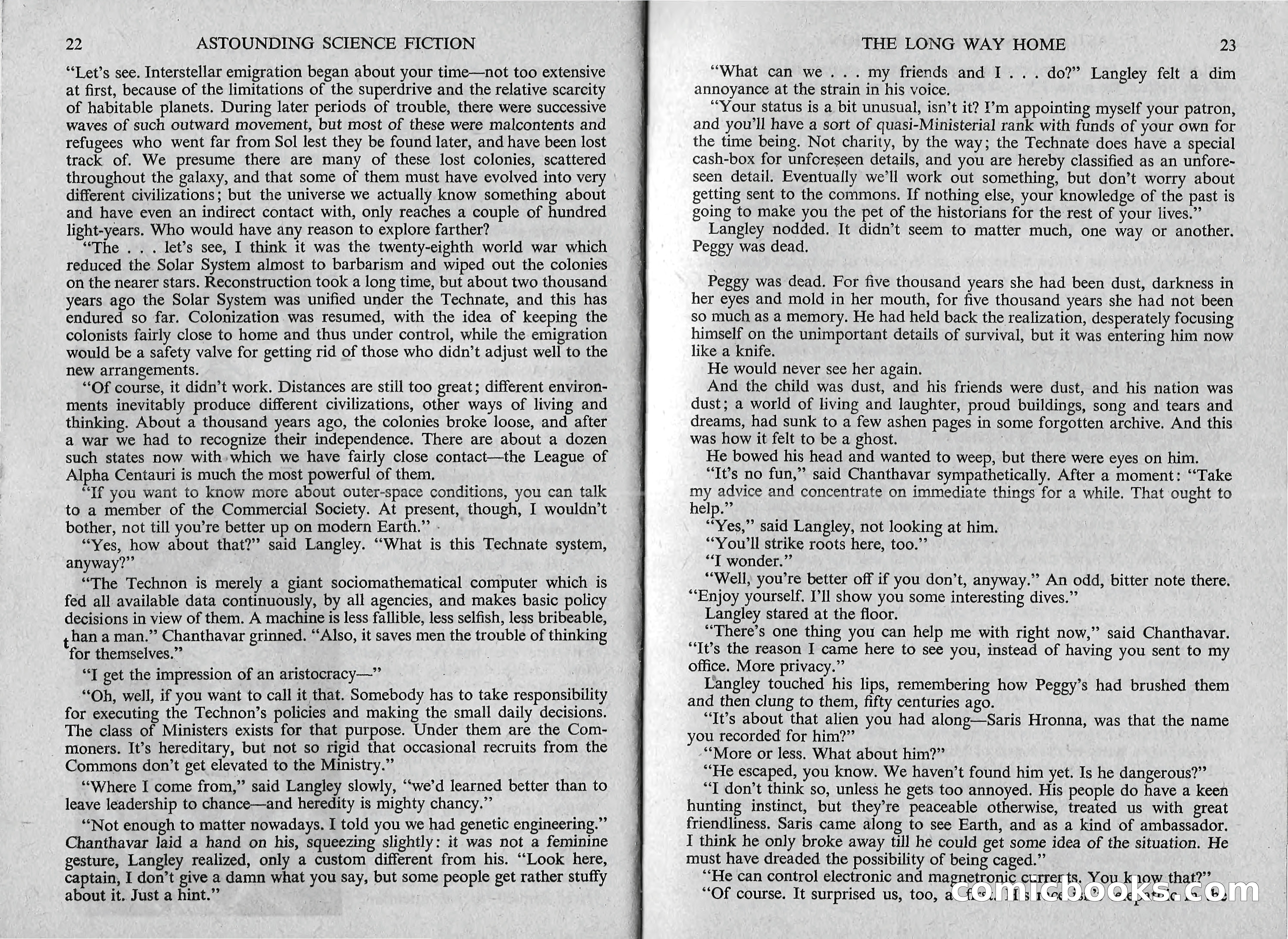
A restored page from Pulp Fiction, 1955. Page through the whole issue in the reader above.
📄 Transcribed text from this page (OCR, searchable)
Machine-transcribed from the original scan — historical spelling and the odd misread are preserved.
22 ASTOUNDING SCIENCE FICTION ‘‘Tet’s see. Interstellar emigration began about your time—not too extensive at first, because of the limitations of the superdrive and the relative scarcity of habitable planets. During later periods of trouble, there were successive waves of such outward movement, but most of these were malcontents and refugees who went far from Sol lest they be found later, and have been lost track of. We presume there are many of these lost colonies, scattered throughout the galaxy, and that some of them must have evolved into very | different civilizations; but the universe we actually know something about and have even an indirect contact with, only reaches a couple of hundred light-years. Who would have any reason to explore farther? “The . . . let’s see, I think it was the twenty-eighth world war which reduced the Solar System almost to barbarism and wiped out the colonies on the nearer stars. Reconstruction took a long time, but about two thousand years ago the Solar System was unified under the Technate, and this has endured so far. Colonization was resumed, with the idea of keeping the colonists fairly close to home and thus under control, while the emigration would be a safety valve for getting rid of those who didn’t adjust well to the new arrangements. “Of course, it didn’t work. Distances are still too great; different environ- ments inevitably produce different civilizations, other ways of living and thinking. About a thousand years ago, the colonies broke loose, and after a war we had to recognize their independence. There are about a dozen such states now with» which we have fairly close contact—the League of Alpha Centauri is much the most powerful of them. “If you want to know more about outer-space conditions, you can talk to a member of the Commercial Society. At present, though, I wouldn’t bother, not till you’re better up on modern Earth.” - “Yes, how about that?” said Langley. ““What is this Technate system, anyway?”’ 7 “The Technon is merely a giant sociomathematical computer which is fed all available data continuously, by all agencies, and makes basic policy decisions in view of them. A machine is less fallible, less selfish, less bribeable, fan a man.” Chanthavar grinned. “Also, it saves men the trouble of thinking for themselves.” | “T get the impression of an aristocracy—”’ 3 “Oh, well, if you want to call it that. Somebody has to take responsibility for executing the Technon’s policies and making the small daily decisions. The class of Ministers exists for that purpose. Under them are the Com- _ moners. It’s hereditary, but not so rigid that occasional recruits from the Commons don’t get elevated to the Ministry.” “Where I come from,” said Langley slowly, “‘we’d learned better than to leave leadership to chance—and heredity is mighty chancy,” “Not enough to matter nowadays. I told you we had genetic engineering.” Chanthavar laid a hand on his, squeezing slightly: it was not a feminine gesture, Langley realized, only a custom different from his. “Look here, captain, I don’t give a damn what you say, but some people get rather stuffy about it. Just a hint.” | THE LONG WAY HOME 23 “What can we... my friends and I... do?” Langley felt a dim annoyance at the strain in his voice, | ~ Your status is a bit unusual, isn’t it? I’m appointing myself your patron, and you'll have a sort of quasi-Ministerial rank with funds of your own for the time being. Not charity, by the way; the Technate does have a special cash-box for unforeseen details, and you are hereby classified as an unfore-~ seen detail. Eventually we'll work out something, but don’t worry about getting sent to the commons. If nothing else, your knowledge of the past is going to make you the pet of the historians for the rest of your lives.” Langley nodded. It didn’t seem to matter much, one way or another. Peggy was dead, Peggy was dead. For five thousand years she had been dust, darkness in her eyes and mold in her mouth, for five thousand years she had not been so much as a memory. He had held back the realization, desperately focusing himself on the unimportant details of survival, but it was entering him now like a knife. ) He would never see her again. And the child was dust, and his friends were dust, and his nation was dust; a world of living and laughter, proud buildings, song and tears and dreams, had sunk to a few ashen pages in some forgotten archive. And this was how it felt to be a ghost. | | He bowed his head and wanted to weep, but there were eyes on him. “It’s no fun,” said Chanthavar sympathetically. After a moment: “Take my advice and concentrate on immediate things for a while. That ought to help.” ; Yes,” said Langley, not looking at him. “You'll strike roots here, too.”’ : “TI wonder.” | “Well, you’re better off if you don’t, anyway.’ An odd, bitter note there. “Enjoy yourself, Pll show you some interesting dives.” Langley stared at the floor. “There’s one thing you can help me with right now,” said Chanthavar. “It’s the reason I came here to see you, instead of having you sent to my office. More privacy.” Langley touched his lips, remembering how Peggy’s had brushed them and then clung to them, fifty centuries ago. “It’s about that alien you had along—Saris Hronna, was that the name you recorded for him?” “More or less. What about him?” “He escaped, you know. We haven’t found him yet. Is he dangerous?” “I don’t think so, unless he gets too annoyed. His people do have a keen hunting instinct, but they’re peaceable otherwise, treated us with great friendliness. Saris came along to see Earth, and as a kind of ambassador. I think he only broke away till he could get some idea of the situation. He must have dreaded the possibility of being caged.” “‘He can control electronic and magnetronic c . Yo that?’’ “Of course. It surprised us, too, con ie é (eo 9) ks:com time)