
Pulp Fiction, 1955 · page 13 of 67
Astounding Science Fiction, British Edition — page 13: what you’re looking at
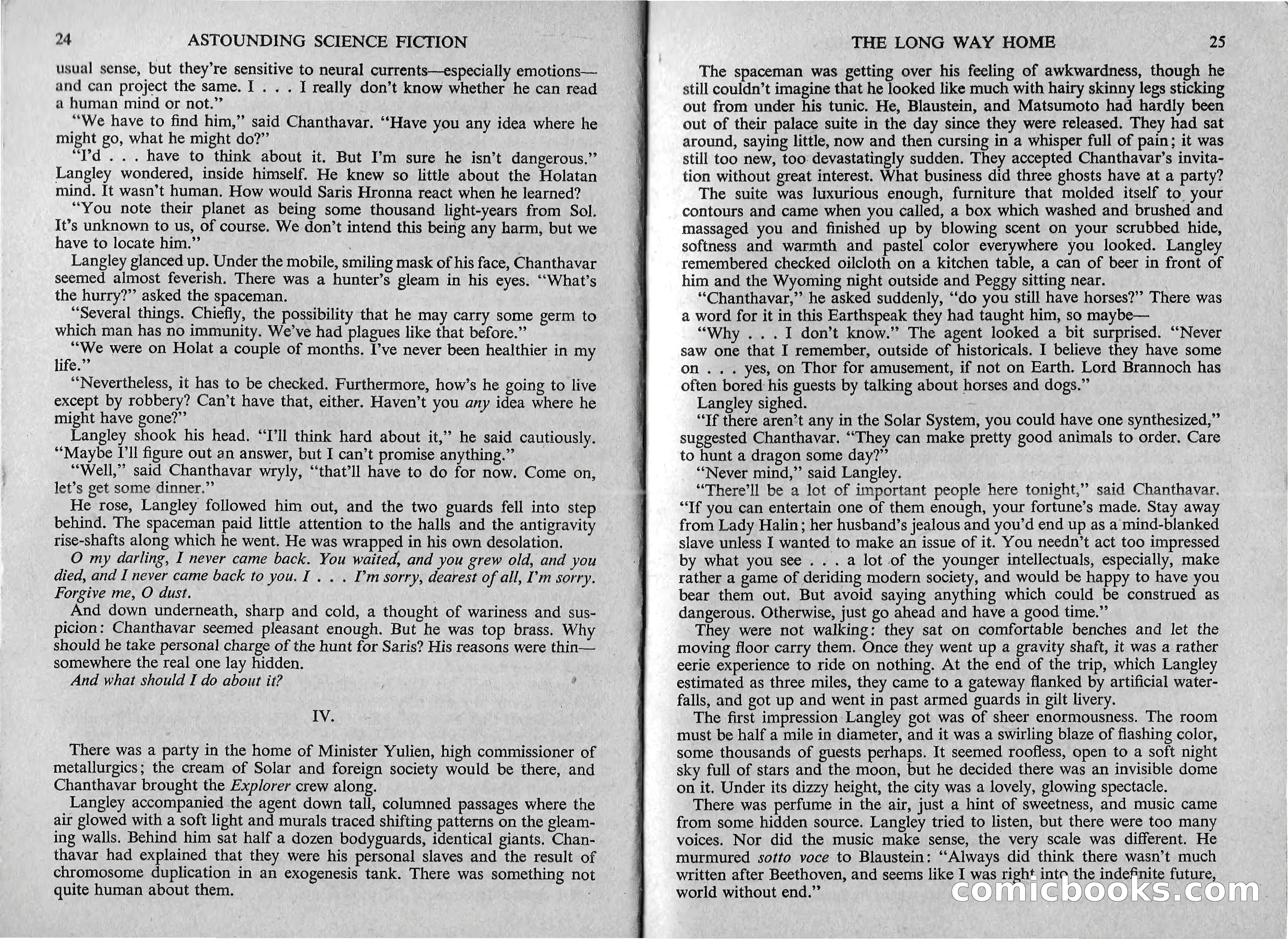
A restored page from Pulp Fiction, 1955. Page through the whole issue in the reader above.
📄 Transcribed text from this page (OCR, searchable)
Machine-transcribed from the original scan — historical spelling and the odd misread are preserved.
24 ASTOUNDING SCIENCE FICTION usual sense, but they’re sensitive to neural currents—especially emotions— and can project the same. I . . . I really don’t know whether he can read a human mind or not.” “We have to find him,” said Chanthavar. “Have you any idea where he might go, what he might do?” “I'd... have to think about it. But I’m sure he isn’t dangerous,” Langley wondered, inside himself. He knew so little about the Holatan mind. It wasn’t human. How would Saris Hronna react when he learned? “You note their planet as being some thousand light-years from Sol. It’s unknown to us, of course. We don’t intend this being any harm, but we have to locate him.” | | Langley glanced up. Under the mobile, smiling mask of his face, Chanthavar seemed almost feverish. There was a hunter’s gleam in his eyes. ““What’s the hurry?” asked the spaceman. “Several things. Chiefly, the possibility that he may carry some germ to which man has no immunity. We’ve had plagues like that before.” eal were on Holat a couple of months. I’ve never been healthier in my e.”” “Nevertheless, it has to be checked. Furthermore, how’s he going to live except by robbery? Can’t have that, either. Haven’t you any idea where he might have gone?” Langley shook his head. “I’ll think hard about it,” he said cautiously. “Maybe I'll figure out an answer, but I can’t promise anything.” “Well,” said Chanthavar wryly, ‘‘that’ll have to do for now. Come on, let’s get some dinner.” He rose, Langley followed him out, and the two guards fell into step behind. The spaceman paid little attention to the halls and the antigravity rise-shafts along which he went. He was wrapped in his own desolation. O my darling, I never came back. You waited, and you grew old, and you died, and I never came back to you. I . . . ’m sorry, dearest of all, I’m sorry. Forgive me, O dust. And down underneath, sharp and cold, a thought of wariness and sus- picion: Chanthavar seemed pleasant enough. But he was top brass. Why should he take personal charge of the hunt for Saris? His reasons were thin— somewhere the real one lay hidden. And what should I do about it? | TVs There was a party in the home of Minister Yulien, high commissioner of metallurgics; the cream of Solar and foreign society would be there, and Chanthavar brought the Explorer crew along. Langley accompanied the agent down tall, columned passages where the air glowed with a soft light and murals traced shifting patterns on the gleam- ing walls. Behind him sat half a dozen bodyguards, identical giants. Chan- thavar had explained that they were his personal slaves and the result of chromosome duplication in an exogenesis tank. There was something no quite human about them. . THE LONG WAY HOME 25 The spaceman was getting over his feeling of awkwardness, though he still couldn’t imagine that he looked like much with hairy skinny legs sticking out from under his tunic. He, Blaustein, and Matsumoto had hardly been out of their palace suite in the day since they were released. They had sat around, saying little, now and then cursing in a whisper full of pain; it was still too new, too. devastatingly sudden. They accepted Chanthavar’s invita- tion without great interest. What business did three ghosts have at a party? The suite was luxurious enough, furniture that molded itself to your contours and came when you called, a box which washed and brushed and massaged you and finished up by blowing scent on your scrubbed hide, softness and warmth and pastel color everywhere you looked. Langley remembered checked oilcloth on a kitchen table, a can of beer in front of him and the Wyoming night outside and Peggy sitting near. | ‘“Chanthavar,” he asked suddenly, “‘do you still have horses?” There was a word for it in this Earthspeak they had taught him, so maybe— “Why ...I don’t know.” The agent looked a bit surprised. “Never saw one that I remember, outside of historicals. I believe they have some on... yes, on Thor for amusement, if not on Earth. Lord Brannoch has often bored his guests by talking about horses and dogs.” Langley sighed. “Tf there aren’t any in the Solar System, you could have one synthesized,” suggested Chanthavar. “They can make pretty good animals to order. Care to hunt a dragon some day?” ‘“Never mind,” said Langley. | ‘There'll be a lot of important people here tonight,”’ said Chanthavar. “If you can entertain one of them enough, your fortune’s made. Stay away from Lady Halin; her husband’s jealous and you'd end up as a mind-blanked slave unless I wanted to make an issue of it. You needn’t act too impressed by what you see .. . a lot of the younger intellectuals, especially, make rather a game of deriding modern society, and would be happy to have you bear them out. But avoid saying anything which could be construed as dangerous. Otherwise, just go ahead and have a good time.” They were not walking: they sat on comfortable benches and let the moving floor carry them. Once they went up a gravity shaft, it was a rather eerie experience to ride on nothing. At the end of the trip, which Langley estimated as three miles, they came to a gateway flanked by artificial water- falls, and got up and went in past armed guards in gilt livery. The first impression Langley got was of sheer enormousness. The room must be half a mile in diameter, and it was a swirling blaze of flashing color, some thousands of guests perhaps. It seemed roofless, open to a soft night sky full of stars and the moon, but he decided there was an invisible dome on it. Under its dizzy height, the city was a lovely, glowing spectacle. There was perfume in the air, just a hint of sweetness, and music came from some hidden source. Langley tried to listen, but there were too many voices. Nor did the music make sense, the very scale was different. He murmured sotto voce to Blaustein: “Always did think there wasn’t much written after Beethoven, and seems like I was right inte, the indefinite future, world without end.” (el @ v) G€DOOKS: CO