
Pulp Fiction, 1955 · page 11 of 67
Astounding Science Fiction, British Edition — page 11: what you’re looking at
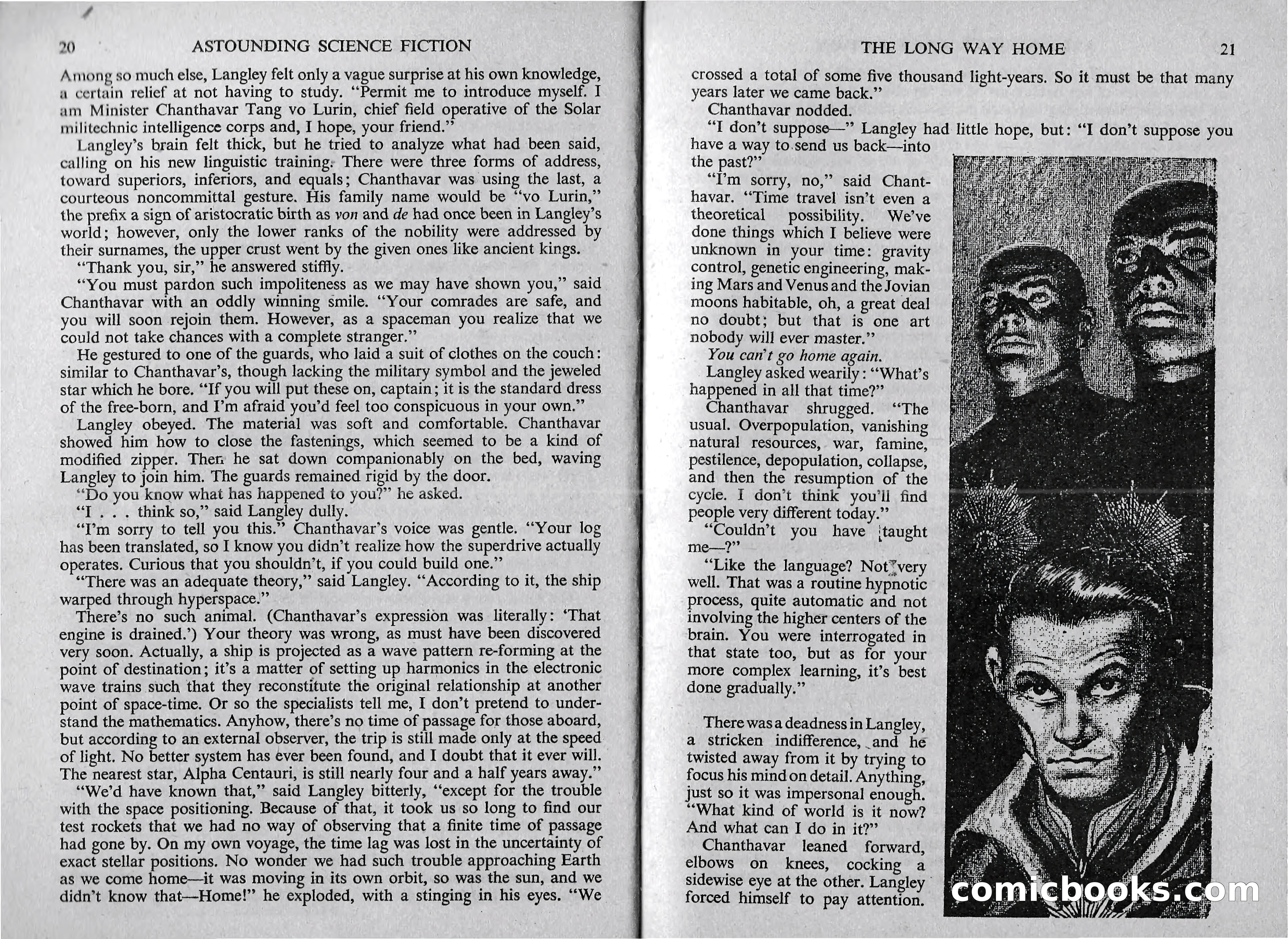
A restored page from Pulp Fiction, 1955. Page through the whole issue in the reader above.
📄 Transcribed text from this page (OCR, searchable)
Machine-transcribed from the original scan — historical spelling and the odd misread are preserved.
20 ASTOUNDING SCIENCE FICTION Among so much else, Langley felt only a vague surprise at his own knowledge, a certain relief at not having to study. “Permit me to introduce myself. I am Minister Chanthavar Tang vo Lurin, chief field operative of the Solar militechnic intelligence corps and, I hope, your friend.” Langley’s brain felt thick, but he tried to analyze what had been said, calling on his new linguistic training: There were three forms of address, toward superiors, inferiors, and equals; Chanthavar was using the last, a courteous noncommittal gesture. His family name would be ‘‘vo Lurin,”’ the prefix a sign of aristocratic birth as von and de had once been in Langley’s world; however, only the lower ranks of the nobility were addressed by their surnames, the upper crust went by the given ones like ancient kings. “Thank you, sir,” he answered stiffly. ‘You must pardon such impoliteness as we may have shown you,” said Chanthavar with an oddly winning smile. ‘““Your comrades are safe, and you will soon rejoin them. However, as a spaceman you realize that we could not take chances with a complete stranger.” He gestured to one of the guards, who laid a suit of clothes on the couch: similar to Chanthavar’s, though lacking the military symbol and the jeweled star which he bore. “If you will put these on, captain; it is the standard dress of the free-born, and I’m afraid you’d feel too conspicuous in your own.” Langley obeyed. The material was soft and comfortable. Chanthavar showed him how to close the fastenings, which seemed to be a kind of modified zipper. Ther he sat down companionably on the bed, waving Langley to join him. The guards remained rigid by the door. ‘Do you know what has happened to you?” he asked. “J... . think so,” said Langley dully. “I’m sorry to tell you this.” Chanthavar’s voice was gentle. “Your log has been translated, so I know you didn’t realize how the superdrive actually operates. Curious that you shouldn’t, if you could build one.” “There was an adequate theory,” said Langley. “According to it, the ship warped through hyperspace.’ There’s no such animal. (Chanthavar’s expression was literally: “That engine is drained.’) Your theory was wrong, as must have been discovered very soon. Actually, a ship is projected as a wave pattern re-forming at the point of destination; it’s a matter of setting up harmonics in the electronic wave trains such that they reconstitute the original relationship at another point of space-time. Or so the specialists tell me, I don’t pretend to under- stand the mathematics. Anyhow, there’s no time of passage for those aboard, but according to an external observer, the trip is still made only at the speed of light. No better system has ever been found, and I doubt that it ever will. The nearest star, Alpha Centauri, is still nearly four and a half years away.” ‘“‘We’d have known that,” said Langley bitterly, “except for the trouble with the space positioning. Because of that, it took us so long to find our test rockets that we had no way of observing that a finite time of passage had gone by. On my own voyage, the time lag was lost in the uncertainty of exact stellar positions. No wonder we had such trouble approaching Earth as we come home—it was moving in its own orbit, so was the sun, and we didn’t know that—Home!” he exploded, with a stinging in his eyes. “We THE LONG WAY HOME 2] crossed a total of some five thousand light-years. So it must be that many years later we came back.” Chanthavar nodded. “I don’t suppose—” Langley had little hope, but: “I don’t suppose you have a way to.send us back—into the past?” “I’m sorry, no,” said Chant- havar. “Time travel isn’t even a theoretical possibility. We've done things which I believe were unknown in your time: gravity control, genetic engineering, mak- ing Mars and Venusand the Jovian moons habitable, oh, a great deal no doubt; but that is one art nobody will ever master.”’ You can’t go home again. Langley asked wearily : ““What’s happened in all that time?” Chanthavar shrugged. “The usual. Overpopulation, vanishing natural resources, war, famine, pestilence, depopulation, collapse, and then the resumption of the cycle. I don’t think you'll find people very different today.” “Couldn’t you have ‘taught me—?” “Like the language? Not®very well. That was a routine hypnotic process, quite automatic and not involving the higher centers of the brain. You were interrogated in that state too, but as for your more complex learning, it’s best done gradually.” a | SS aS ' == There wasa deadness in Langley, a stricken indifference, and he twisted away from it by trying to focus his mind on detail. Anything, Just so it was impersonal enough. “What kind of world is it now? And what can I do in it?” Chanthavar leaned forward, elbows on knees, cocking a sidewise eye at the other. Langley forced himself to pay attention.