
Pulp Fiction, 1955 · page 124 of 133
Astounding Science Fiction, August 1955 (British Edition) — page 124: what you’re looking at
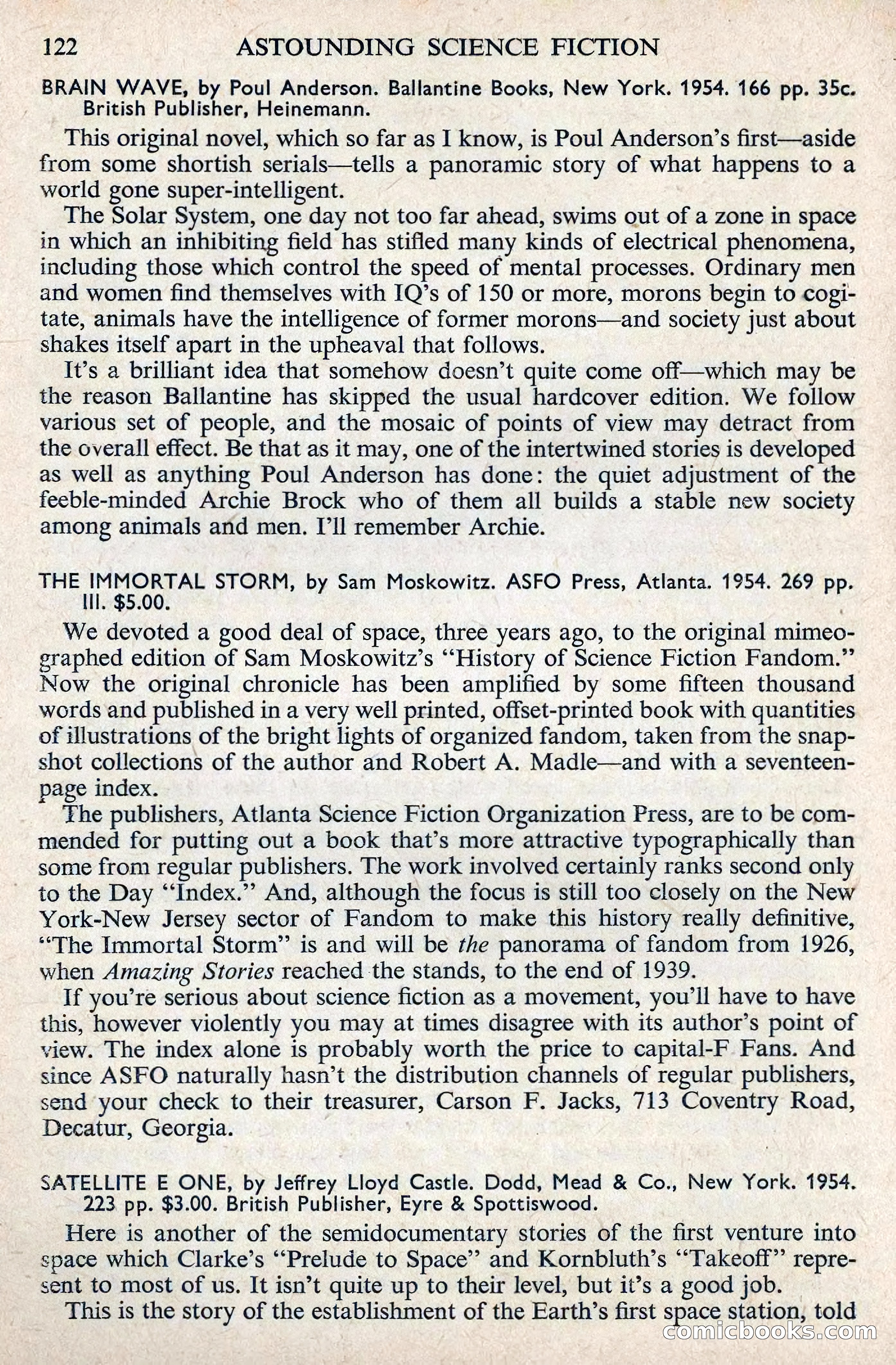
A restored page from Pulp Fiction, 1955. Page through the whole issue in the reader above.
📄 Transcribed text from this page (OCR, searchable)
Machine-transcribed from the original scan — historical spelling and the odd misread are preserved.
122 ASTOUNDING SCIENCE FICTION BRAIN WAVE, by Poul Anderson. Ballantine Books, New York. 1954. 166 pp. 35c. British Publisher, Heinemann. This original novel, which so far as I know, is Poul Anderson’s first—aside from some shortish serials—tells a panoramic story of what happens to a world gone super-intelligent. The Solar System, one day not too far ahead, swims out of a zone in space in which an inhibiting field has stifled many kinds of electrical phenomena, including those which control the speed of mental processes. Ordinary men and women find themselves with IQ’s of 150 or more, morons begin to cogi- tate, animals have the intelligence of former morons—and society just about shakes itself apart in the upheaval that follows. It’s a brilliant idea that somehow doesn’t quite come off—which may be the reason Ballantine has skipped the usual hardcover edition. We follow various set of people, and the mosaic of points of view may detract from the overall effect. Be that as it may, one of the intertwined stories is developed as well as anything Poul Anderson has done: the quiet adjustment of the feeble-minded Archie Brock who of them all builds a stable new society among animals and men. [’ll remember Archie. Sie See STORM, by Sam Moskowitz. ASFO Press, Atlanta. 1954. 269 pp. We devoted a good deal of space, three years ago, to the original mimeo- graphed edition of Sam Moskowitz’s “History of Science Fiction Fandom.” Now the original chronicle has been amplified by some fifteen thousand words and published in a very well printed, offset-printed book with quantities of illustrations of the bright lights of organized fandom, taken from the snap- shot collections of the author and Robert A. Madle—and with a seventeen- page index. The publishers, Atlanta Science Fiction Organization Press, are to be com- mended for putting out a book that’s more attractive typographically than some from regular publishers. The work involved certainly ranks second only to the Day “‘Index.” And, although the focus is still too closely on the New York-New Jersey sector of Fandom to make this history really definitive, “The Immortal Storm” is and will be the panorama of fandom from 1926, when Amazing Stories reached the stands, to the end of 1939. If you’re serious about science fiction as a movement, you'll have to have this, however violently you may at times disagree with its author’s point of view. The index alone is probably worth the price to capital-F Fans. And since ASFO naturally hasn’t the distribution channels of regular publishers, send your check to their treasurer, Carson F. Jacks, 713 Coventry Road, Decatur, Georgia. SATELLITE E ONE, by Jeffrey Lloyd Castle. Dodd, Mead & Co., New York. 1954. 223 pp. $3.00. British Publisher, Eyre & Spottiswood. Here is another of the semidocumentary stories of the first venture into space which Clarke’s “‘Prelude to Space” and Kornbluth’s “Takeoff”’ repre- sent to most of us. It isn’t quite up to their level, but it’s a good job. This is the story of the establishment of the Earth’s first space station, told cOMMICDOOKS.COM