
Pulp Fiction, 1955 · page 125 of 133
Astounding Science Fiction, August 1955 (British Edition) — page 125: what you’re looking at
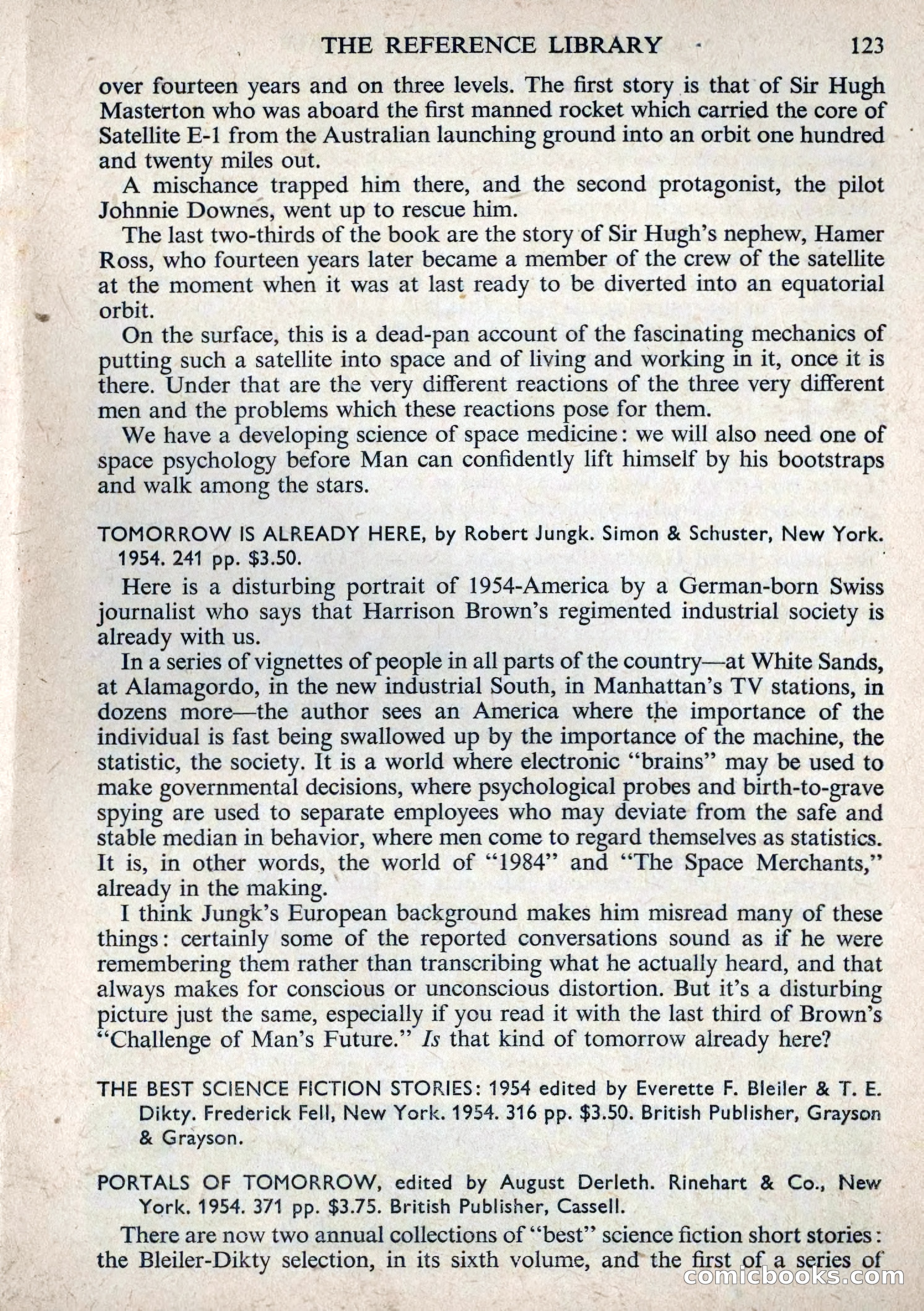
A restored page from Pulp Fiction, 1955. Page through the whole issue in the reader above.
📄 Transcribed text from this page (OCR, searchable)
Machine-transcribed from the original scan — historical spelling and the odd misread are preserved.
THE REFERENCE LIBRARY - 123 over fourteen years and on three levels. The first story is that of Sir Hugh Masterton who was aboard the first manned rocket which carried the core of Satellite E-1 from the Australian launching ground into an orbit one hundred and twenty miles out. A mischance trapped him there, and the second protagonist, the pilot Johnnie Downes, went up to rescue him. The last two-thirds of the book are the story of Sir Hugh’s nephew, Hamer Ross, who fourteen years later became a member of the crew of the satellite at the moment when it was at last ready to be diverted into an equatorial orbit. On the surface, this is a dead-pan account of the fascinating mechanics of putting such a satellite into space and of living and working in it, once it is there. Under that are the very different reactions of the three very different men and the problems which these reactions pose for them. We have a developing science of space medicine: we will also need one of space psychology before Man can confidently lift himself by his bootstraps and walk among the stars. TOMORROW IS ALREADY HERE, by Robert Jungk. Simon & Schuster, New York. 1954, 241 pp. $3.50. Here is a disturbing portrait of 1954-America by a German-born Swiss journalist who says that Harrison Brown’s regimented industrial society is already with us. In a series of vignettes of people in all parts of the country—at White Sands, at Alamagordo, in the new industrial South, in Manhattan’s TV stations, in dozens more—the author sees an America where the importance of the individual is fast being swallowed up by the importance of the machine, the statistic, the society. It is a world where electronic “‘brains” may be used to make governmental decisions, where psychological probes and birth-to-grave spying are used to separate employees who may deviate from the safe and stable median in behavior, where men come to regard themselves as statistics. It is, in other words, the world of “1984” and “The Space Merchants,” already in the making. I think Jungk’s European background makes him misread many of these things: certainly some of the reported conversations sound as if he were remembering them rather than transcribing what he actually heard, and that always makes for conscious or unconscious distortion. But it’s a disturbing picture just the same, especially if you read it with the last third of Brown’s “Challenge of Man’s Future.” Js that kind of tomorrow already here? THE BEST SCIENCE FICTION STORIES: 1954 edited by Everette F. Bleiler & T. E. Dikty. Frederick Fell, New York. 1954. 316 pp. $3.50. British Publisher, Grayson & Grayson. PORTALS OF TOMORROW, edited by August Derleth. Rinehart & Co., New York. 1954. 371 pp. $3.75. British Publisher, Cassell. There are now two annual collections of ‘“‘best’’ science fiction short stories : the Bleiler-Dikty selection, in its sixth volume, and the fast of, a series of omichookscom