
Pulp Fiction, 1950 · page 21 of 68
Astounding Science Fiction, October 1950 — page 21: what you’re looking at
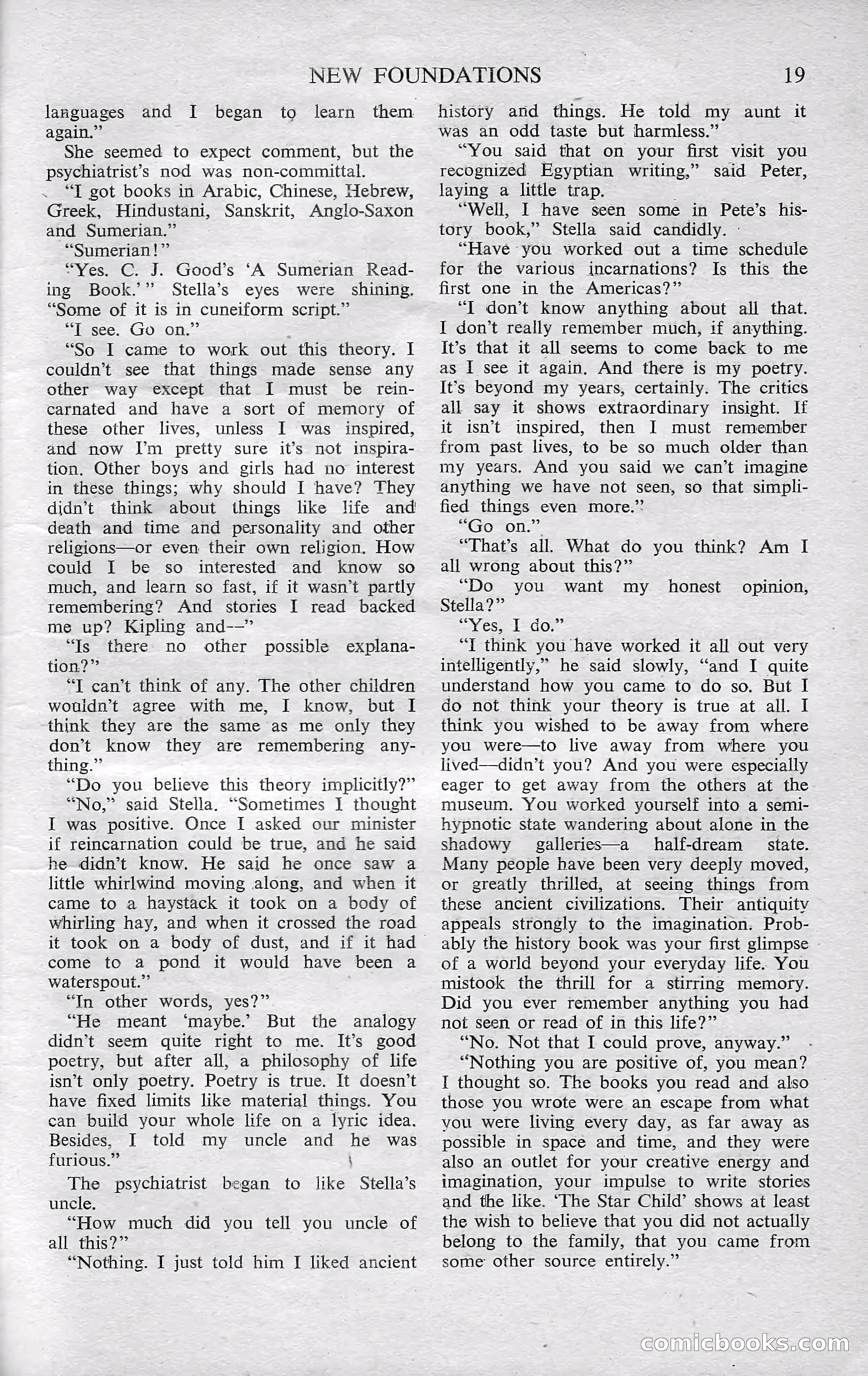
A restored page from Pulp Fiction, 1950. Page through the whole issue in the reader above.
📄 Transcribed text from this page (OCR, searchable)
Machine-transcribed from the original scan — historical spelling and the odd misread are preserved.
NEW FOUNDATIONS 19 languages and [I began to learn them again.” She seemed to expect comment, but the psychiatrist’s nod was non-committal. “I got books in Arabic, Chinese, Hebrew, Greek, Hindustani, Sanskrit, Anglo-Saxon and Sumerian.” “Sumerian!” “Yes. C. J. Good’s ‘A Sumerian Read- ing Book.” Stella’s eyes were shining. “Some of it is in cuneiform script.” “T see. Go on.” “So I came to work out this theory. I couldn’t see that things made sense any other way except that I must be rein- carnated and have a sort of memory of these other lives, unless I was inspired, and now I’m pretty sure it’s not inspira- tion. Other boys and girls had no interest in these things; why should I have? They didn’t think about things like life and death and time and personality and other religions—or even their own religion. How could I be so interested and know so much, and learn so fast, if it wasn’t partly remembering? And stories I read backed me up? Kipling and--” “Is there no other possible explana- tion?” “T can’t think of any. The other children wouldn't agree with me, I know, but I think they are the same as me only they don’t know they are remembering any- thing.” “Do you believe this theory implicitly?” “No,” said Stella. “Sometimes ] thought I was positive. Once I asked our minister if reincarnation could be true, and he said he didn’t know. He said he once saw a little whirlwind moving along, and when it came to a haystack it took on a body of whirling hay, and when it crossed the road it took on a body of dust, and if it had come to a pond it would have been a waterspout.” “In other words, yes?” “He meant ‘maybe.’ But the analogy didn’t seem quite right to me. It’s good poetry, but after all, a philosophy of life isn’t only poetry. Poetry is true. It doesn’t have fixed limits like material things. You can build your whole life on a lyric idea. Besides, I told my uncle and he was furious.” \ The psychiatrist began to like Stella’s uncle. “How much did you tell you uncle of all this?” “Nothing. I just told him I liked ancient history and things. He told my aunt it was an odd taste but harmless.” “You said that on your first visit you recognized Egyptian writing,” said Peter, laying a little trap. “Well, I have seen some in Pete’s his- tory book,” Stella said candidly. - “Have you worked out a time schedule for the various incarnations? Is this the first one in the Americas?” “I don’t know anything about all that. I don’t really remember much, if anything. It’s that it all seems to come back to me as I see it again. And there is my poetry. It's beyond my years, certainly. The critics all say it shows extraordinary insight. If it isn’t inspired, then I must remember from past lives, to be so much older than my years. And you said we can’t imagine anything we have not seen, so that simpli- fied things even more.” “Go on.” “That’s all. What do you think? Am I all wrong about this?” “Do you want my _ honest Stella?” —¥ 6S. 1-0; “I think you have worked it all out very intelligently,” he said slowly, “and I quite understand how you came to do so. But I do not think your theory is true at all. I think you wished to be away from where you were—to live away from where you lived—-didn’t you? And you were especially eager to get away from the others at the museum. You worked yourself into a semi- hypnotic state wandering about alone in the shadowy galleries—a half-dream state. Many people bave been very deeply moved, or greatly thrilled, at seeing things from these ancient civilizations. Their antiquity appeals strongly to the imagination. Prob- opinion, ably the history book was your first glimpse - of a world beyond your everyday life. You mistook the thrill for a stirring memory. Did you ever remember anything you had not seen or read of in this life?” “No. Not that I could prove, anyway.” “Nothing you are positive of, you mean? I thought so. The books you read and also those you wrote were an escape from what vou were living every day, as far away as possible in space and time, and they were also an outlet for your creative energy and imagination, your impulse to write stories and the like. “The Star Child’ shows at least the wish to believe that you did not actually belong to the family, that you came from some other source entirely.” im COPMIC LOOKS EO