
Pulp Fiction, 1950 · page 20 of 68
Astounding Science Fiction, October 1950 — page 20: what you’re looking at
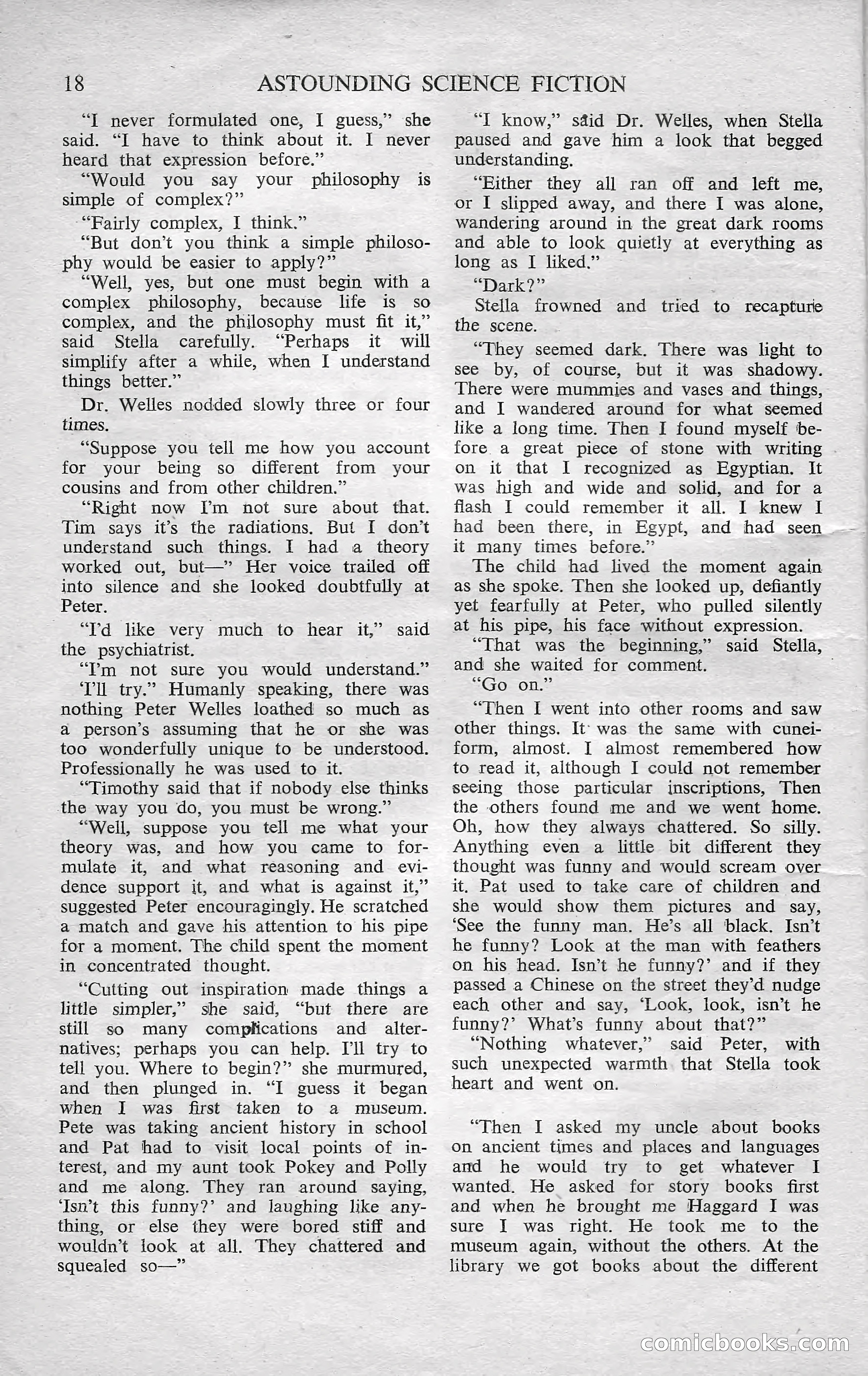
A restored page from Pulp Fiction, 1950. Page through the whole issue in the reader above.
📄 Transcribed text from this page (OCR, searchable)
Machine-transcribed from the original scan — historical spelling and the odd misread are preserved.
18 “I never formulated one, I guess,” she said. “I have to think about it. I never heard that expression before.” “Would you say your philosophy is simple of complex?” -“Fairly complex, I think.” “But don’t you think a simple philoso- phy would be easier to apply?” “Well, yes, but one must begin with a complex philosophy, because life is so complex, and the philosophy must fit it,” said Stella carefully. “Perhaps it will simplify after a while, when I understand things better.” Dr. Welles nodded slowly three or four times. “Suppose you tell me how you account for your being so different from your cousins and from other children.” “Right now I’m not sure about that. Tim says it’s the radiations. But I don’t understand such things. I had a theory worked out, but—” Her voice trailed off into silence and she looked doubtfully at Peter. “Td like very much to hear it,” said the psychiatrist. “Tm not sure you would understand.” ‘Til try.’ Humanly speaking, there was nothing Peter Welles loathed so much as a person’s assuming that he or she was too wonderfully unique to be understood. Professionally he was used to it. “Timothy said that if nobody else thinks the way you do, you must be wrong.” “Well, suppose you tell me what your theory was, and how you came to for- mulate it, and what reasoning and evi- dence support it, and what is against it,” suggested Peter encouragingly. He scratched a match and gave his attention to his pipe for a moment. The child spent the moment in concentrated thought. “Cutting out inspiration made things a little simpler,’ she said, “but there are still so many complications and alter- natives; perhaps you can help. I'll try to tell you. Where to begin?” she murmured, and then plunged in. “I guess it began when J was first taken to a museum. Pete was taking ancient history in school and Pat had to visit local points of in- terest, and my aunt took Pokey and Polly and me along. They ran around saying, ‘Isn’t this funny?’ and laughing like any- thing, or else they were bored stiff and wouldn’t look at all. They chattered and Squealed so—” ASTOUNDING SCIENCE FICTION “IT know,” said Dr. Welles, when Stella paused and gave him a look that begged understanding. “Bither they all ran off and left me, or I slipped away, and there I was alone, Wandering around in the great dark rooms and able to look quietly at everything as long as I liked.” “Dark?” | Stella frowned and tried to recapture the scene. “They seemed dark. There was light to see by, of course, but it was shadowy. There were mummies and vases and things, and I wandered around for what seemed like a long time. Then I found myself be- fore. a great piece of stone with writing on it that I recognized as Egyptian. It was high and wide and solid, and for a flash I could remember it all. I knew I had been there, in Egypt, and had seen it many times before.” The child had lived the moment again as she spoke. Then she looked up, defiantly yet fearfully at Peter, who pulled silently at his pipe, his face without expression. “That was the beginning,” said Stella, | and she waited for comment. “Go on.”’ “Then I went into other rooms and saw other things. It' was the same with cunei- form, almost. I almost remembered how to read it, although I could not remember seeing those particular inscriptions, Then the others found me and we went home. Oh, how they always chattered. So silly. Anything even a little bit different they thought was funny and would scream over it. Pat used to take care of children and she would show them pictures and say, ‘See the funny man. He’s all black. Isn’t he funny? Look at the man with feathers on his head. Isn’t he funny?’ and if they passed a Chinese on the street they’d nudge each other and say, ‘Look, look, isn’t he funny?’ What’s funny about that?” “Nothing whatever,” said Peter, with such unexpected warmth that Stella took heart and went on. “Then I asked my uncle about books on ancient times and places and languages and he would try to get whatever I wanted. He asked for story books first and when he brought me Haggard I was sure J was right. He took me to the museum again, without the others. At the library we got books about the different Comicboo SECO im