
Pulp Fiction, 1950 · page 22 of 68
Astounding Science Fiction, October 1950 — page 22: what you’re looking at
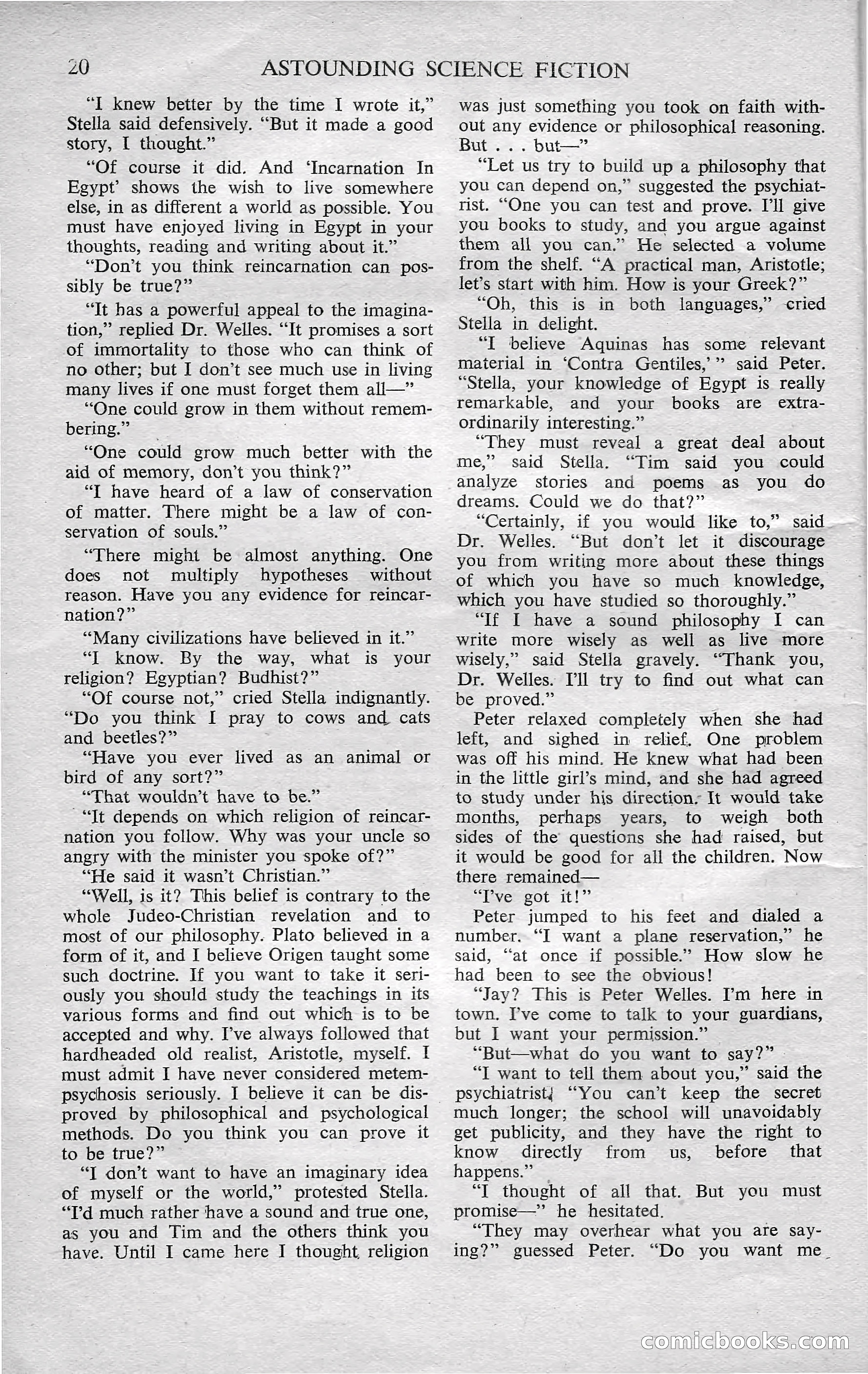
A restored page from Pulp Fiction, 1950. Page through the whole issue in the reader above.
📄 Transcribed text from this page (OCR, searchable)
Machine-transcribed from the original scan — historical spelling and the odd misread are preserved.
20 “I knew better by the time I wrote it,” Stella said defensively. “But it made a good story, I thought.” “Of course it did. And ‘Incarnation In Egypt’ shows the wish to live somewhere else, in as different a world as possible. You must have enjoyed living in Egypt in your thoughts, reading and writing about it.” “Don’t you think reincarnation can pos- sibly be true?” “It bas a powerful appeal to the imagina- tion,” replied Dr. Welles. “It promises a sort of immortality to those who can think of no other; but I don’t see much use in living many lives if one must forget them all—” “One could grow in them without remem- bering.” “One could grow much better with the aid of memory, don’t you think?” “IT have heard of a law of conservation of matter. There might be a law of con- servation of souls.” “There might be almost anything. One does not multiply hypotheses without reason. Have you any evidence for reincar- nation?” “Many civilizations have believed in it.” “fT know. By the way, what is your religion? Egyptian? Budhist?” “Of course not,” cried Stella indignantly. “Do you think I pray to cows and cats and beetles?” “Have you ever lived as an animal or bird of any sort?” “That wouldn’t have to be.” “Tt depends on which religion of reincar- nation you follow. Why was your uncle so angry with the minister you spoke of?” “He said it wasn’t Christian.” “Well, is it? This belief is contrary to the whole Judeo-Christian revelation and to most of our philosophy. Plato believed in a form of it, and I believe Origen taught some such doctrine. If you want to take it seri- ously you should study the teachings in its various forms and find out which is to be accepted and why. I’ve always followed that hardheaded old realist, Aristotle, myself. I must admit I have never considered metem- psychosis seriously. I believe it can be dis- © proved by philosophical and psychological methods. Do you think you can prove it to be true?” “TI don’t want to have an imaginary idea of myself or the world,” protested Stella. “T’d much rather have a sound and true one, as you and Tim and the others think you have. Until I came here I thought, religion ASTOUNDING SCIENCE FICTION was just something you took on faith with- out any evidence or philosophical reasoning. But... but—” “Let us try to build up a philosophy that you can depend on,” suggested the psychiat- rist. “One you can test and prove. I'll give you books to study, and you argue against them all you can.” He selected a volume from the shelf. “A practical man, Aristotle; let’s start with him. How is your Greek?” “Oh, this is in both languages,’ -cried Stella in delight. “I believe Aquinas has some relevant material in “Contra Gentiles,’ said Peter. “Stella, your knowledge of Egypt is really remarkable, and your books are extra- ordinarily interesting.” “They must reveal a great deal about me,” said Stella. “Tim said you could analyze stories and poems as you do dreams. Could we do that?” “Certainly, if you would like to,” said Dr. Welles. “But don’t let it discourage you from writing more about these things of which you have so much knowledge, Which you have studied so thoroughly.” “If I have a sound philosophy I can write more wisely as well as live more wisely,” said Stella gravely. “Thank you, Dr. Welles. TPIl try to find out what can be proved.” 3 Peter relaxed completely when she had left, and sighed in relief. One problem was off his mind. He knew what had been in the little girl’s mind, and she had agreed to study under his direction, It would take months, perhaps years, to sides of the questions she had raised, but it would be good for all the children. Now there remained— eievom-pat- it!” Peter jumped to his feet and dialed a number. “I want a plane reservation,” he said, “at once if possible.” How slow he had been to see the obvious! “Jay? This is Peter Welles. I’m here in town. I’ve come to talk to your guardians, but I want your permission.” “But—what do you want to say?” - “T want to tell them about you,” said the psychiatrist; “You can’t keep the secret much longer; the school will unavoidably get publicity, and they have the right to know directly from us, before that happens.” “J thought of all that. But you must promise—” he hesitated. “They may overhear what you are say- ing?” guessed Peter. MICLOOO) KS. (E00) weigh both | “Do you want me_