
Pulp Fiction, 1950 · page 17 of 68
Astounding Science Fiction, October 1950 — page 17: what you’re looking at
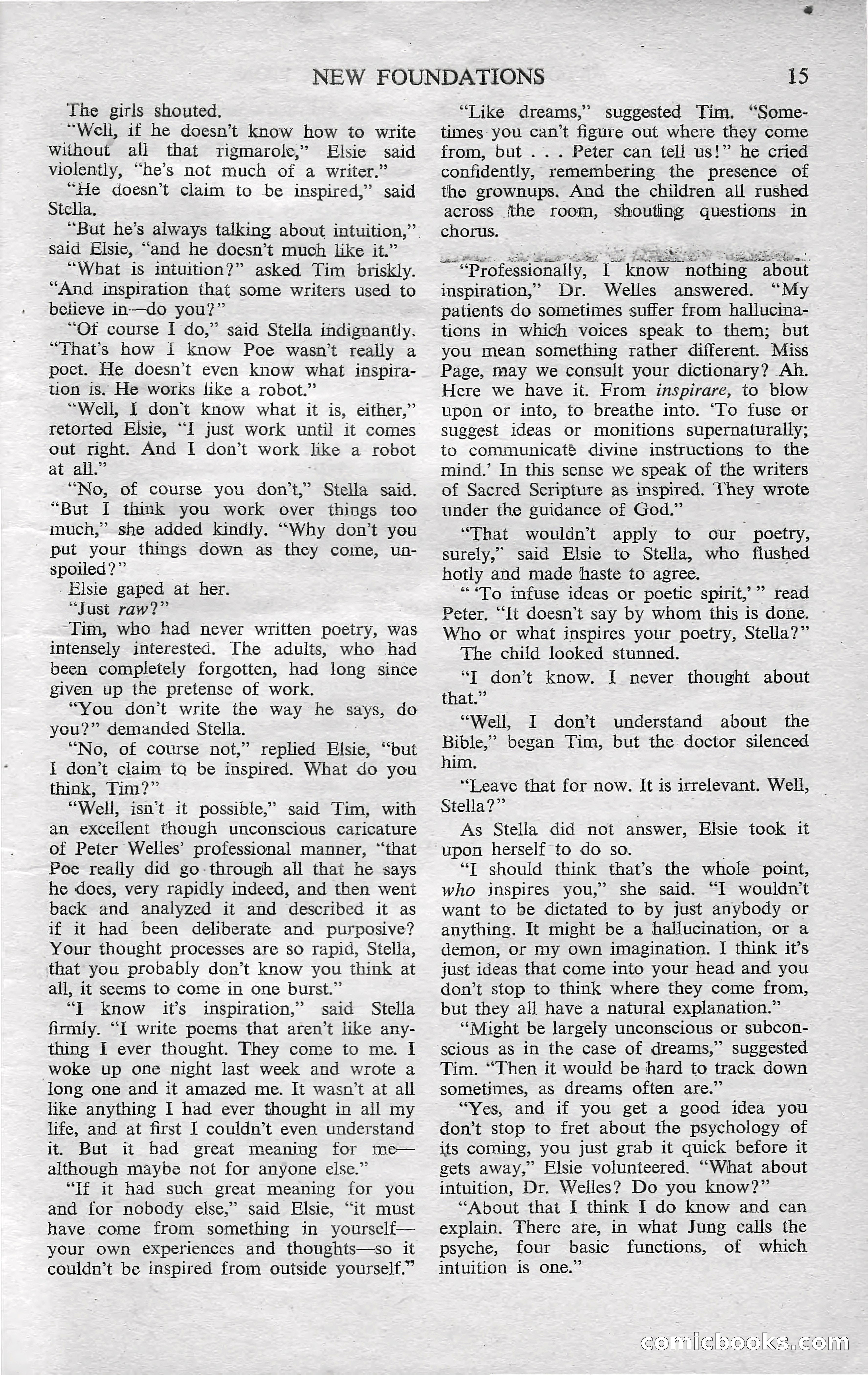
A restored page from Pulp Fiction, 1950. Page through the whole issue in the reader above.
📄 Transcribed text from this page (OCR, searchable)
Machine-transcribed from the original scan — historical spelling and the odd misread are preserved.
NEW FOUNDATIONS 15 The girls shouted, “Weli, if he doesn’t know how to write Without ail that rigmarole,’ Elsie said violently, “he’s not much of a writer.” “fie doesn’t claim to be inspired,” said Stella. _ “But he’s always talking about intuition,” said Elsie, “and he doesn’t much like it.” “What is intuition?” asked Tim briskly. “And inspiration that some writers used to believe in-—do you?” “Of course I do,” said Stella indignantly. “That’s how { know Poe wasn’t really a poet. He doesn’t even know what inspira- tion is. He works like a robot.” “Well, I don’t know what it is, either,” retorted Elsie, “I just work until it comes out right. And I don’t work like a robot at all.” “No, of course you don’t,” Stella said. “But IL think you work over things too much,” she added kindly. “Why don’t you ' put your things down as they come, un- spoiled?” -Elsie gaped at her. “Just raw?” Tim, who had never written poetry, was intensely interested. The adults, who had been completely forgotten, had long since given up the pretense of work. “You don’t write the way he says, do you?” demanded Stella. “No, of course not,” replied Elsie, “but i don’t claim tq be inspired. What do you think, Tim?” “Well, isn’t it possible,’ said Tim, with an excellent though unconscious caricature of Peter Welles’ professional manner, “that Poe really did go-through all that he says he does, very rapidly indeed, and then went back and analyzed it and described it as if it had been deliberate and purposive? Your thought processes are so rapid, Stella, that you probably don’t know you think at all, it seems to come in one burst.” “I Know it’s inspiration,’ said Stella firmly. “I write poems that aren’t like any- thing I ever thought. They come to me. I woke up one night last week and wrote a long one and it amazed me. It wasn’t at all like anything I had ever thought in all my life, and at first I couldn’t even understand it. But it bad great meaning for me— although maybe not for anyone else.” “If it had such great meaning for you and for nobody else,” said Elsie, “it must have come from something in yourself— your own experiences and thoughts—so it couldn’t be inspired from outside yourself.” 3 “Tike dreams,” suggested Tim. ‘Some- times you can’t figure out where they come from, but . . . Peter can tell us!” he cried confidently, remembering the presence of the grownups. And the children all rushed across jthe room, =SRODUDE questions in chorus. “Professionally, I know ine about inspiration,” Dr. Welles answered. “My patients do sometimes suffer from hallucina- tions in which voices speak to them; but you mean something rather different. Miss Page, may we consult your dictionary? Ah. Here we have it. From inspirare, to blow upon or into, to breathe into. “Io fuse or suggest ideas or monitions supernaturally; to communicaté divine instructions to the mind.’ In this sense we speak of the writers of Sacred Scripture as inspired. They wrote under the guidance of God.” “That wouldn’t apply to our poetry, surely, said Elsie to Stella, who flushed hotly and made haste to agree. “To infuse ideas or poetic spirit,’ read Peter. “It doesn’t say by whom this is done. Who or what inspires your poetry, Stella?” The child looked stunned. “T don’t know. J never thought about that.” “Well, I don’t understand about the Bible,” began Tim, but the doctor silenced him. “Leave that for now. It is irrelevant. Well, Stella?” As Stella did not answer, Elsie took it upon herself to do so. “I should think that’s the whole point, who inspires you,’ she said. “I wouldn't want to be dictated to by just anybody or anything. It might be a hallucination, or a demon, or my own imagination. I think it’s just ideas that come into your head and you don’t stop to think where they come from, but they all have a natural explanation.” “Might be largely unconscious or subcon- scious as in the case of dreams,” suggested Tim. ““Then it would be hard to track down sometimes, as dreams often are.” “Yes, and if you get a good idea you don’t stop to fret about the psychology of its coming, you just grab it quick before it gets away, Elsie volunteered. “What about intuition, Dr. Welles? Do you know?” “About that I think I do know and can explain. There are, in what Jung calls the psyche, four basic functions, of which intuition is one.” ECOMIicbooksico