
Pulp Fiction, 1950 · page 18 of 68
Astounding Science Fiction, October 1950 — page 18: what you’re looking at
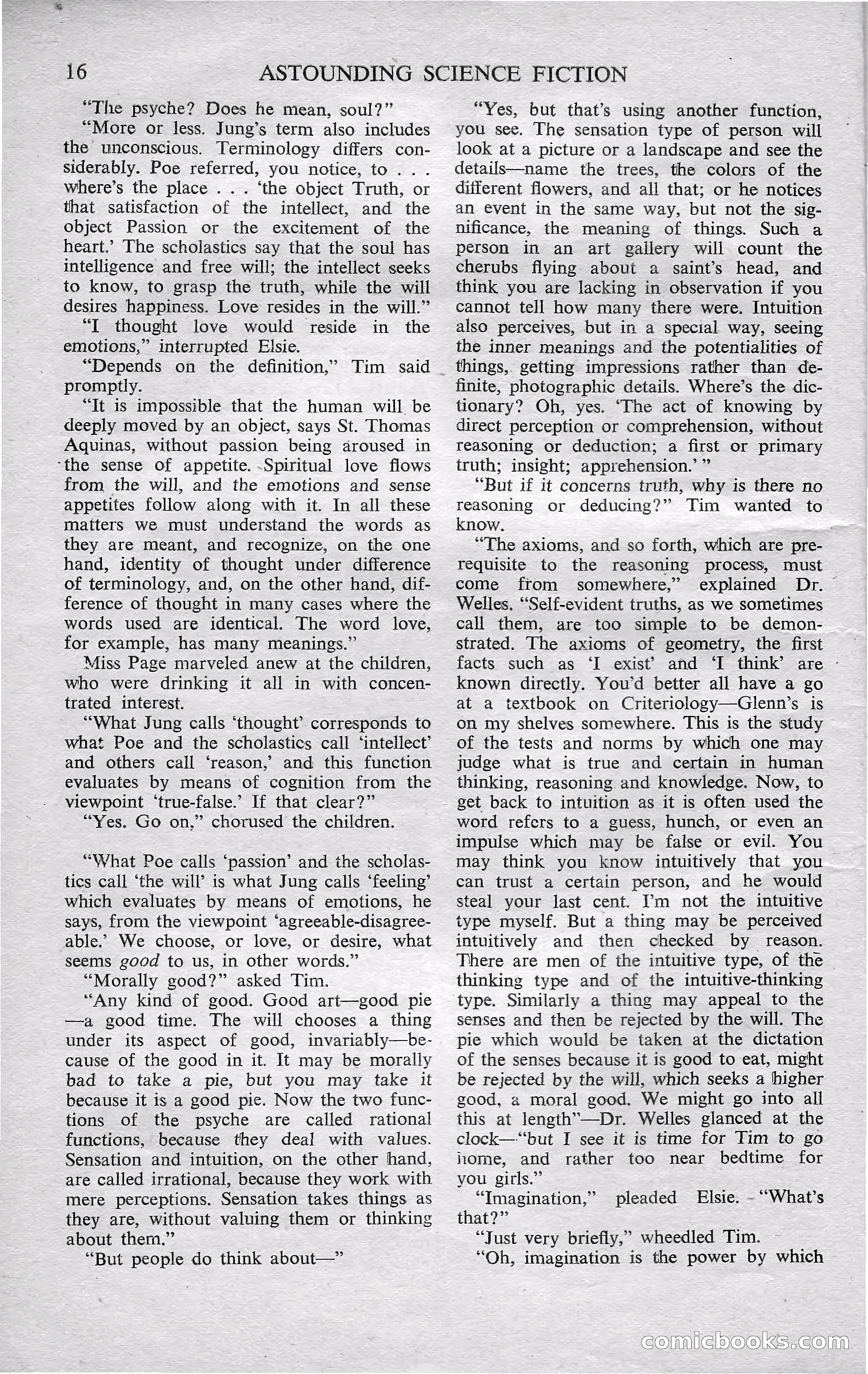
A restored page from Pulp Fiction, 1950. Page through the whole issue in the reader above.
📄 Transcribed text from this page (OCR, searchable)
Machine-transcribed from the original scan — historical spelling and the odd misread are preserved.
16 “The psyche? Does he mean, soul?” “More or less. Jung’s term also includes the unconscious. Terminology differs con- siderably. Poe referred, you notice, to... Where’s the place . . . ‘the object Truth, or that satisfaction of the intellect, and the object Passion or the excitement of the heart.’ The scholastics say that the soul has intelligence and free will; the intellect seeks to know, to grasp the truth, while the will desires happiness. Love resides in the will.” “I thought love would reside in the emotions,” interrupted Elsie. “Depends on the definition,’ Tim said | promptly. “It is impossible that the human will be deeply moved by an object, says St. Thomas Aquinas, without passion being aroused in ‘the sense of appetite. ~Spiritual love flows from the will, and the emotions and sense appetites follow along with it. In all these matters we must understand the words as they are meant, and recognize, on the one hand, identity of thought under difference of terminology, and, on the other hand, dif- ference of thought in many cases where the words used are identical. The word love, for example, has many meanings.” Miss Page marveled anew at the children, who were drinking it all in with concen- trated interest. “What Jung calls ‘thought’ corresponds to What Poe and the scholastics call ‘intellect’ and others call ‘reason,’ and this function evaluates by means of cognition from the viewpoint ‘true-false.’ If that clear?” “Yes. Go on,” chorused the children. “What Poe calls ‘passion’ and the scholas- tics call ‘the will’ is what Jung calls ‘feeling’ Which evaluates by means of emotions, he says, from the viewpoint ‘agreeable-disagree- able.’ We choose, or love, or desire, what seems good to us, in other words.” “Morally good?” asked Tim. “Any kind of good. Good art—good pie —a good time. The will chooses a thing under its aspect of good, invariably—be- cause of the good in it. It may be morally bad to take a pie, but you may take it because it is a good pie. Now the two func- tions of the psyche are called rational functions, because they deal with values. Sensation and intuition, on the other hand, are called irrational, because they work with mere perceptions. Sensation takes things as they are, without valuing them or thinking about them.” “But people do think about—” ASTOUNDING SCIENCE FICTION “Yes, but that’s using another function, you see. The sensation type of person will look at a picture or a landscape and see the details—name the trees, the colors of the different flowers, and all that; or he notices an event in the same way, but not the sig- nificance, the meaning of things. Such a person in an art gailery will count the cherubs flying about a saint’s head, and think you are lacking in observation if you cannot tell how many there were. Intuition also perceives, but in a special way, seeing the inner meanings and the potentialities of things,. getting impressions rather than de- finite, photographic details. Where’s the dic- tionary? Oh, yes. ‘The act of knowing by direct perception or comprehension, without reasoning or deduction; a first or primary truth; insight; apprehension.’ ” “But if it concerns truth, why is there no reasoning or deducing?” Tim wanted to know. “The axioms, and so forth, which are pre- requisite to the reasoning process, must come from Welles. “Self-evident truths, as we sometimes call them, are too simple to be demon- strated. The axioms of geometry, the first facts such as ‘I exist’ and ‘I think’ known directly. You'd better all have a go at a textbook on Criteriology—Glenn’s is on my shelves somewhere. This is the study of the tests and norms by which one may judge what is true and certain in human thinking, reasoning and knowledge. Now, to get back to intuition as it is often used the word refers to a guess, hunch, or even an impulse which may be false or evil. You may think you know intuitively that you can trust a certain person, and he would steal your last cent. I'm not the intuitive type myself. But a thing may be perceived intuitively and then checked by reason. There are men of the intuitive type, of the thinking type and of the intuitive-thinking ‘type. Similarly a thing may appeal to the senses and then be rejected by the will. The pie which would be taken at the dictation of the senses because it is good to eat, might be rejected by the will, which seeks a higher good, a moral good. We might go into all this at length’—Dr. Welles glanced at the clock—-<“‘but I see it is time for Tim to go home, and rather too near bedtime for you girls.” “Tmagination,” that?” “Just very briefly,” wheedled Tim. “Oh, imagination is the power by which pleaded Elsie. - ““What’s somewhere,” explained Dr. — are ~ GComichbookssco im