
Pulp Fiction, 1950 · page 16 of 68
Astounding Science Fiction, October 1950 — page 16: what you’re looking at
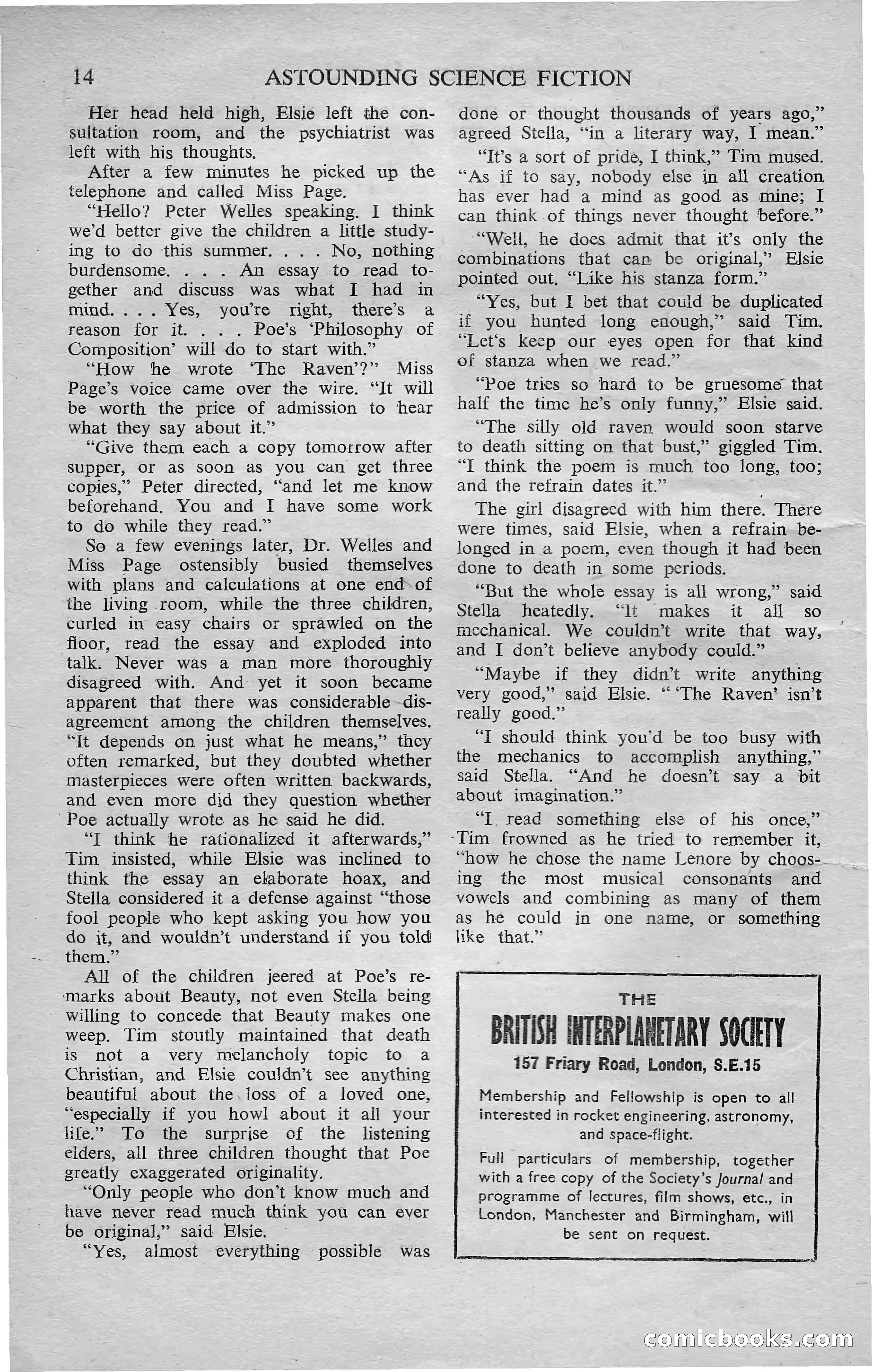
A restored page from Pulp Fiction, 1950. Page through the whole issue in the reader above.
📄 Transcribed text from this page (OCR, searchable)
Machine-transcribed from the original scan — historical spelling and the odd misread are preserved.
14 Her head held high, Elsie left the con- sultation room, and the psychiatrist was left with his thoughts. After a few minutes he picked up the telephone and called Miss Page. “Hello? Peter Welles speaking. I think we'd better give the children a little study- ing to do this summer. ... No, nothing burdensome. . An essay to read to- gether and discuss was what I had in mind. yes, “youre. right =there’s a reason for it. . . . Poe’s ‘Philosophy of Composition’ will do to start with.” “How he wrote “The Raven’?”’ Miss Page’s voice came over the wire. “It will be worth the price of admission to hear what they say about it.” “Give them each a copy tomorrow after supper, OF aS soon as you can get three copies,’ Peter directed, “and let me know beforehand. You and I have some work to do while they read.” So a few evenings later, Dr. Welles and Miss Page ostensibly busied themselves with plans and calculations at one end of the living room, while the three children, curled in easy chairs or sprawled on the floor, read the essay and exploded into talk. Never was a man more thoroughly disagreed with. And yet it soon became apparent that there was considerable -dis- agreement among the children themselves. “It depends on just what he means,” they often remarked, but they doubted whether masterpieces were often written backwards, and even more did they question whether ~Poe actually wrote as he said he did. “T think he rationalized it afterwards,” Tim insisted, while Elsie was inclined to think the essay an ebhaborate hoax, and Stella considered it a defense against “those fool people who kept asking you how you do it, and wouldn’t understand if you told them.” All of the children jeered at Poe’s re- ‘marks about Beauty, not even Stella being willing to concede that Beauty makes one weep. Tim stoutly maintained that death is not a very melancholy topic to a Christian, and Elsie couldn’t see anything beautiful about the.loss of a loved one, “especially if you howl about it all your life.’ To the surprise of the listening elders, all three children thought that Poe greatly exaggerated originality. “Only people who don’t know much and have never read much think you can ever be original,” said Elsie. “Yes, almost everything possible was ASTOUNDING SCIENCE FICTION done or thought thousands of years ago,” agreed Stella, “in a literary way, I mean.” “It’s a sort of pride, I think,’ Tim mused. “As if to say, nobody else in all creation has ever had a mind as good as mine; I can think of things never thought before.” “Well, he does admit that it’s only the combinations that can be original,’ Elsie pointed out, “Like his stanza form.” “Yes, but I bet that could be duplicated if you hunted long enough,” said Tim. “Let’s Keep our eyes open for that kind of stanza when we read.” “Poe tres so hard to be gruesome that half the time he’s only funny,” Elsie said. “The silly old raven would soon starve to death sitting on that bust,” giggled Tim. “IT think the poem is much too long, too; and the refrain dates it.” The girl disagreed with him there. There were times, said Elsie, when a refrain be- longed in a poem, even though it had been done to death in some periods. “But the whole essay is all wrong,” said Stella heatedly. “lt makes it all so mechanical. We couldn’t write that way, and I don’t believe anybody could.” “Maybe if they didn’t write anything very good,” said Elsie. “ “The Raven’ isn’t teally good.” “I should think you'd be too busy with the mechanics to accomplish anything,” said Stella. “And he doesn’t say a bit about imagination.” “I. read something else of his once,” ‘Tim frowned as he tried to remember it, “how he chose the name Lenore by choos-. ing the most musical consonants and vowels and combining as many of them as he could in one name, or something like that.” BRITISH INTERPLABETARY SOCIETY 157 Friary Road, London, S.E.15 Membership and Fellowship is open to all interested in rocket engineering, astronomy, and space-flight. Full particulars of membership, together with a free copy of the Society’s journal and programme of lectures, film shows, etc., in London, Manchester and Birmingham, will be sent on request. Eomichook (S@)