
Pulp Fiction, 1950 · page 15 of 68
Astounding Science Fiction, October 1950 — page 15: what you’re looking at
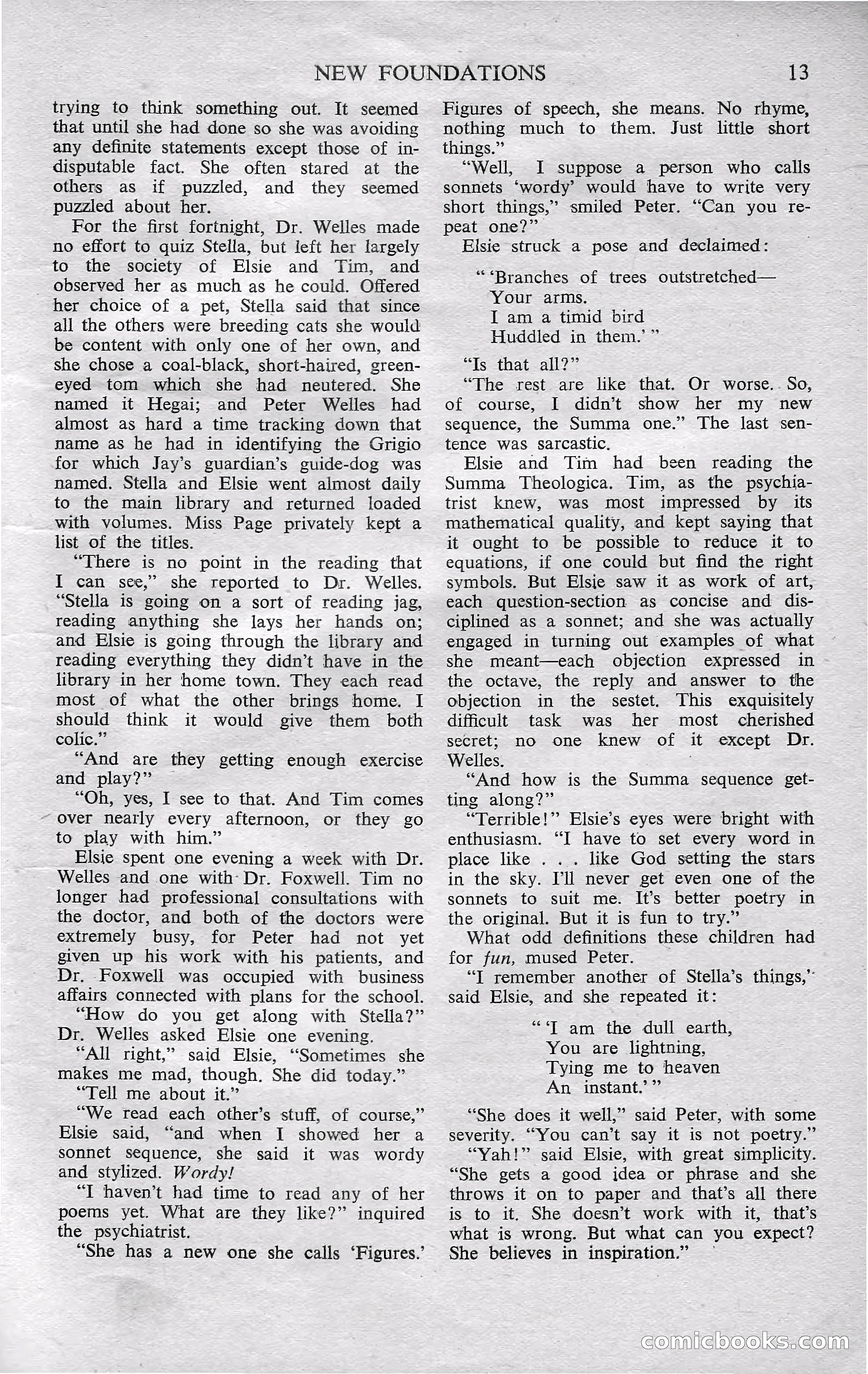
A restored page from Pulp Fiction, 1950. Page through the whole issue in the reader above.
📄 Transcribed text from this page (OCR, searchable)
Machine-transcribed from the original scan — historical spelling and the odd misread are preserved.
NEW FOUNDATIONS trying to think something out. It seemed that until she had done so she was avoiding any definite statements except those of in- disputable fact. She often stared at the others as if puzzled, and they seemed puzzled about her. For the first fortnight, Dr. Welles made no effort to quiz Stella, but left her largely to the society of Elsie and Tim, and observed her as much as he could. Offered her choice of a pet, Stella said that since all the others were breeding cats she would be content with only one of her own, and She chose a coal-black, short-haired, green- eyed tom which she had neutered. She named it Hegai; and Peter Welles had almost as hard a time tracking down that name as he had in identifying the Grigio for which Jay’s guardian’s guide-dog was named. Stella and Elsie went almost daily to the main library and returned loaded with volumes. Miss Page privately kept a list of the titles. “There is no point in the reading that I can see,” she reported to Dr. Welles. “Stella is going on a sort of reading jag, reading anything she lays her hands on; and Elsie is going through the library and reading everything they didn’t have in the library in her home town. They each read most of what the other brings home. I should think it would give them both colic.” “And are they getting enough exercise and play?” “Oh, yes, I see to that. And Tim comes Over nearly every afternoon, or they go to play with him.” Elsie spent one evening a week with Dr. Welles and one with: Dr. Foxwell. Tim no longer had professional consultations with the doctor, and both of the doctors were extremely busy, for Peter had not yet given up his work with his patients, and Dr, Foxwell was occupied with business affairs connected with plans for the school. “How do you get along with Stella?” Dr. Welles asked Elsie one evening. “All right,” said Elsie, “Sometimes she makes me mad, though. She did today.” “Tell me about it.” “We read each other’s stuff, of course,” Elsie said, “and when I showed her a sonnet sequence, she said it was wordy and stylized. Wordy! “T haven’t had time to read any of her poems yet. What are they like?” inquired the psychiatrist. “She has a new one she calls ‘Figures.’ 13 Figures of speech, she means. No rhyme, nothing much to them. Just little short things.” “Well, I suppose a person who calls sonnets ‘wordy’ would have to write very short things,’ smiled Peter. “Can you re- peat one?” Elsie struck a pose and declaimed: ‘“““Branches of trees outstretched— Your arms. I am a timid bird Huddled in them.’ ” “Ts that all?” “The rest are like that. Or worse.. So, of course, I didn’t show her my new sequence, the Summa one.” The last sen- tence was sarcastic. Elsie and Tim had been reading the Summa Theologica. Tim, as the psychia- trist knew, was most impressed by its mathematical quality, and kept saying that it ought to be possible to reduce it to equations, if one could but find the right symbols. But Elsie saw it as work of art, each question-section as concise and dis- ciplined as a sonnet; and she was actually engaged in turning out examples of what she meant—each objection expressed in the octave, the reply and answer to the objection in the sestet. This exquisitely difficult task was her most cherished secret; no one knew of it except Dr. Welles. : “And how is the Summa sequence get- ting along?” “Terrible!’”’ Elsie’s eyes were bright with enthusiasm. “I have to set every word in place like . . . like God setting the stars in the sky. Ill never get even one of the sonnets to suit me. It’s better poetry in the original. But it is fun to try.” What odd definitions these children had for fun, mused Peter. “TJ remember another of Stella’s things,” said Elsie, and she repeated it: ““T am the dull earth, You are lightning, Tying me to heaven An instant.’ ” “She does it well,” said Peter, with some severity. “You can’t say it is not poetry.” “Yah!” said Elsie, with great simplicity. “She gets a good idea or phrase and she throws it on to paper and that’s all there is to it. She doesn’t work with it, that’s what is wrong. But what can you expect? She believes in inspiration.” Eomichboo SnlS@)