
Pulp Fiction, 1950 · page 12 of 68
Astounding Science Fiction, October 1950 — page 12: what you’re looking at
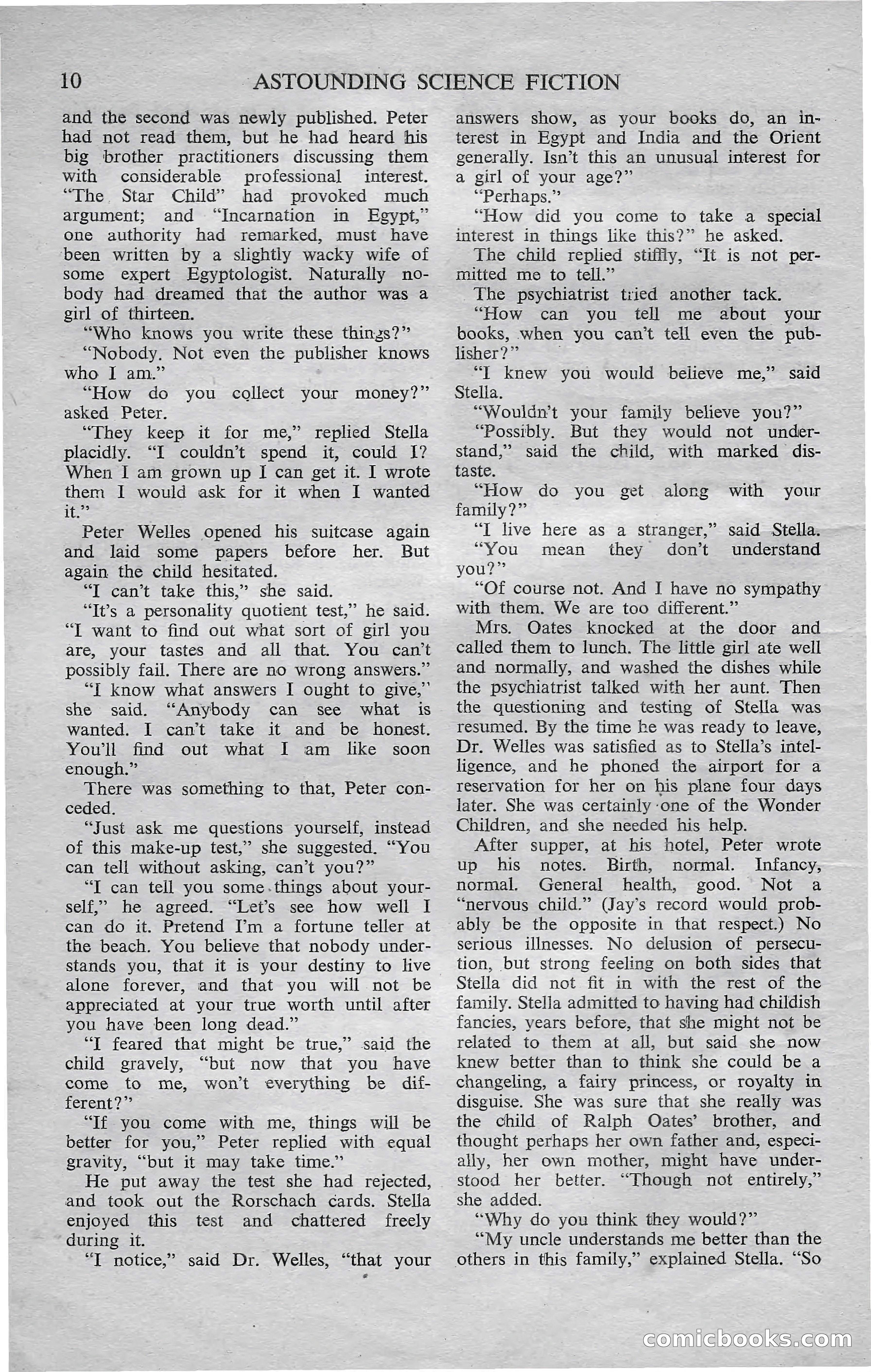
A restored page from Pulp Fiction, 1950. Page through the whole issue in the reader above.
📄 Transcribed text from this page (OCR, searchable)
Machine-transcribed from the original scan — historical spelling and the odd misread are preserved.
10 and the second was newly published. Peter had not read them, but he had heard his big brother practitioners discussing them with considerable professional interest. “The. Star Child” had provoked much argument; and “Incarnation in Egypt,” one authority had remarked, must have ‘been written by a slightly wacky wife of some expert Egyptologist. Naturally no- body had dreamed that the author was a girl of thirteen. “Who knows you write these thinzs?” “Nobody. Not even the publisher knows who J am.” : “How do you collect your money?” asked Peter. “They keep it for me,” replied Stella placidly. “I couldn’t spend it, could I? When I am grown up I can get it. I wrote them I would ask for it when I wanted ie Peter Welles opened his suitcase again and laid some papers before her. But again the child hesitated. “T can’t take this,” she said. “It’s a personality quotient test,” he said. “T want to find out what sort of girl you are, your tastes and all that. You cant possibly fail. There are no wrong answers.” “T know what answers I ought to give,” she said. “Anybody can see what is wanted. I can’t take it and be honest. You'll find out what I am like soon enough.” There was something to that, Peter con- ceded. “Just ask me questions yourself, instead of this make-up test,” she suggested. “You can tell without asking, can’t you?” “T can tell you some.things about your- self,” he agreed. “Let’s see how well I can do it. Pretend I’m a fortune teller at the beach. You believe that nobody under- stands you, that it is your destiny to live alone forever, and that you will not be appreciated at your true worth until after you have been long dead.” “TI feared that might be true,” said the child gravely, “but now that you have come to me, won't everything be dii- ferent?” “If you come with me, things will be better for you,’ Peter replied with equal gravity, “but it may take time.” He put away the test she had rejected, and took out the Rorschach cards. Stella enjoyed this test and chattered freely during it. “T notice,” said Dr. Welles, “that your others in this family, -ASTOUNDING SCIENCE FICTION answers show, as your books do, an in- . terest in Egypt and India and the Orient generally. Isn’t this an unusual interest for a girl of your age?” ““Perhaps.” “How did you come to take a special interest in things like this?” he asked. The child replied stiffly, “It is not per- mitted me to tell.” The psychiatrist tried another tack. “How can you tell me about your books, when you can’t tell even the pub- lisher?” . “I knew you would believe me,” said Stella. “Wouldn't your family believe you?” “Possibly. But they would not under- stand,” said the child, with marked dis- taste. “How do you get along with your family?” “IT live here as a stranger,” said Stella. “You mean they don’t understand you?” “Of course not. And I have no sympathy with them. We are too different.” Mrs. Oates knocked at the door and called them to lunch. The little girl ate well and normally, and washed the dishes while the psychiatrist talked with her aunt. Then the questioning and testing of Stella was resumed. By the time he was ready to leave, Dr. Welles was satisfied as to Stella’s intel- ligence, and he phoned the airport for a reservation for her on his plane four days later. She was certainly one of the Wonder Children, and she needed his help. After supper, at his hotel, Peter wrote up his notes. Birth, normal. Infancy, normal. General health, good. Not a “nervous child.” (Jay’s record would prob- ably be the opposite in that respect.) No serious illnesses. No delusion of persecu- tion, but strong feeling on both sides that Stella did not fit in with the rest of the family. Stella admitted to having had childish fancies, years before, that she might not be related to them at all, but said she now knew better than to think she could be a changeling, a fairy princess, or royalty in disguise. She was sure that she really was the child of Ralph Oates’ brother, and thought perhaps her own father and, especi- ally, her own mother, might have under- stood her better. “Though not entirely,” she added. “Why do you think they would?” “My uncle understands me better than the 7,’ explained Stella. “So Eomichook (G)