
Pulp Fiction, 1950 · page 13 of 68
Astounding Science Fiction, October 1950 — page 13: what you’re looking at
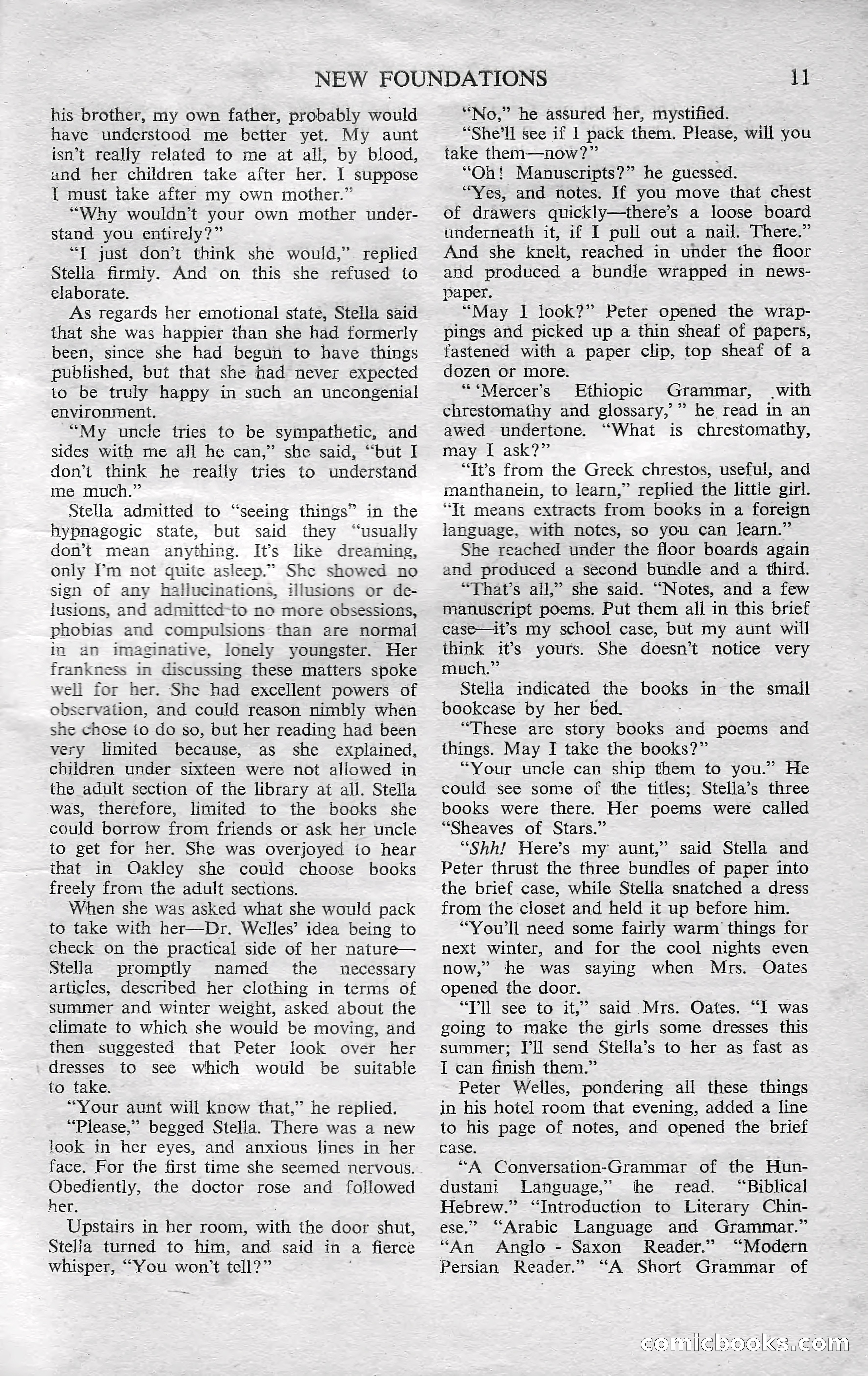
A restored page from Pulp Fiction, 1950. Page through the whole issue in the reader above.
📄 Transcribed text from this page (OCR, searchable)
Machine-transcribed from the original scan — historical spelling and the odd misread are preserved.
NEW FOUNDATIONS 11 his brother, my own father, probably would have understood me better yet. My aunt isn’t really related to me at all, by blood, and her children take after her. I suppose {i must take after my own mother.” “Why wouldn’t your own mother under- stand you entirely?” “T just don’t think she would,” replied Stella firmly. And on this she refused to elaborate. As regards her emotional state, Stella said that she was happier than she had formerly been, since she had begun to have things published, but that she had never expected to be truly happy in such an uncongenial environment. “My uncle tries to be sympathetic, and sides with me all he can,” she said, “but I don’t think he really tries to understand me much.” Stella admitted to “seeing things” in the hypnagogic state, but said they “usually don’t mean anything. It’s like dreaming, only I’m not quite asleep.” She showed no sign of any hallucinations, illusions or de- lusions, and admitted-to no more obsessions, phobias and compulsions than are normal in an imaginative, lonely youngster. Her frankness in discussing these matters spoke well for her. She had excellent powers of observation, and could reason nimbly when she chose to do so, but her reading had been very limited because, as she explained, children under sixteen were not allowed in the adult section of the library at all. Stella was, therefore, limited to the books she could borrow from friends or ask her uncle to get for her. She was overjoyed to hear that in Oakley she could choose books freely from the adult sections. When she was asked what she would pack to take with her—Dr. Welles’ idea being to check on the practical side of her nature— Stella promptly named the necessary articles, described her clothing in terms of summer and winter weight, asked about the climate to which she would be moving, and then suggested that Peter look over her dresses to see which would be suitable to take. “Your aunt will know that,” he replied. “Please,” begged Stella. There was a new look in her eyes, and anxious lines in her face. For the first time she seemed nervous. Obediently, the doctor rose and followed her. Upstairs in her room, with the door shut, Stella turned to him, and said in a fierce whisper, “You won’t tell?” “No,” he assured her, mystified. “She'll see if I pack them. Please, will you take them—now?” “Oh! Manuscripts?” he guessed. “Yes, and notes. If you move that chest of drawers quickly—there’s a loose board underneath it, if I pull out a nail. There.” And she knelt, reached in under the floor and produced a bundle wrapped in news- paper. “May I look?” Peter opened the wrap- pings and picked up a thin sheaf of papers, fastened with a paper clip, top sheaf of a dozen or mote. ““Mercer’s Ethiopic Grammar, with chrestomathy and glossary,” he read in an awed undertone. “What is chrestomathy, may I ask?” “It’s from the Greek chrestos, useful, and manthanein, to learn,” replied the little girl. “It means extracts from books in a foreign language, with notes, so you can learn.” She reached under the floor boards again and produced a second bundle and a third. “That’s all,” she said. “Notes, and a few manuscript poems. Put them all in this brief case—it’s my school case, but my aunt will think it’s yours. She doesn’t notice very much.” Stella indicated the books in the small bookcase by her bed. “These are story books and poems and things. May I take the books?” “Your uncle can ship them to you.” He could see some of the titles; Stella’s three books were there. Her poems were called “Sheaves of Stars.” “Shh! Here’s my aunt,” said Stella and Peter thrust the three bundles of paper into the brief case, while Stella snatched a dress from the closet and held it up before him. “You'll need some fairly warm things for next winter, and for the cool nights even now,” he was saying when Mrs. Oates opened the door. “T’ll see to it,’ said Mrs. Oates. “I was going to make the girls some dresses this summer; I'll send Stella’s to her as fast as I can finish them.” Peter Welles, pondering all these things in his hotel room that evening, added a line to his page of notes, and opened the brief case. “A Conversation-Grammar of the Hun- dustani Language,” the read. “Biblical Hebrew.” “Introduction to Literary Chin- ese.” “Arabic Language and Grammar.” “An Anglo - Saxon Reader.” “Modern Persian Reader.” “A Short Grammar of im Comichbooksnco