
Pulp Fiction, 1950 · page 11 of 68
Astounding Science Fiction, October 1950 — page 11: what you’re looking at
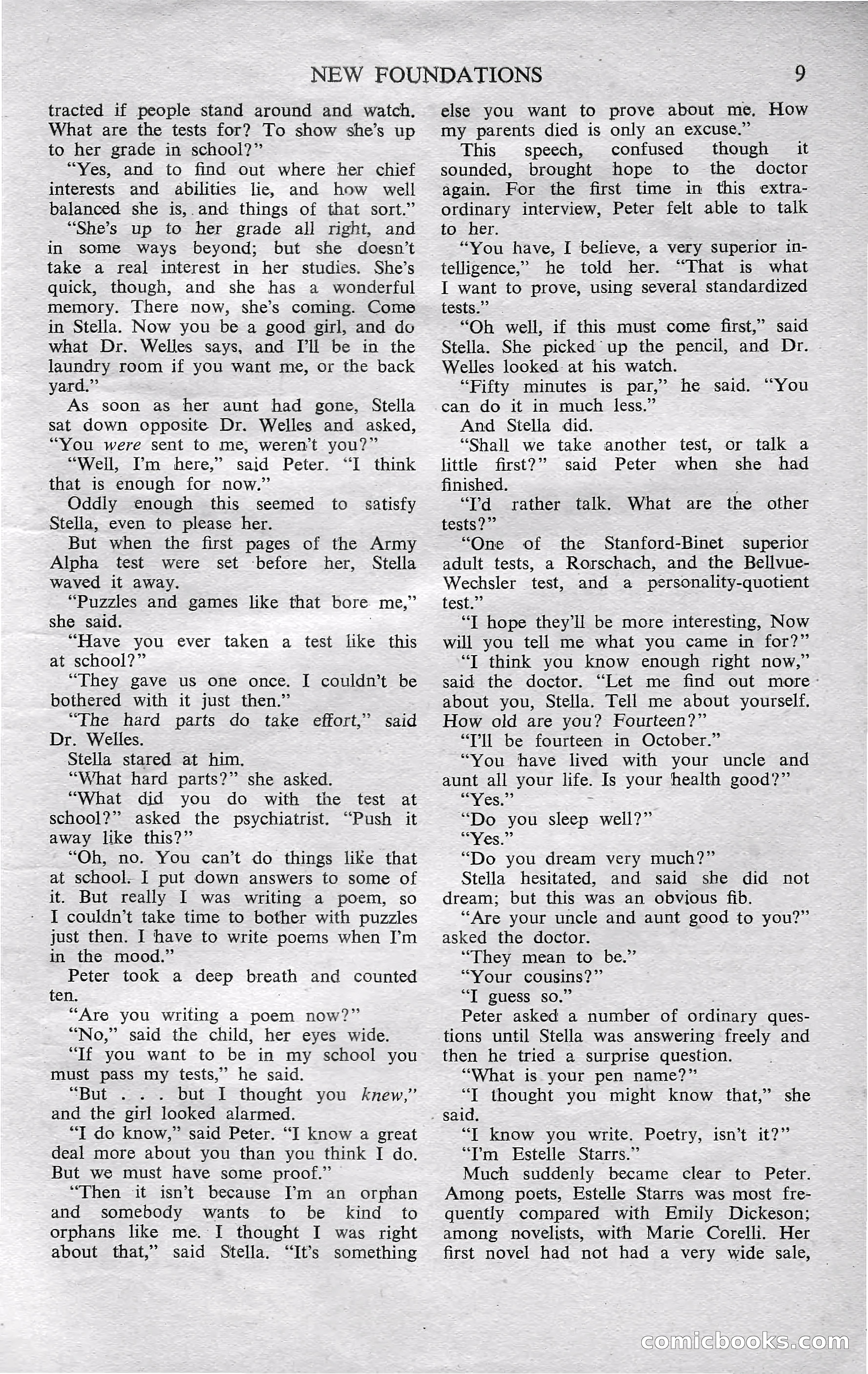
A restored page from Pulp Fiction, 1950. Page through the whole issue in the reader above.
📄 Transcribed text from this page (OCR, searchable)
Machine-transcribed from the original scan — historical spelling and the odd misread are preserved.
NEW FOUNDATIONS | 9 tracted if people stand around and watch. What are the tests for? To show she’s up to her grade in school?” “Yes, and to find out where her chief interests and abilities lie, and how well balanced she is,.and things of that sort.” “She’s up to her grade all right, and in some ways beyond; but she doesn’t take a real interest in her studies. She’s quick, though, and she has a wonderful memory. There now, she’s coming. Come in Stella. Now you be a good girl, and do what Dr. Welles says, and Ill be in the laundry room it you want me, or the back yard.” As soon as her aunt had gone, Stella sat down opposite Dr. Welles and asked, “You were sent to me, weren't you?” “Well, Pm here,” said Peter. “I think that is enough for now.” Oddly enough this seemed to satisfy Stella, even to please her. But when the first pages of the Army Alpha test were set ‘before her, Stella waved it away. “Puzzles and games like that bore me,’ she said. “Have you ever taken a test like this at school?” “They gave us one once. I couldn’t be bothered with it just then.” “The hard parts do take effort,” said Dr. Welles. Stella stared at him. “What hard parts?” she asked. “What did you do with the test at school?” asked the psychiatrist. “Push it away like this?” “Oh, no. You can’t do things like that at school. I put down answers to some of it. But really I was writing a poem, so I couldn’t take time to bother with puzzles just then. I have to write poems when I’m in the mood.” Peter took a deep eg ae and counted ten. “Are you writing a poem now?” “No,” said the child, her eyes wide. “If you want to be in my school you must pass my tests,” he said. “But . . . but I thought you knew,” and the girl looked alarmed. “I do know,” said Peter. “I know a great deal more about you than you think I do. But we must have some proof.” “Then it isn’t because I’m an orphan and somebody wants to be kind to orphans like me. I thought I was right about that,” said Stella. “It’s something else you want to prove about me. How my parents died is only an excuse.” This speech, confused though it sounded, brought hope to the doctor again. For the first time in this extra- ordinary interview, Peter felt able to talk to her. “You have, I believe, a very superior in- telligence,’ he told her. “That is what I want to prove, using several standardized tests.” “Oh well, if this must come first,’ said Stella. She picked up the pencil, and Dr. Welles looked at his watch. “Fifty minutes is par,” can do it in much less.” And Stella did. “Shall we take another test, or talk a he said. “You little first?” said Peter when she had finished. “Td rather talk. What are the other tests?” “One of the Stanford-Binet superior adult tests, a Rorschach, and the Bellvue- Wechsler test, and a personality-quotient test.” “T hope they'll be more interesting, Now will you tell me what you came in for?” “T think you know enough right now,” said the doctor. about you, Stella. Tell me about yourself. How old are you? Fourteen?” “Tl be fourteen in October.” “You have lived with your uncle and aunt all your life. Is your health good?” ev CS. “Do you sleep well?” yess: “Do you dream very much?” Stella hesitated, and said she did not dream; but this was an obvious fib. “Are your uncle and aunt good to you?” asked the doctor. “They mean to be.” “Your cousins?” “IT guess so.’ Peter asked a number of ordinary ques- tions until Stella was answering freely and then he tried a surprise question. “What is your pen name?” “T thought you might know that,” she . said. “[T know you write. Poetry, isn’t it?” “Tm Estelle Starrs.” “Let me find out more: Much suddenly became clear to Peter. Among poets, Estelle Starrs was most fre- quently compared with Emily Dickeson; among novelists, with Marie Corelli. Her first novel had not had a very wide sale, EComichoo