
Pulp Fiction, 1949 · page 9 of 68
Astounding British Edition, Vol. 6, No. 8 — page 9: what you’re looking at
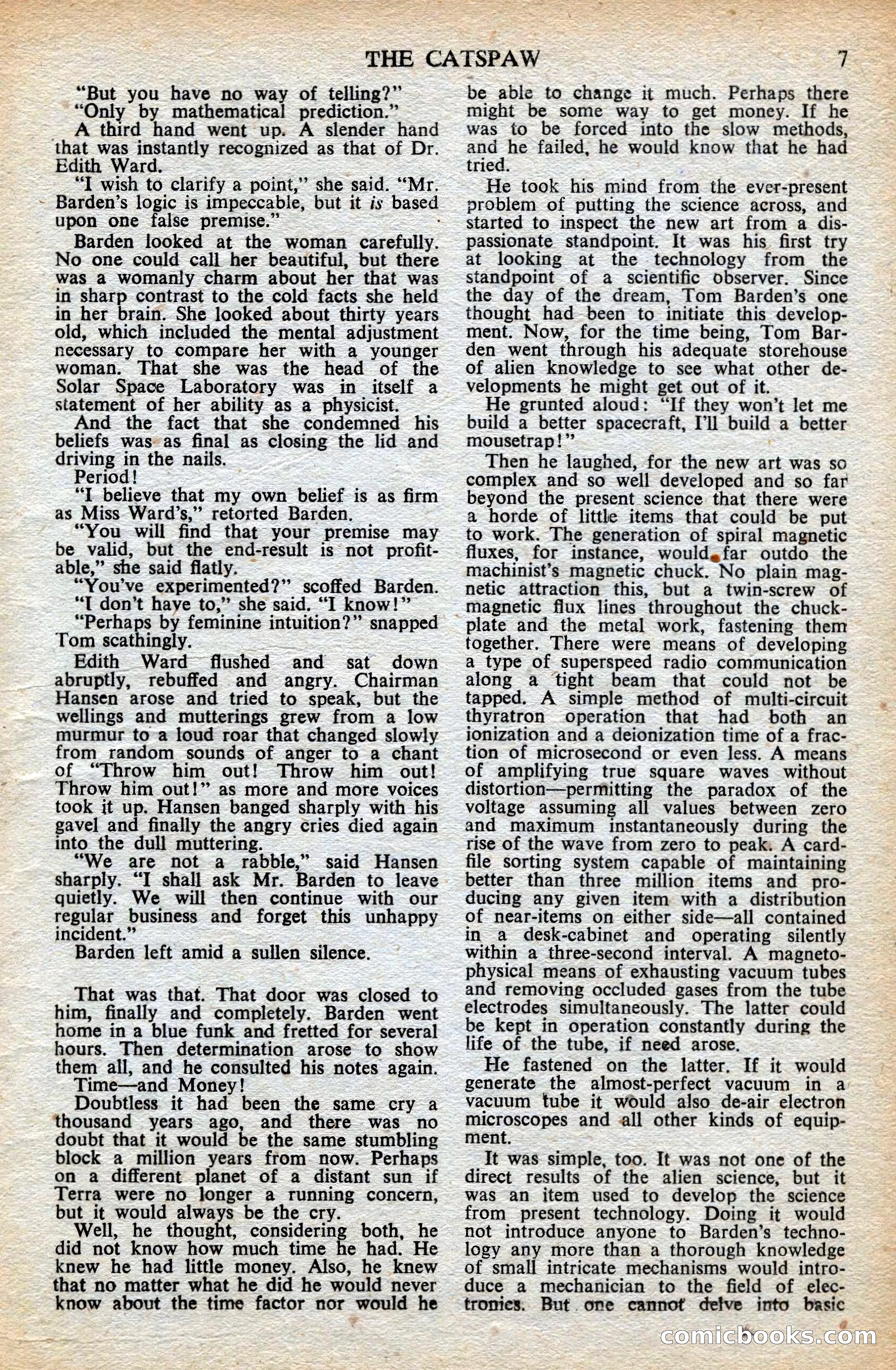
A restored page from Pulp Fiction, 1949. Page through the whole issue in the reader above.
📄 Transcribed text from this page (OCR, searchable)
Machine-transcribed from the original scan — historical spelling and the odd misread are preserved.
THE CATSPAW 7 “But you have no way of telling?” “Only by mathematical prediction.” A third hand went up. A slender hand that was instantly recognized as that of Dr. Edith Ward. “I wish to clarify a point,” she said. ‘Mr. Barden’s logic is impeccable, but it is based upon one false premise.” Barden looked at the woman carefully. No one could call her beautiful, but there was a womanly charm about her that was in sharp contrast to the cold facts she held in her brain. She looked about thirty years old, which included the mental adjustment necessary to compare her with a younger woman. That she was the head of the Solar Space Laboratory was in itself a statement of her ability as a physicist. And the fact that she condemned his beliefs was as final as closing the lid and driving in the nails. Period! “I. believe that my own belief is as firm as Miss Ward’s,” retorted Barden. “You will find that your premise may be valid, but the end-result is not profit- able,” she said flatly. © “You've experimented?” scoffed Barden. “[ don’t haye to,” she said. “I know!” “Perhaps by feminine intuition?” snapped Tom scathingly. Edith Ward flushed and sat down abruptly, rebuffed and angry. Chairman Hansen arose and tried to speak, but the wellings and mutterings grew from a low murmur to a loud roar that changed slowly from random sounds of anger to a chant of “Throw him out! Throw him out! Throw him out!” as more and more voices took it up. Hansen banged sharply with his gavel and finally the angry cries died again into the dull muttering. “We are not a rabble,” said Hansen sharply. “I shall ask Mr. Barden to leave quietly. We will then continue with our regular business and forget this unhappy incident.” Barden left amid a sullen silence. That was that. That door was closed to him, finally and completely. Barden went home in a blue funk and fretted for several hours. Then determination arose to show them all, and he consulted his notes again. Time—and Money! Doubtless it had been the same cry a thousand years ago, and there was no doubt that it would be the same stumbling block a million years from now. Perhaps on a different planet of a distant sun if Terra were no Jonger a running concern, but it would always be the cry. Well, he thought, considering both, he did not know how much time he had. He knew he had little money. Also, he knew that no matter what he did he would never know about the time factor nor would he be able to change it much. Perhaps there might be some way to get money. If he was to be forced into the slow methods, and he failed, he would know that he had tried. He took his mind from the ever-present problem of putting the science across, and started to inspect the new art from a dis- passionate standpoint. It was his first try at looking at the technology from the standpoint of a scientific observer. Since the day of the dream, Tom Barden’s one thought had been to initiate this develop- ment. Now, for the time being, Tom Bar- den went through his adequate storehouse of alien knowledge to see what other de- velopments he might get out of it. He grunted aloud: “If they won’t let me build a better spacecraft, I'll build a better mousetrap!” Then he laughed, for the new art was so complex and so well developed and so far beyond the present science that there were a horde of little items that could be put to work. The generation of spiral magnetic fluxes, for instance, would,far outdo the machinist’s magnetic chuck. No plain mag- netic attraction this, but a twin-screw of magnetic flux lines throughout the chuck- plate and the metal work, fastening them together. There were means of developing a type of superspeed radio communication along a tight beam that could not be tapped. A simple method of multi-circuit thyratron operation that had both an ionization and a deionization time of a frac- tion of microsecond or even less. A means of amplifying true square waves without distortion—permitting the paradox of the voltage assuming all values between zero and maximum instantaneously during the rise of the wave from zero to peak. A card- file sorting system capable of maintaining better than three million items and _ pro- ducing any given item with a distribution of near-items on either side—all contained in a desk-cabinet and operating silently within a three-second interval. A magneto- physical means of exhausting vacuum tubes and removing occluded gases from the tube electrodes simultaneously. The latter could be kept in operation constantly during the life of the tube, if need arose. He fastened on the latter. If it would generate the almost-perfect vacuum in a vacuum tube it would also de-air electron microscopes and all other kinds of equip- ment. It was simple, too. It was not one of the direct results of the alien science, but it was an item used to develop the science from present technology. Doing it would not introduce anyone to Barden’s techno- logy any more than a thorough knowledge of small intricate mechanisms would intro- duce a mechanician to the field of elec- tromics. But. one cannot delve into basic GOmIiGcbooks a com