
Pulp Fiction, 1949 · page 10 of 68
Astounding British Edition, Vol. 6, No. 8 — page 10: what you’re looking at
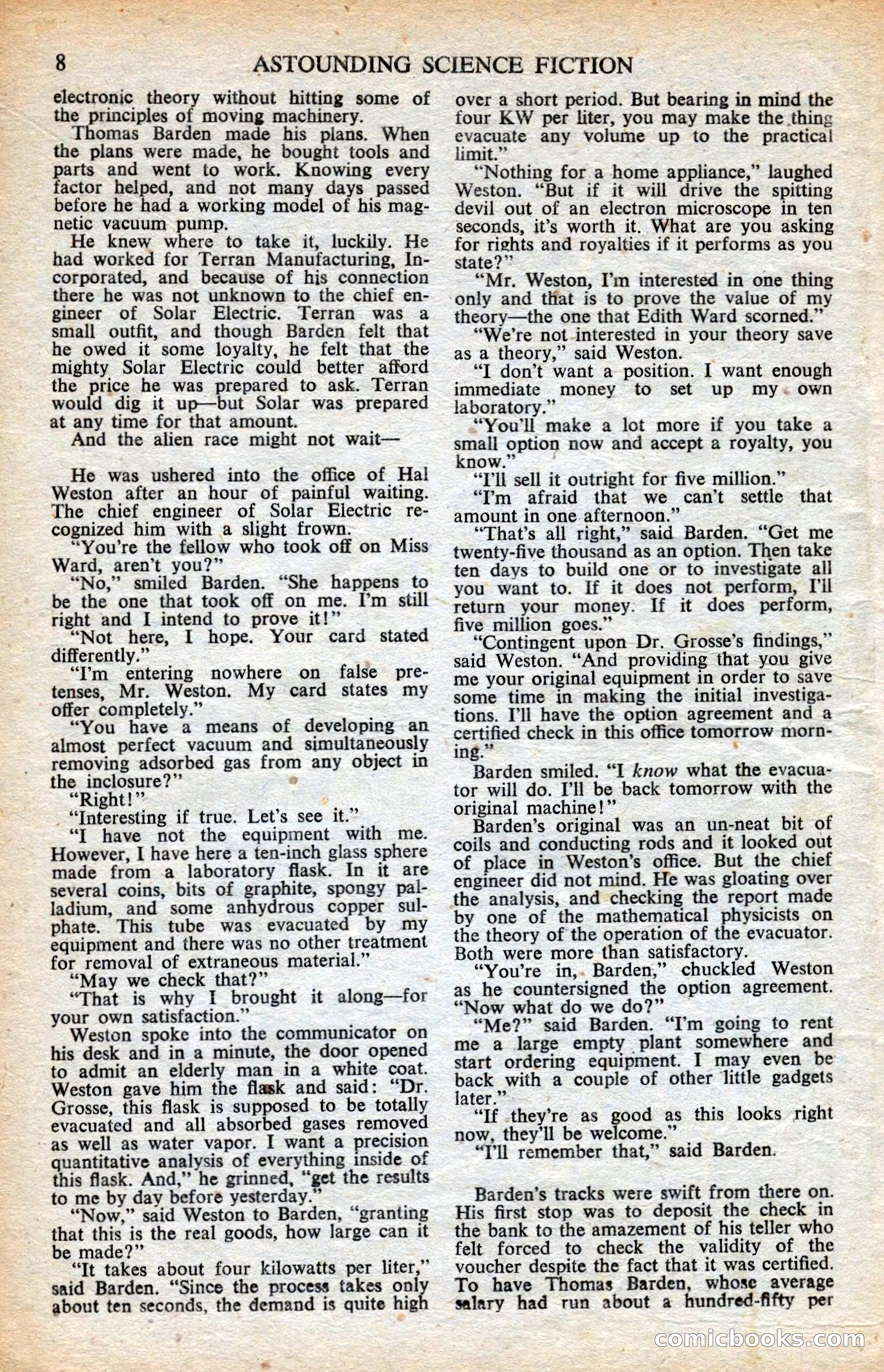
A restored page from Pulp Fiction, 1949. Page through the whole issue in the reader above.
📄 Transcribed text from this page (OCR, searchable)
Machine-transcribed from the original scan — historical spelling and the odd misread are preserved.
- a ae ee Se wer ' _ ~ “a « J _— ‘ 2 *- > - ty i ee ~ = > Pac < ser . 7 * 8 ASTOUNDING SCIENCE FICTION electronic theory without hitting some of the principles of moving machinery. Thomas Barden made his plans. When the plans were made, he bought tools and parts and went to work. Knowing every factor helped, and not many days passed before he had a working model of his mag- netic vacuum pump. He knew where to take it, luckily. He had worked for Terran Manufacturing, In- corporated, and because of his connection there he was not unknown to the chief en- gineer of Solar Electric. Terran was a small outfit, and though Barden felt that he owed it some loyalty, he felt that the mighty Solar Electric could better afford the price he was prepared to ask. Terran would dig it up—but Solar was prepared at any time for that amount. And the alien race might not wait— He was ushered into the office of Hal Weston after an hour of painful waiting. The chief engineer of Solar Electric re- cognized him with a slight frown. “You're the fellow who took off on Miss Ward, aren’t you?” “No,” smiled Barden. “She happens to be the one that took off on me. I’m still right and [ intend to prove it!” “Not here, I hope. Your card stated differently.” “I’m entering nowhere on false pre- tenses, Mr. Weston. My card states my offer completely.” “You have a means of developing an almost perfect vacuum and simultaneously removing adsorbed gas from any object in the inclosure?” 9 “Right!” : “Interesting if true. Let’s see it.” “T have not the equipment with me. However, I have here a ten-inch glass sphere made from a laboratory flask. In it are several coins, bits of graphite, spongy pal- ladium, and some anhydrous copper sul- phate. This tube was evacuated by my equipment and there was no other treatment for removal of extraneous material.” “May we check that?” “That is why I brought it along—for your own satisfaction.” Weston spoke into the communicator on his desk and in a minute, the door opened to admit an elderly man in a white coat. Weston gave him the flask and said: “Dr. Grosse, this flask is supposed to be totally evacuated and all absorbed gases removed as well as water vapor. I want a precision quantitative analysis of everything inside of this flask. And,” he grinned, “get the results to me by day before yesterday.” “Now,” said Weston to Barden, “granting that this is the real goods, how large can it be made?”’ “Tt takes about four kilowatts per liter,” said Barden. “Since the process takes onl about ten seconds, the demand is quite hig over a short period. But bearing in mind the four KW per liter, you may make the thing evacuate any volume up to the practical limit.” “Nothing for a home appliance,” laughed Weston. “But if it will drive the spitting devil out of an electron microscope in ten seconds, it’s worth it. What are you asking for rights and royalties if it performs as you state?” | “Mr. Weston, I’m interested in one thing only and tHat is to prove the value of my theory—the one that Edith Ward scorned.” “We're not interested in your theory save as a theory,” said Weston. “T don’t want a position. I want enough immediate money to set up my. own laboratory.” “You'll make a lot more if you take a small option now and accept a royalty, you know.” “T'li sell it outright for five million.” “I'm afraid that we can’t settle that “amount in one afternoon.” “That’s all right,” said Barden. “Get me twenty-five thousand as an option. Then take ten days to build one or to investigate all you want to. If it does not perform, Til return your money. If it does perform, five million goes.” “Contingent upon Dr. Grosse’s findings,” said Weston. “And providing that you give me your original equipment in order to save some time in making the initial investiga- tions. I'll have the option agreement and a certified check in this office tomorrow morn- ing.” . Barden smiled. “I know what the evacua- tor will do. I'll be back tomorrow with the original machine!” Barden’s original was an un-neat bit of coils and conducting rods and it looked out of place in Weston’s office. But the chief engineer did not mind. He was gloating over the analysis, and checking the report made by one of the mathematical physicists on the theory of the operation of the evacuator. Both were more than satisfactory. “You're in,. Barden,” chuckled Weston as he countersigned the option agreement. “Now what do we do?” “Me?” said Barden. “I’m going to rent me a large empty plant somewhere and start ordering equipment. I may even be — with a couple of other little gadgets ater.” “If they’re as good as this looks right now, they'll be welcome.” “I'll remember that,” said Barden. Barden’s tracks were swift from there on. His first stop was to deposit the check in the bank to the amazement of his teller who felt forced to check the validity of the voucher despite the fact that it was certified. To have Thomas Barden, whose average salary had run about a hundred-fifty per ConmicooOokSse®