
Pulp Fiction, 1949 · page 8 of 68
Astounding British Edition, Vol. 6, No. 8 — page 8: what you’re looking at
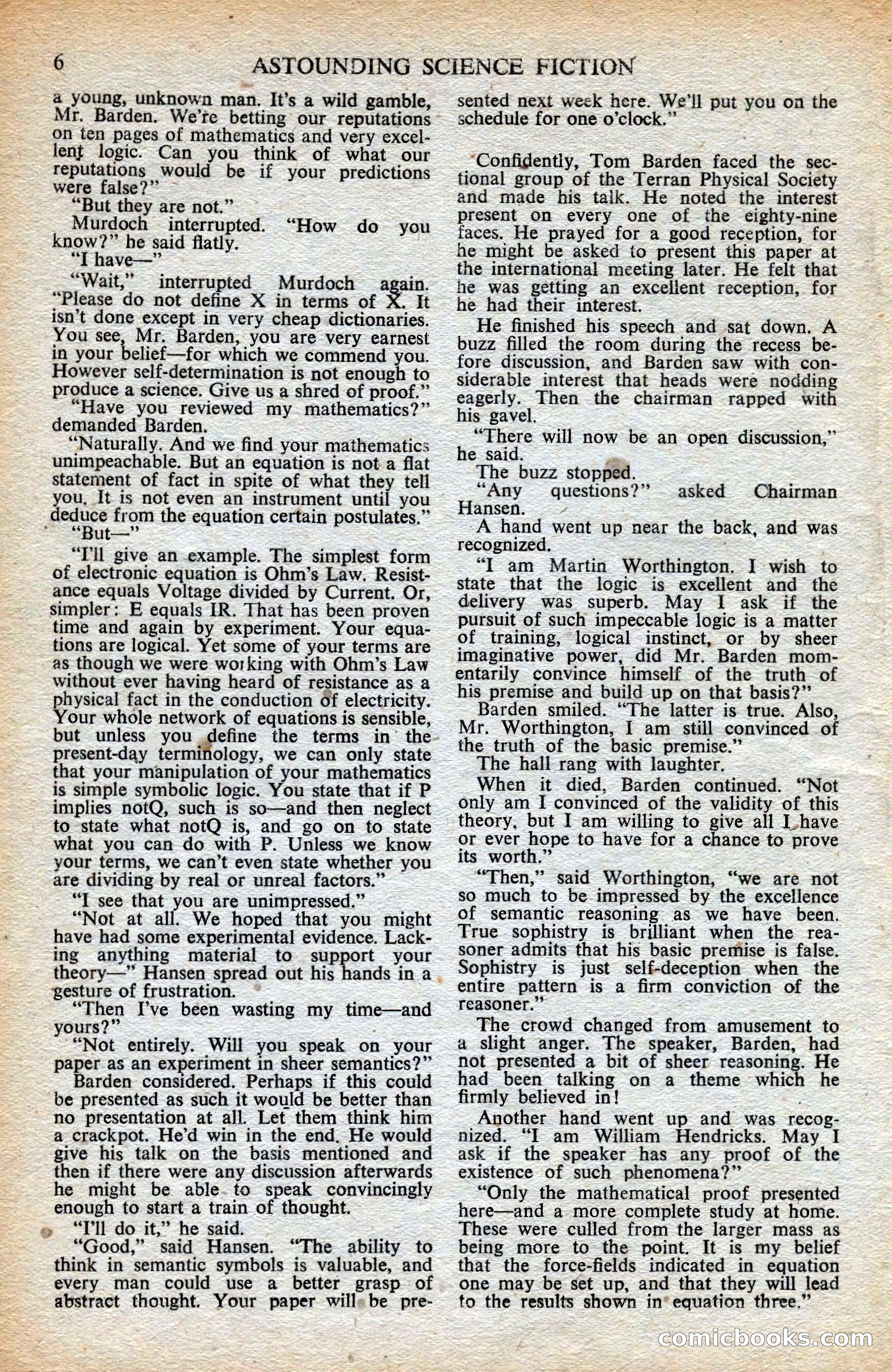
A restored page from Pulp Fiction, 1949. Page through the whole issue in the reader above.
📄 Transcribed text from this page (OCR, searchable)
Machine-transcribed from the original scan — historical spelling and the odd misread are preserved.
a young, unknown man. It’s a wild gamble, Mr. Barden. We’te betting our reputations on ten pages of mathematics and very excel- lent logic. Can you think of what our reputations would be if your predictions were false?” ~ “But they are not.” Murdoch interrupted. “How do you know?” he said flatly. “IT have—” “Wait,” interrupted Murdoch again. “Please do not define X in terms of X. It isn’t done except in very cheap dictionaries. You see, Mr. Barden, you are very earnest in your belief—for which we commend you. However self-determination is not enough to produce a science. Give us a shred of proof.” “Have you reviewed my mathematics?” demanded Barden. “Naturally. And we find your mathematics unimpeachable. But an equation is not a flat statement of fact in spite of what they tell you, It is not even an instrument until you © deduce from the equation certain postulates,” aed “But—” “Til give an example. The simplest form of electronic equation is Ohm’s Law. Resist- ance equals Voltage divided by Current. Or, simpler: E equals IR. That has been proven time and again by experiment. Your equa- tions are logical. Yet some of your terms are as though we were working with Ohm’s Law without ever having heard of resistance as a physical fact in the conduction of electricity. Your whole network of equations is sensible, but unless you eed the terms in’ the present-day terminology, we can only state that your manipulation of your mathematics is simple symbolic logic. You state that if P implies notQ, such is so—and then neglect to state what notQ is, and go on to state what you can do with P. Unless we know your terms, we can’t even state whether you are dividing by real or unreal factors.” “I see that you are unimpressed.” “Not at all. We hoped that you might have had some experimental evidence. Lack- ing anything material to support your theory—” Hansen spread out his hands in a . gesture of frustration. “Then I’ve been wasting my time—and yours?” “Not entirely. Will you speak on your paper as an experiment in sheer semantics?” Barden considered. Perhaps if this could be presented as such it would be better than no presentation at all. Let them think him a crackpot. He’d win in the end. He would give his talk on the basis mentioned and then if there were any discussion afterwards he might be able. to speak convincingly enough to start a train of thought. “T'll do it,” he said. “Good,” said Hansen. “The ability to think in semantic symbols is valuable, and every man could use a better grasp of abstract thought. Your paper wills be pre- 26 ASTOUNDING SCIENCE FICTION sented next weck here. We’ll put you on the schedule for one o’clock.” “Confidentiy, Tom Barden faced the sec- tional group of the Terran Physical Society and made his talk. He noted the interest present on every one of the eighty-nine faces. He prayed for a good reception, for he might be asked to present this paper at the international meeting later. He felt that he was getting an excellent reception, for he had their interest. He finished his speech and sat down. A buzz filled the room during the recess be- fore discussion, and Barden saw with con- siderable interest that heads were nodding eagerly. Then the chairman rapped with his gavel, “There will now be an open discussion,” he said. = The buzz stopped. “Any questions?” Hansen. 4 -A hand went up near the back, and was recognized. “I am Martin Worthington. I wish to state that the logic is excellent and the delivery was superb. May I ask if the pursuit of such impeccable logic is a matter of training, logical instinct, or by sheer imaginative power, did Mr. Barden mom- entarily convince himself of the truth of his premise and build up on that basis?” Barden smiled. “The latter is true. Also, Mr. Worthington, I am still convinced of the truth of the basic premise.” The hall rang with laughter. When it died, Barden continued. “Not only am I convinced of the validity of this theory, but I am willing to give all I have or ever hope to have for a chance to prove its worth.” “Then,” said Worthington, “we are not so much to be impressed by the excellence of semantic reasoning as we have been. True sophistry is brilliant when the rea- soner admits that his basic premise is false. Sophistry is just self-deception when the entire pattern is a firm conviction of the reasoner.” The crowd changed from amusement to a slight anger. The speaker, Barden, had not presented a bit of sheer reasoning. He had been talking on a theme which he firmly believed in! 3 Another hand went up and was recog- nized. “I am William Hendricks. May I ask if the speaker has any proof of the existence of such phenomena?” “Only the mathematical proof presented here—and a more complete study at home. These were culled from the larger mass as being more to the point. It is my belief that the -force-fields indicated in equation One may be set up, and that they will lead to the results shown in* equation three.” asked Chairman Gomichooks. co