
Pulp Fiction, 1949 · page 58 of 68
Astounding British Edition, Vol. 6, No. 8 — page 58: what you’re looking at
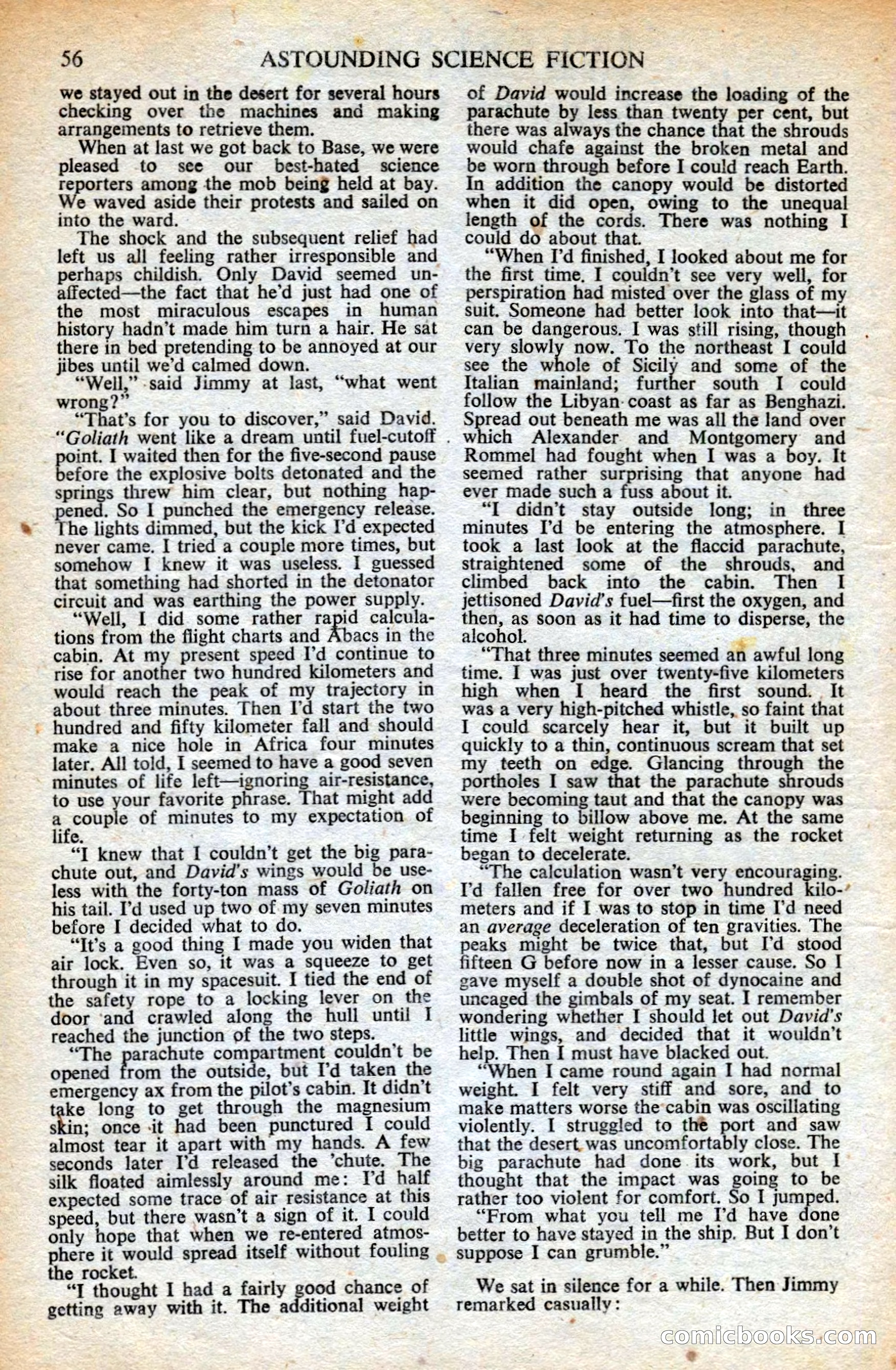
A restored page from Pulp Fiction, 1949. Page through the whole issue in the reader above.
📄 Transcribed text from this page (OCR, searchable)
Machine-transcribed from the original scan — historical spelling and the odd misread are preserved.
we stayed out in the desert for several hours checking over the machines and making arrangements to retrieve them. When at last we got back to Base, we were pleased to see our best-hated science oe among the mob being held at bay. e waved aside their protests and sailed on into the ward. The shock and the subsequent relief had left us all feeling rather irresponsible and perhaps childish. Only David seemed un- affected—the fact that he’d just had one of the most miraculous escapes in human history hadn’t made him turn a hair. He sat there in bed pretending to be annoyed at our jibes until we’d calmed down. “Well,” -said Jimmy at last, “what went wrong?” “That’s for you to discover,” said David. “Goliath went like a dream until fuel-cutoff . int. I waited then for the five-second pause efore the explosive bolts detonated and the springs threw him clear, but nothing hap- pened. So I punched the emergency release. The lights dimmed, but the kick I'd expected never came. I tried a couple more times, but somehow I knew it was useless. I guessed that something had shorted in the detonator circuit and was earthing the power supply. “Well, I did some rather rapid calcula- tions from the flight charts and Abacs in the cabin. At my present speed I’d continue to rise for another two hundred kilometers and would reach the peak of my trajectory in about three minutes. Then I'd start the two - hundred and fifty kilometer fall and should make a nice hole in Africa four minutes later. All told, I seemed to have a good seven minutes of life left—ignoring air-resistance, to use your favorite phrase. That might add a couple of minutes to my expectation of life. “TI knew that I couldn’t get the big para- chute out, and David's wings would be use- less with the forty-ton mass of Goliath on his tail. ’'d used up two of my seven minutes before I decided what to do. “It’s a good thing I made you widen that air lock. Even so, it was a squeeze to get through it in my spacesuit. I tied the end of the safety rope to a locking lever on the door ‘and crawled along the hull until I reached the junction of the two steps. “The parachute compartment couldn't be opened from the outside, but I'd taken the emergency ax from the pilot's cabin. It didn’t ke long to get through the magnesium skin: once it had been punctured I could almost tear it apart with my hands. A few seconds later I’d released the ‘chute. The silk floated aimlessly around me: Id half expected some trace of air resistance at this speed, but there wasn’t a sign of it. I could only hope that when we re-entered atmos- phere it would spread itself without fouling the rocket. “I thought I had a fairly good chance of getting away with it. The additional weight g&. i ’ ie PP ne ee * en _ ae Se *. Le a ee ae ee, CR wien 3 ? : ohn ee ae at : + .. > oe ee : ar a an Paine a oS0 2 ASTOUNDING SCIENCE FICTION of David would increase the loading of the parachute by less than twenty per cent, but there was always the chance that the shrouds would chafe against the broken metal and be worn through before I could reach Earth. In addition the canopy would be distorted when it did open, owing to the unequal length of the cords. There was nothing I could do about that. “When I'd finished, I looked about me for the first time. I couldn’t see very well, for perspiration had misted over the glass of my suit. Someone had better look into that—it can be dangerous. I was still rising, though very slowly now. To the northeast I could see the whole of Sicily and some of the Italian mainland; further south I could follow the Libyan-coast as far as Benghazi. Spread out beneath me was all the land over which Alexander and Montgomery and Rommel had fought when I was a bay: It seemed rather surprising that anyone had ever made such a fuss about it. “I didn’t stay outside long; in three minutes I’d be entering the atmosphere. I took a last look at the flaccid parachute, straightened some of the shrouds, and climbed back into the cabin. Then I jettisoned David's fuel—first the oxygen, and then, as soon as it had time to disperse, the alcohol. _ “That three minutes seemed an awful long time. I was just over twenty-five kilometers high when I heard the first sound. It was a very high-pitched whistle, so faint that I could scarcely hear it, but it built up quickly to a thin, continuous scream that set my teeth on edge. Glancing through the portholes I saw that the parachute shrouds were becoming taut and that the canopy was beginning to billow above me. At the same time I felt weight returning as the rocket began to decelerate. “The calculation wasn’t very encouraging. I'd fallen free for over two hundred kilo-’ meters and if I was to stop in time I'd need an average deceleration of ten gravities. The peaks might be twice that, but I'd stood fifteen G before now in a lesser cause. So I gave myself a double shot of dynocaine and uncaged the gimbals of my seat. I remember wondering whether I should let out David's little wings, and decided that it wouldn't help. Then I must have blacked out. “When I came round again I had normal weight. I felt very stiff and sore, and to make matters worse the’cabin was oscillating violently. I struggled to thé port and saw that the desert. was uncomfortably close. The big parachute had done its work, but I thought that the impact was going to be rather too violent for comfort. So I jumped. “From what you tell me I'd have done better to have stayed in the ship. But I don’t suppose I can grumble.” We sat in silence for a while. Then Jimmy remarked casually: IelOOOKS4e€@© CO 2