
Pulp Fiction, 1949 · page 59 of 68
Astounding British Edition, Vol. 6, No. 8 — page 59: what you’re looking at
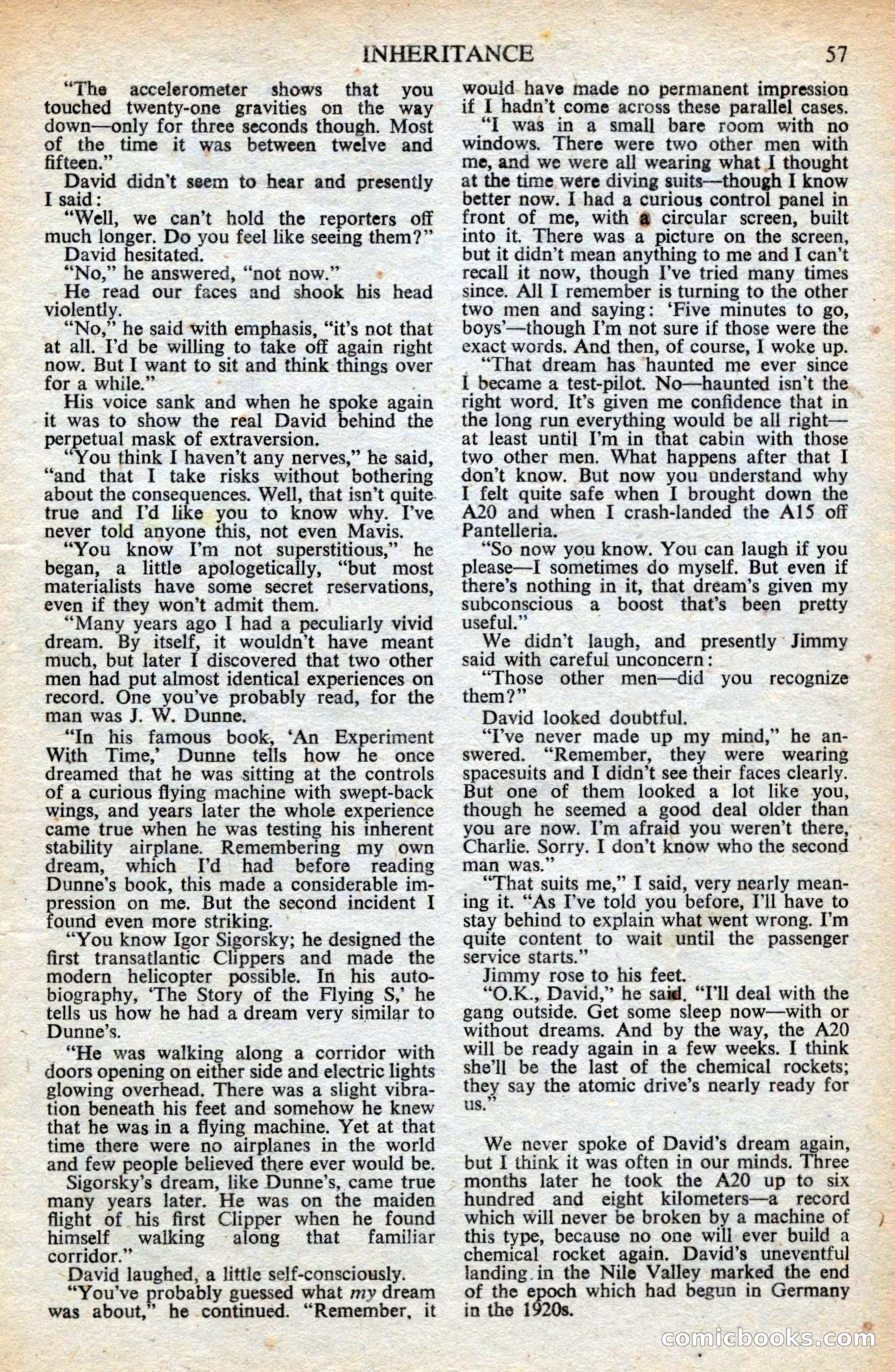
A restored page from Pulp Fiction, 1949. Page through the whole issue in the reader above.
📄 Transcribed text from this page (OCR, searchable)
Machine-transcribed from the original scan — historical spelling and the odd misread are preserved.
INHERITANCE — “The accelerometer shows that you touched twenty-one gravities on the way down—only for three seconds though. Most of the time it was between twelve and fifteen.” : wre didn’t seem to hear and presently said : “Well, we can’t hold the reporters off much longer. Do you feel like seeing them?” David hesitated. “No,” he answered, ‘“‘not now.” . He read our faces and shook his head violently. “No,” he said ‘with emphasis, “it’s not that at all. Pd be willing to take off again right now. But I want to sit and think things over for a while.” His voice sank and when he spoke again it was to show the real David behind the perpetual mask of extraversion. “You think I haven’t any nerves,” he said, “and that I take risks without bothering about the consequences. Well, that isn’t quite. true and [Id like you to know why. I’ve never told anyone this, not even Mavis. “You know I’m not superstitious,’ he began, a little apologetically, “but most materialists have some secret reservations, even if they won’t admit them. ““Many years ago I had a peculiarly vivid dream. By itself, it wouldn’t have meant much, but later I discovered that two other men had put almost identical experiences on record. One you’ve probably read, for the man was J. W. Dunne. “In his famous book, ‘An Experiment With Time, Dunne tells how he once dreamed that he was sitting at the controls of a curious flying machine with swept-back wings, and years later the whole experience came true when he was testing his inherent stability airplane. Remembering my own dream, which I’d had before reading Dunne’s book, this made a considerable im- pression on me. But the second incident I found even more striking. — “You know Igor Sigorsky; he designed the first transatlantic Clippers and made the modern helicopter possible. In his auto- biography, ‘The Story of the Flying S,’ he tells us how he had a dream very similar to Dunne’s. “He was walking along a corridor with doors opening on either side and electric lights glowing overhead. There was a slight vibra- tion beneath his feet and somehow he knew that he was in a flying machine. Yet at that time there were no airplanes in the world and few people believed there ever would be. Sigorsky’s dream, like Dunne’s, came true many years later. He was on the maiden flight of his first Clipper when he found himself walking along that familiar corridor.” David laughed, a little self-consciously. “You've probably guessed what my dream was about,” he continued. “Remember, it 57 would. have made no permanent impression if I hadn’t come across these parallel cases. “I was in a small bare room with no windows. There were two other men with me, and we were all wearing what I thought at the time were diving suits—though I know better now. I had a curious control panel in front of me, with @ circular screen, built into it. There was a picture on the screen, but it didn’t mean anything to me and I can’t recall it now, though I’ve tried many times since. AJl I remember is turning to the other two men and saying: ‘Five minutes to go, boys’—though I’m not sure if those were the exact words. And then, of course, I woke up. “That dream has haunted me ever since I became a test-pilot. No—haunted isn’t the right word, It’s given me confidence that in the long run everything would be all right— at least until I’m in that cabin with those two other men. What happens after that I don’t know. But now you understand why I felt quite safe when I brought down the A20 and when I crash-landed the A1S off Pantelleria. “So now you know. You can laugh if you please—I sometimes do myself. But even if there’s nothing in it, that dream’s given my subconscious a boost that’s been pretty useful.” We didn’t laugh, and presently Jimmy said with careful unconcern: “Those other men—did you recognize them?” David looked doubtful. “T’ve never made up my mind,” he an- swered. “Remember, they were wearing spacesuits and I didn’t see their faces clearly. But one of them looked a lot like you, though he seemed a good deal older than you are now. I’m afraid you weren’t there, Charlie. Sorry. I don’t know who the second | man was.” “That suits me,” I said, very nearly mean- ing it. “As I’ve told you before, I’ll have to stay behind to explain what went wrong. I’m quite content to wait until the passenger service starts.” Jimmy rose to his feet. “O.K., David,” he said, “Ill deal with the gang outside. Get some sleep now—with or without dreams. And by the way, the A20 will be ready again in a few weeks. I think she'll be the last of the chemical rockets; they say the atomic drive’s nearly ready for us.” We never spoke of David’s dream again, but I think it was often in our minds. Three - months later he took the A20 up to six hundred and eight kilometers—a_ record which will never be broken by a machine of this type, because no one will ever build a chemical rocket again. David’s uneventful landing.in the Nile Valley marked the end of the epoch which had begun in Germany in the 1920s. SalGO) Sie EOMIGHoOO