
Pulp Fiction, 1949 · page 57 of 68
Astounding British Edition, Vol. 6, No. 8 — page 57: what you’re looking at
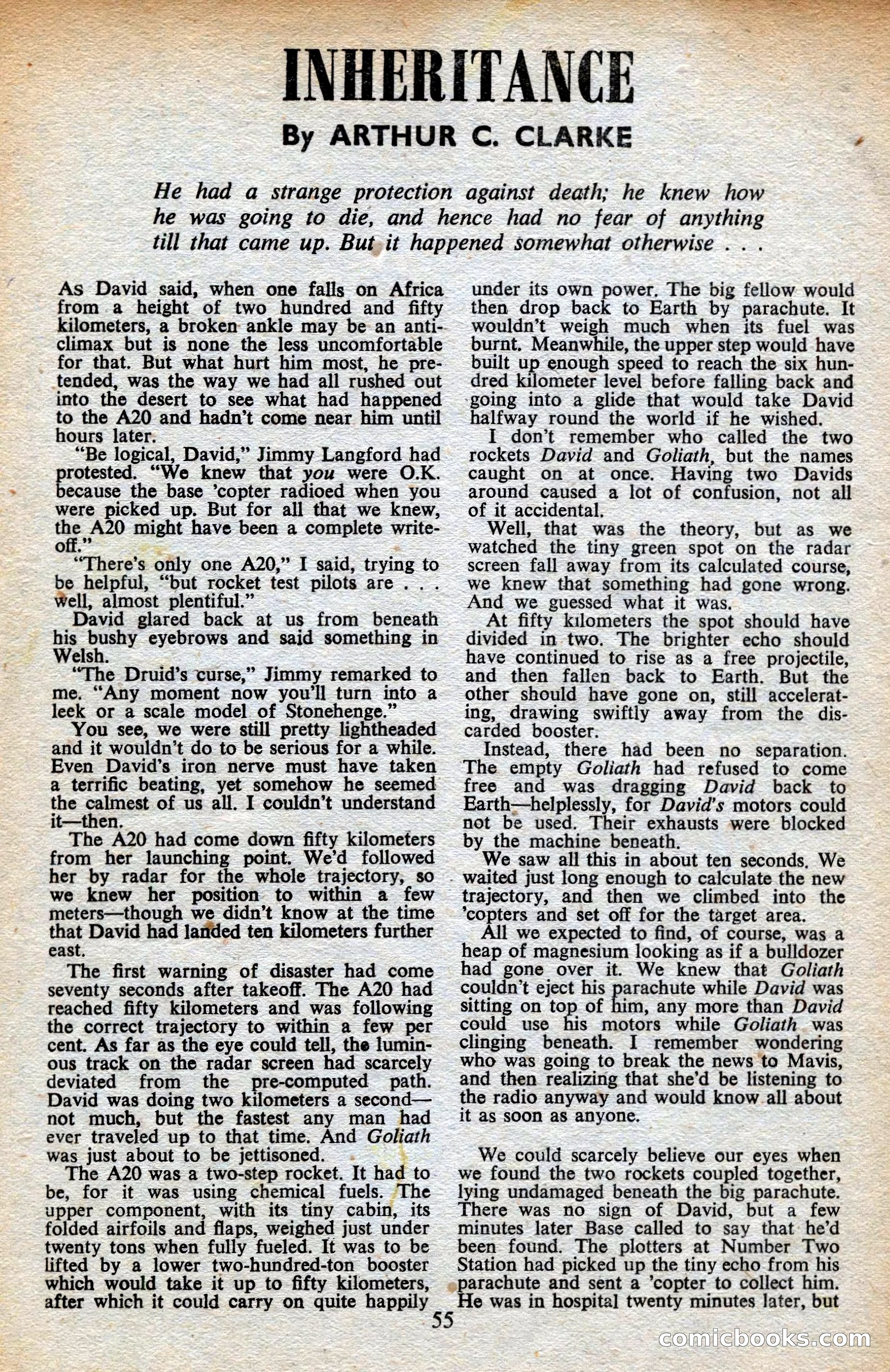
A restored page from Pulp Fiction, 1949. Page through the whole issue in the reader above.
📄 Transcribed text from this page (OCR, searchable)
Machine-transcribed from the original scan — historical spelling and the odd misread are preserved.
ee s— - La eo = So By ARTHUR C. CLARKE . He had a strange protection against death; he knew how he was going to die, and hence had no fear of anything till that came up. But,it happened somewhat otherwise . . . As David said, when one falls on Africa from a height of two hundred and fifty kilometers, a broken ankle may be an anti- climax but is none the less uncomfortable - for that. But what hurt him most, he pre- tended, was the way we had all rushed out into the desert to see what had happened to the A20 and hadn’t come near him until hours later. “Be logical, David,” Jimmy Langford had rotested. “We knew that you were O.K. ecause the base ‘copter radioed when you were picked up. But for all that we knew, po Fra might have been a complete write- ra) b “There’s only one A20,” I said, trying to be helpful, “but rocket test pilots are . Well, almost plentiful.” David glared back at us from beneath his bushy eyebrows and said something in Welsh. : “The Druid’s curse,” Jimmy remarked to me. “Any moment now you'll turn into a leek or a scale model of Stonehenge.” You see, we were still pretty lightheaded and it wouldn’t do to be serious for a while. Even David’s iron nerve must have taken a terrific beating, yet somehow he seemed the seboee of us all. I couldn’t understand it—then. The A20 had come down fifty kilometers from her launching point. Wed followed her by radar for the whole trajectory, so we knew her position to within a few meters—though we didn’t know at the time that David had latided ten kilometers further east. The first warning of disaster had come seventy seconds after takeoff. The A20 had reached fifty kilometers and was following the correct trajectory to within a few per cent. As far as the eye could tell, the lumin- ous track on the radar screen had scarcely deviated from the pre-computed path. David was doing two kilometers a second— not much, but the fastest any man had ever traveled up to that time. And Goliath was just about to be jettisoned. - 7 The A20 was a two-step rocket. It had to be, for it was using chemical fuels. The upper component, with its tiny cabin, its folded airfoils and flaps, weighed just under twenty tons when fully fueled. It was to be lifted by a lower two-hundred-ton booster which would take it up to fifty kilometers, after which it could carry on quite aise under its own power, The big fellow would then drop back to Earth by parachute. It wouldn’t weigh much when its fuel was burnt. Meanwhile, the upper step would have built up enough speed to reach the six hun- dred kilometer level before falling back and ‘going into a glide that would take David halfway round the world if he wished. I don’t remember who called the two rockets David and Goliath, but the names caught on at once. Having two Davids around caused a lot of confusion, not all of it accidental. . Well, that was the theory, but as we watched the tiny green spot on the radar screen fall away from its calculated course, we knew that something had gone wrong. And we guessed what it was. At fifty kilometers the spot should have divided in two. The brighter echo should have continued to rise as a free projectile, and then fallen back to Earth. But the other should have gone on, still accelerat- ing, drawing swiftly away from the dis- carded booster. Instead, there had been no separation. The empty Goliath had refused to come free and was dragging David back to Earth—helplessly, for David’s motors could not be used. Their exhausts were blocked by the machine beneath. We saw all this in about ten seconds, We - waited just long enough to calculate the new trajectory, and then we climbed into the *copters and set off for the target area. All we expected to find, of course, was a heap of magnesium looking as if a bulldozer had gone over it. We knew that Goliath couldn’t eject his parachute while David was sitting on << of him, any more than David could use his motors while Goliath was clinging beneath. I remember wondering who was going to break the news to Mavis, and then realizing that she’d be listening to the radio anyway and would know all about it as soon as anyone. We could scarcely believe our eyes when we found the two rockets coupled together, lying undamaged beneath the big parachute. There was no sign of David, but a few minutes later Base called to say that he’d been found. The plotters at Number Two Station had picked up the tiny echo from his »parachute and sent a ’copter to collect him. He was in hospital twenty minutes later, but (COMMIG OCKO_KSa(EO)