
Pulp Fiction, 1949 · page 19 of 68
Astounding British Edition, Vol. 6, No. 8 — page 19: what you’re looking at
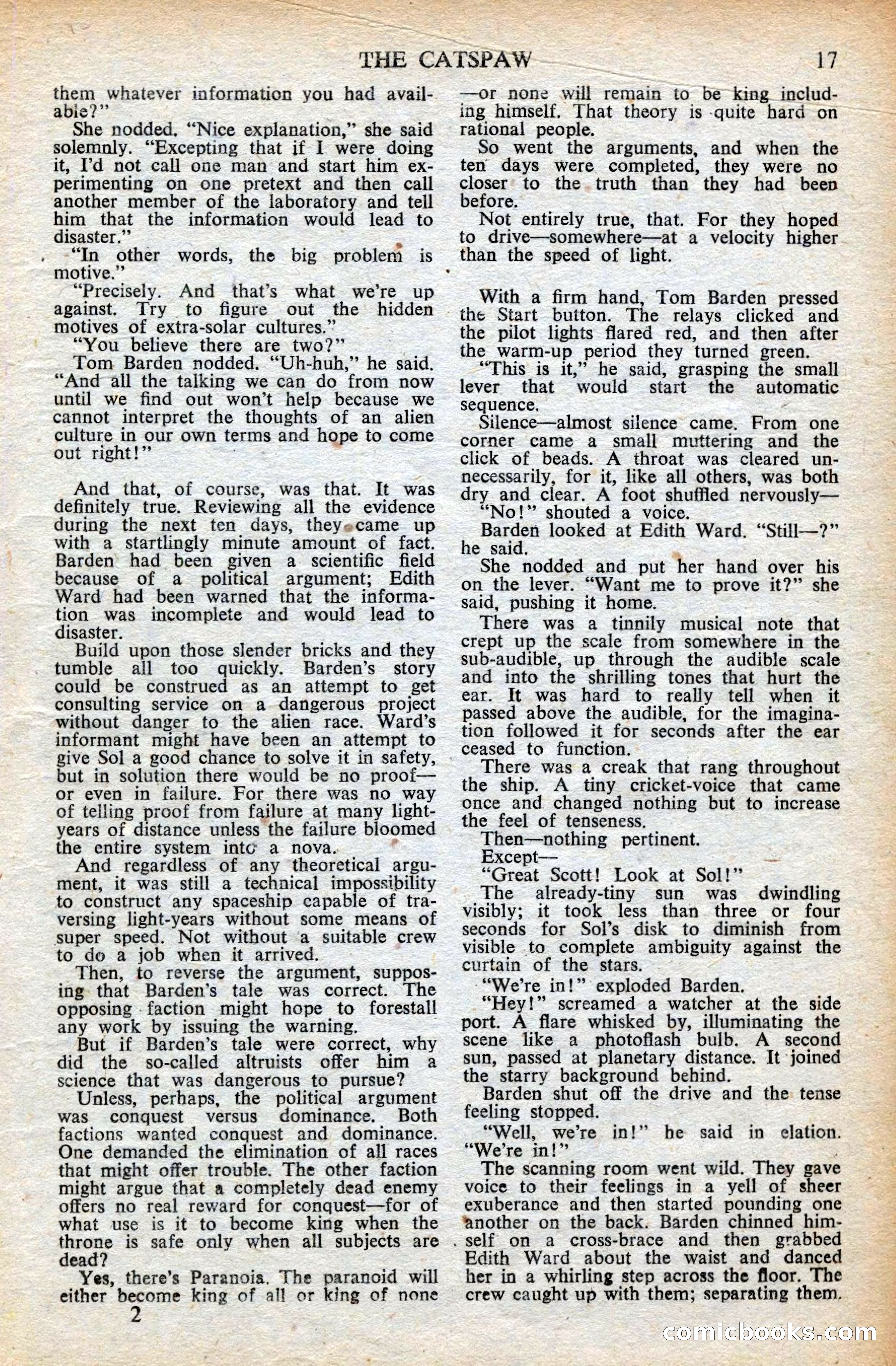
A restored page from Pulp Fiction, 1949. Page through the whole issue in the reader above.
📄 Transcribed text from this page (OCR, searchable)
Machine-transcribed from the original scan — historical spelling and the odd misread are preserved.
aves whatever information you had avail- abie?” She nodded. “Nice explanation,” she said solemnly. “Excepting that if I were doing it, I'd not call one man and start him ex- perimenting on one pretext and then call another member of the laboratory and tell him that the information would lead to disaster.” — = “In other words, the big problem is motive.” “Precisely. And that’s what were up against. Try to figure out the hidden motives of extra-solar cultures.” “You believe there are two?” 7 Tom Barden nodded. “Uh-huh,” he said. “And all the talking we can do from now until we find out won’t help because we cannot interpret the thoughts of an alien culture in our own terms and hope to come out right!” And that, of course, was that. It was definitely true. Reviewing all the evidence during the next ten days, theyecame up with a startlingly minute amount of fact. Barden had been given a scientific field because of a political argument; Edith Ward had been warned that the informa- tion was incomplete and would lead to disaster. Build upon those slender bricks and they tumble ail too quickly. Barden’s_ story could be construed as an attempt to get consulting service on a dangerous project without danger to the alien race. Ward’s informant might have been an attempt to give Sol a good chance to solve it in safety, . but in solution there would be no proof— or even in failure. For there was no way of telling proof from failure at many light- years of distance unless the failure bloomed the entire system intG a nova. e And regardless of any theoretical argu- ment, it was still a technical impossibility to construct any spaceship capable of tra- versing light-years without some means of super speed. Not without a suitable crew to do a job when it arrived. Then, to reverse the argument, suppos- ing that Barden’s tale was correct. The opposing -faction might hope to forestall any work by issuing the warning. But if Barden’s tale were correct, why did the so-called altruists offer him a science that was dangerous to pursue? Unless, perhaps, the political argument was conquest versus dominance. Both factions wanted conquest and dominance. One demanded the elimination of all races that might offer trouble. The other faction might argue that a completely dead enemy offers no real reward for conquest—for of what use is it to become king when the throne is safe only when all subjects are dead? Yes, there’s Paranoia. The paranoid will either become king of all or king of none THE CATSPAW ae tee - oa - Bi oh a. s ee SS re 8 eS es Oy 17 —or none will remain to be king includ- ing himself. That theory is -quite hard on rational people. So went the arguments, and when the ten days were completed, they were no closer. to the truth than they had been before. Not entirely true, that. For they hoped to drive—somewhere—at a velocity higher than the speed of light. With a firm hand, Tom Barden pressed the Start button. The relays clicked and the pilot lights flared red, and then after the warm-up period they turned green. “This is it,” he said, grasping the small lever that would start the automatic sequence, Silence—almost silence came. From one corner came a small muttering and the click of beads. A throat was cleared un- necessarily, for it, like all others, was both dry and clear. A foot shuffled nervously— “No!” shouted a voice. Barden looked at Edith Ward. “‘Still—?” he said. | She nodded and put her hand over his on the lever. “Want me to prove it?” she said, pushing it home. There was a tinnily musical note that crept up the scale from somewhere in the sub-audible, up through the audible scale and into the shrilling tones that hurt the ear. It was hard to really tell when it passed above the audible, for the imagina- tion followed it for seconds after the ear ceased to function. There was a creak that rang throughout the ship. A tiny cricket-voice that came once and changed nothing but to increase the feel of tenseness. Then—nothing pertinent. Except— “Great Scott! Look at Sol!” The already-tiny sun was dwindling visibly; it took less than three or four seconds for Sol’s disk to diminish from visible to complete ambiguity against the curtain of the stars. “We're in!” exploded Barden. “Hey!” screamed a watcher at the side port. A flare whisked by, illuminating the scene like a_ photoflash bulb. A_ second sun, passed at planetary distance. It joined the starry background behind. Barden shut off the drive and the tense feeling stopped. “Well, we're in!” “We're in!” ; The scanning room went wild. They gave voice to their feelings in a yell of sheer exuberance and then started pounding one ‘another on the back. Barden chinned him- he said in elation. . self on a cross-brace and then grabbed Edith Ward about the waist and danced her in a whirling step across the floor. The crew caught up with them; separating them. EOMIGdOO Ss (EO)